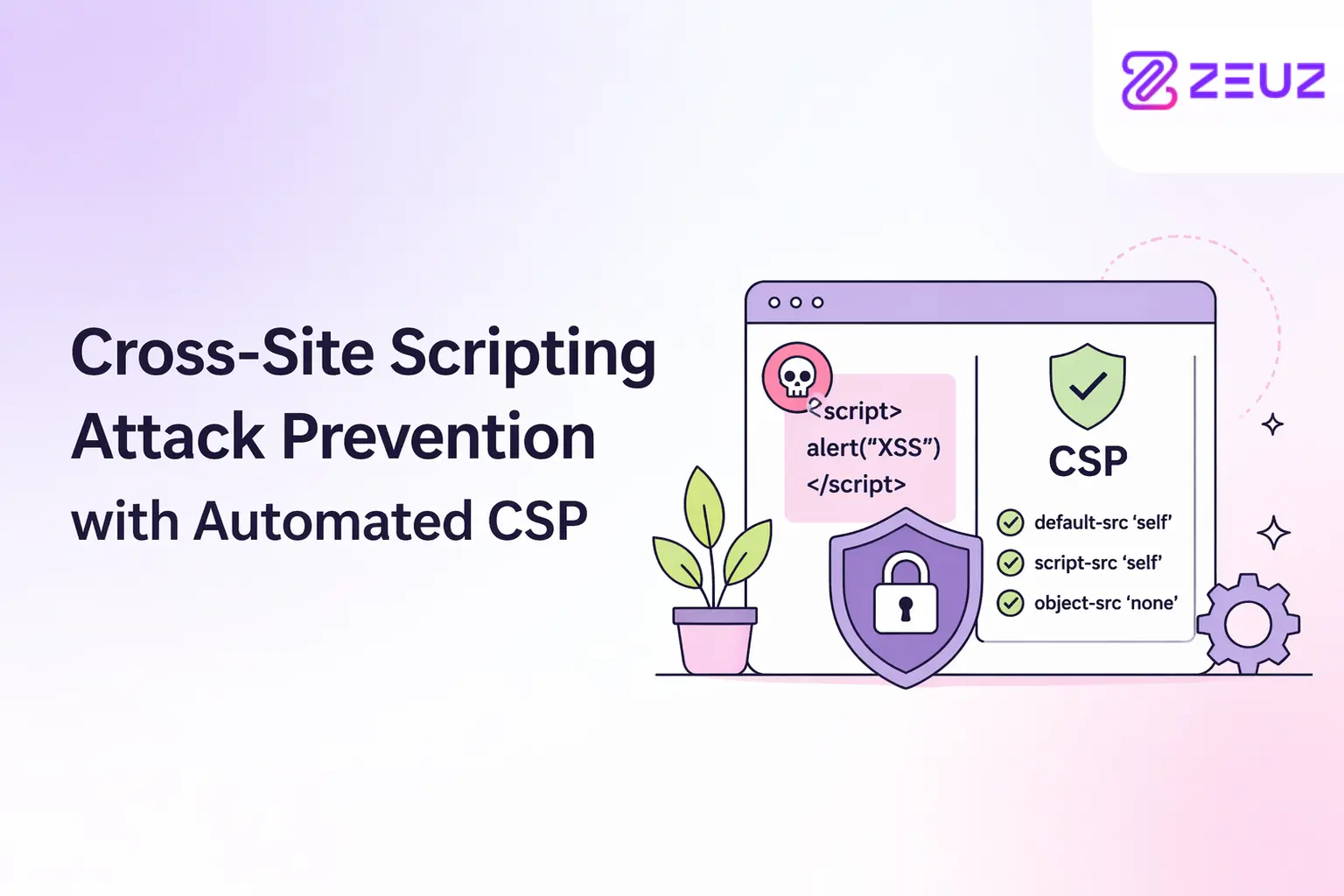
Cross-Site Scripting Attack Prevention with Automated CSP
Modern web apps move fast. Faster than reviews. Faster than audits. Faster than most teams expect. But that speed comes with a price. Cross-site scripting attacks remain stubbornly present, ranking among the most persistent and damaging web vulnerabilities even today. The uncomfortable truth is simple. If you render user-controlled content, you are already exposed. Cross-site scripting attack prevention is no longer optional hygiene. It is foundational engineering.
Cross-Site Scripting Attack Prevention Basics
Cross-site scripting occurs when untrusted input is interpreted as executable code by a browser. Rather than showing data, the application unintentionally delivers commands that execute during the user session. Cross-site scripting attack prevention revolves around a few essential principles:
-
Proper output encoding based on context.
-
Strict separation between data and executable content.
-
Controlled handling of user-generated input at every layer.
-
Browser-level enforcement that limits what scripts are allowed to execute.
Common XSS Risks in Modern Web Applications
Modern web applications are rarely simple. They are layered systems stitched together from frameworks, APIs, third-party services, and front-end libraries. Each layer adds speed and flexibility. Each layer also widens the attack surface. Cross-site scripting attack prevention becomes difficult when trust boundaries blur.
● Unescaped User Input in Dynamic Views
User-generated content still sits at the center of most XSS incidents. Comment boxes. Profile fields. Search queries. When this data is injected into HTML without proper context-aware encoding, it becomes executable. Many teams assume frameworks handle this by default. Some do. Some do not. Assumptions are where XSS survives.
● Client Side Rendering and DOM-Based XSS
Single-page applications rely heavily on client-side rendering. Data flows from APIs directly into the DOM. When that data is manipulated using unsafe methods, scripts can execute without ever touching the server. DOM-based XSS is especially dangerous because traditional server-side defenses never see it.
● Inline Scripts and Legacy Patterns
Inline JavaScript still exists in production systems. Often for convenience. Sometimes, due to legacy architecture. Inline scripts weaken cross-site scripting attack prevention by making it harder to enforce strict execution rules. They also create blind spots when teams try to retrofit modern security controls.
● Third-Party Scripts and External Dependencies
Analytics tools. Chat widgets. Advertising tags. These scripts operate outside direct developer control. Without strict policies, they can introduce malicious behavior or become compromised themselves. One external script is all it takes to undermine an otherwise secure application.
● Framework Misconfigurations and Trust Misuse
Frameworks reduce boilerplate but increase abstraction. Developers may disable built-in escaping features for flexibility. Or trust backend APIs implicitly. Over time, small configuration choices compound into systemic XSS exposure.
Role of Content Security Policy in XSS Prevention
Content Security Policy helps take back control by setting clear guidelines on what the browser can run, display, or load. It stops harmful code before it ever executes, rather than dealing with it afterward.
■ Script Source Restriction
CSP allows applications to define exactly where scripts can originate. Trusted domains only. No exceptions by default. This single rule blocks a large percentage of reflected and stored XSS attacks, even when malicious code slips into the page.
■ Inline Script Control
By default, CSP discourages inline scripts. This matters. Inline execution is one of the easiest paths for attackers. By removing or tightly regulating inline code, teams drastically reduce the likelihood of successful script injection.
■ Mitigating Dynamic Code Execution
Functions that evaluate strings as code create dangerous execution paths. CSP can disable these behaviors at the browser level. Even if unsafe patterns remain in the codebase, the browser becomes a final gatekeeper.
■ Visibility Through Violation Reporting
CSP is not only preventative. It is diagnostic. When violations occur, browsers can report them. These reports reveal attempted attacks, misconfigurations, and weak spots in real time. For cross-site scripting attack prevention, this feedback loop is invaluable.
■ Defense That Evolves With the Application
Unlike hardcoded filters, CSP policies can evolve alongside the application. As new features roll out, policies adapt. Security becomes iterative rather than static. That adaptability is why CSP remains one of the most effective modern defenses against XSS.
Automated CSP Testing for Cross-Site Scripting Attack Prevention
Manual CSP configuration is where good intentions often stall. Policies look correct on paper, then quietly break features in production. Or worse, they are loosened until they offer little real protection. Automation changes that dynamic entirely.
✔ Continuous Validation of Policy Effectiveness
Automated tests simulate real attack patterns against CSP rules. Inline script injections. Unauthorized external sources. Dynamic execution attempts. When policies fail, they fail loudly and early. This allows teams to adjust before exposure reaches users.
✔ Regression Protection as Applications Evolve
Web applications rarely stand still. New features introduce new scripts, endpoints, and dependencies. Automated CSP testing ensures previously secure policies do not degrade over time. Every release becomes an opportunity to confirm that cross-site scripting attack prevention remains intact.
✔ Real Browser Enforcement Checks
CSP is enforced by browsers, not servers. Automation that runs tests in real browser environments exposes gaps that static analysis misses. Subtle differences between browsers surface quickly, which prevents false confidence.
✔ Scaling Security Without Slowing Delivery
As teams adopt CI/CD pipelines, security must keep pace. Automated CSP testing integrates naturally into modern workflows, enabling security validation without blocking releases. Platforms like ZeuZ, quietly add value by supporting security-focused test automation alongside functional coverage.
Integrating CSP Automation into Security Testing
CSP automation works best when treated as part of a broader testing strategy, not an isolated task. Integration matters.
Security teams often embed CSP checks into existing web automation flows and validate policies during normal UI execution rather than separate scans. This approach mirrors real user behavior.
CSP tests can also complement API testing by ensuring responses never introduce unsafe executable content. When paired with performance testing, teams confirm that security controls do not degrade user experience under load.
Within mature CI/CD pipelines, CSP automation becomes just another quality gate. Predictable. Repeatable. Visible.
Final Words
No single control prevents every XSS attack. But layered defenses change outcomes. When CSP is automated, tested, and integrated into delivery pipelines, cross-site scripting attack prevention becomes sustainable instead of fragile. For teams looking to scale cross-site scripting attack prevention without adding friction, ZeuZ offers a practical path forward through unified, automation-first security testing.