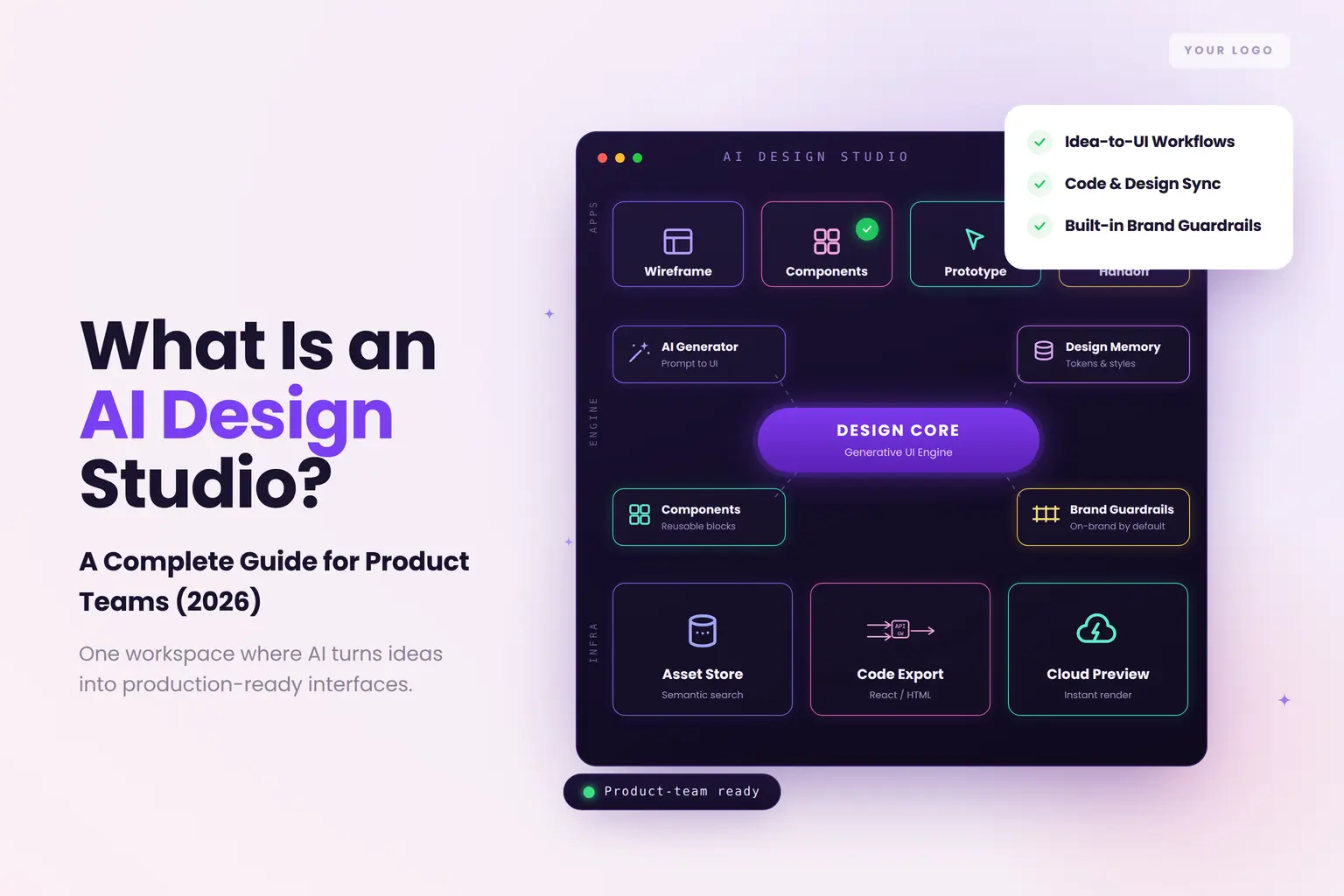
What Is an AI Design Studio? The Complete Guide for Product Teams
The Problem: Why Traditional Design Workflows Break Down
What Is an AI Design Studio?
How an AI Design Studio Works: The Core Capabilities
AI Design Studios vs. Competing Tools: A Direct Comparison
How to Evaluate an AI Design Studio: An Enterprise Checklist
Frequently Asked Questions
Key Takeaways
The Problem: Why Traditional Design Workflows Break Down
What Is an AI Design Studio?
What an AI Design Studio Is Not
How an AI Design Studio Works: The Core Capabilities
AI Design Studios vs. Competing Tools: A Direct Comparison
Who Should Use an AI Design Studio?
What AI Design Studios Actually Save
Share with your community!
What Is an AI Design Studio? The Complete Guide for Product Teams
Every product team knows the scene. A designer finishes a polished set of mockups. They are handed off to engineering. Two weeks later, the shipped UI looks close, but not quite right. Spacing drifts. Interaction states go missing. A component that doesn't exist in the codebase gets invented from scratch. The back-and-forth begins, sprints slip, and everyone is quietly frustrated.
This is not a people problem. It is a structural one, and in 2026, AI Design Studios are the most significant development yet in solving it.
This guide explains exactly what an AI Design Studio is, how it works, what separates the best platforms from surface-level mockup generators, and how enterprise product teams are using this technology to compress the gap between design intent and shipped product.
The Problem: Why Traditional Design Workflows Break Down
Before defining the solution, it helps to understand the cost of the problem.
Poor design handoff costs companies an average of 30–40% in development time due to misinterpretation and rework (Verox Studio, 2026). Research on product team misalignment found that design errors and review processes contributed to 68% of rework costs, with the majority attributable to information lost or never communicated at the handoff boundary (Questworks, 2026).
These failures are structural, not accidental. Traditional design tools, Figma, Sketch, InVision, are built in isolation from the codebase. They have no knowledge of your repository structure, existing component library, architectural conventions, or engineering constraints. A designer creating mockups in Figma is working in a parallel universe to the developer who will implement them.
The result is the most expensive recurring friction in product development: a mockup that looks complete but describes a product that doesn't quite match what can actually be built.
Validating designs before development allows teams to reduce iteration cycles by 25%, effectively avoiding millions in wasted developer rework costs (UserTesting, 2025). AI Design Studios are built specifically to close this gap, not by making handoffs better, but by making them unnecessary.
What Is an AI Design Studio?
An AI Design Studio is a software platform that uses artificial intelligence to generate, refine, and iterate on user interface designs, transforming plain-language requirements, user stories, or feature descriptions into interactive mockups, wireframes, or implementation-ready UI components.
What separates a true AI Design Studio from a generic AI image generator or a basic mockup tool is product intelligence: the ability to understand the team's existing codebase, design system, architecture decisions, and engineering constraints, and generate designs that align with those realities from the first output.
In other words: an AI Design Studio doesn't just make your designs faster. It makes your designs buildable.
The global generative AI in design market was valued at USD 993.90 million in 2025 and is projected to reach USD 16.89 billion by 2035, growing at a CAGR of 32.75% (Precedence Research, 2026). The UI and UX design software market as a whole is valued at USD 2.62 billion in 2026 and is projected to reach USD 15.99 billion by 2035 (Business Research Insights). This is not a niche experiment, it is a mainstream enterprise category in rapid formation.
What an AI Design Studio Is Not
To define the category precisely, it helps to distinguish it from adjacent tools:
Tool Type
What It Does
What It Lacks
Traditional design tools (Figma, Sketch)
Manual UI creation with collaboration features
No AI generation; no codebase awareness
AI image generators (Midjourney, DALL·E)
Visual image creation from prompts
No UI structure, interaction logic, or engineering context
AI coding tools (Copilot, Cursor)
Code generation and completion
No design-layer UI generation or product context
Basic AI mockup tools (Uizard)
Prompt-to-wireframe generation
Limited or no codebase/repository awareness
AI Design Studio
AI UI generation with codebase intelligence, SDLC integration, and implementation-aware output
-
How an AI Design Studio Works: The Core Capabilities
1. Requirement-to-UI Generation
The foundational capability: describe what you want in plain language, and the platform generates a structured, interactive UI that reflects it.
A product manager can type: "Design an onboarding flow for a B2B SaaS platform, three steps, collecting company name, team size, and primary use case, with a progress indicator." Within seconds, a complete UI layout is generated, not a generic template, but a structured design informed by the description's intent.
No design experience is required. No Figma training, no component drag-and-drop, no manual wireframing. The AI does the structural work; the human provides the intent and makes the judgment calls.
2. Repository and Codebase Intelligence
This is the capability that separates a genuine AI Design Studio from a glorified mockup generator, and it is the one that matters most for enterprise product teams.
Production-grade AI Design Studios connect to GitHub repositories and branches, giving the AI access to:
Existing UI patterns and component libraries
Architecture conventions and naming structures
Established workflows and interaction patterns
Product terminology and domain language
Engineering constraints and implementation structures
The effect is significant: instead of generating a design that describes a product in the abstract, the AI generates a design that describes your product, one that your engineering team can implement without re-inventing component infrastructure or translating from a foreign design language.
This is the core capability of ZeuZ AI Design Studio repository and branch-aware design intelligence that creates significantly stronger design-to-development alignment than any codebase-agnostic tool can deliver.
3. Multi-Variant UX Exploration
Traditional design exploration is expensive. A designer might spend two days producing three alternative approaches to a feature flow before the team can evaluate which direction to pursue. AI Design Studios generate multiple design variants simultaneously from a single requirement, enabling product teams to explore the solution space in minutes rather than days.
This is particularly valuable in the early stages of feature development, where the cost of changing direction is low but the value of finding the right approach is high. Teams can evaluate five layout directions before a single sprint commitment is made.
4. Conversational Refinement and Element-Level Editing
After the initial generation, iteration happens through natural language dialogue, not manual pixel adjustment. Product managers and engineers can direct refinements in plain terms: "Make the navigation more compact," "Add an error state for the form fields," "Shift the CTA higher on mobile." The AI updates the design contextually, maintaining consistency across the affected elements.
This is fundamentally different from traditional design iteration, which requires a designer to manually implement each revision and re-export assets for review. Conversational refinement compresses review cycles from days to minutes.
5. Human-in-the-Loop Collaboration
A mature AI Design Studio is not a fully autonomous system, and it should not be. The most effective implementations combine AI generation speed with human judgment on the decisions that matter: brand voice, accessibility standards, strategic UX direction, and edge-case behaviour.
The best platforms make this division of labour explicit, allowing teams to move fast on structural generation while preserving human review checkpoints at the decisions that genuinely require expertise.
AI Design Studios vs. Competing Tools: A Direct Comparison
The 2026 market includes several tools competing in adjacent territory. Here is an honest capability comparison across the dimensions that matter most for enterprise product teams:
Capability
ZeuZ Studio
Figma AI / Dev Mode
v0 by Vercel
Claude Design Artifacts
AI Requirement-to-UI Generation
✅
Partial
✅
✅
Repository-Aware Design Context
✅
❌
Limited
❌
Branch-Aware Product Alignment
✅
❌
❌
❌
Workflow & Architecture Awareness
✅
❌
Limited
Limited
Multi-Variant UX Exploration
✅
Manual
Partial
Limited
Conversational Refinement
✅
Partial
✅
✅
Element-Level AI Editing
✅
Manual
Limited
Limited
Product Context Intelligence
✅
❌
❌
❌
AI + SDLC Integration
✅
❌
❌
❌
QA & Engineering Workflow Alignment
✅
❌
❌
❌
Implementation-Aware Mockups
✅
Manual
Partial
Partial
Enterprise Software Workflow Focus
✅
Partial
Partial
Limited
Human-in-the-Loop AI Collaboration
✅
Manual
Partial
Partial
The pattern is consistent: tools like Figma AI, v0, and Claude Design Artifacts perform well on generation and conversational refinement, but none of them understand your codebase, your architecture, or your existing component system. They generate designs in isolation. ZeuZ Studio generates designs with awareness of the full engineering context, which is the capability gap that determines whether a generated mockup leads to smooth implementation or expensive rework.
Who Should Use an AI Design Studio?
The most important thing to understand about AI Design Studios in 2026 is that their primary audience is not designers. Their primary audience is everyone else who has been locked out of the design process by the complexity of traditional design tools.
Product managers who have spent years writing PRDs that describe UI they cannot visually represent themselves now have the ability to generate implementation-aware prototypes directly from user stories. The PM can produce a design candidate that engineering can actually respond to, rather than handing a written spec across a gap and waiting for interpretation.
Engineering leads and developers who need to evaluate the feasibility of a design before sprint commitment can now interact with generated mockups that reflect the actual codebase, instead of receiving a Figma file that describes a product that doesn't match their component library.
QA teams embedded in delivery pipelines who need to understand what "done" looks like before testing begins can now access implementation-aware design references that align with what was actually built.
Enterprise software teams managing large, complex products where maintaining UI consistency across dozens of features is a constant challenge can use repository-aware generation to ensure every new feature inherits the established patterns automatically, rather than relying on every engineer to manually consult a design system document.
Non-designer founders and lean startups who lack the budget for dedicated design resources can produce professional, structured UI that is production-aligned without hiring a designer.
The unifying thread: no design experience required. The AI handles the structural work; the human provides direction and judgment.
Enterprise Use Cases: Where AI Design Studios Deliver the Most Value
New Feature UX Exploration
Before a sprint begins, product and engineering leads can generate five candidate approaches to a new feature flow, evaluate them against user goals and technical constraints, and commit to a direction with confidence, all before a single line of code is written. A 2025 BCG study found that companies with formal assumption-testing practices reduced rework cycles by an average of 47% compared to peers without them. AI-generated multi-variant exploration is the most accessible form of early assumption testing.
Legacy System Modernisation
For enterprises modernising large legacy systems, the challenge is not just generating new UI, it is generating UI that is consistent with the existing architecture and won't require rebuilding infrastructure that already works. Repository-aware AI Design Studios can generate modernised interfaces that align with the existing component system rather than designing against it.
Design System Compliance at Scale
Large product organisations struggle to enforce design system standards consistently, especially when multiple teams are contributing to the same product simultaneously. An AI Design Studio that understands your repository's component library generates designs that automatically respect those standards, making design system compliance a built-in output rather than a manual review step.
Rapid Prototype-to-Stakeholder Alignment
Business stakeholders can see and respond to visual prototypes significantly more effectively than written specifications. AI Design Studios that generate structured, interactive mockups from requirement descriptions compress the time from "idea in a meeting" to "visual concept ready for stakeholder review" from days to hours, improving alignment before development investment is made.
How to Evaluate an AI Design Studio: An Enterprise Checklist
When evaluating AI Design Studio platforms for enterprise deployment, these are the criteria that separate production-grade tools from impressive demos:
1. Repository and codebase integration Can the platform connect to your GitHub repository? Does it understand your existing component system and UI patterns? This is the single most important differentiator for enterprise teams.
2. Implementation alignment Do generated mockups reflect what can actually be built with your current tech stack, or do they describe an ideal state that requires significant engineering interpretation to implement?
3. SDLC and workflow integration Does the platform integrate with your existing delivery tools — issue trackers, CI/CD pipelines, QA workflows? Or does it exist as a separate island?
4. Multi-platform support Does the platform support web, mobile, and desktop UI generation? Can it handle responsive design requirements?
5. Iterative refinement quality How well does the AI maintain design consistency when refining elements conversationally? Does editing one component break consistency elsewhere?
6. Enterprise access controls Does the platform support role-based access, SSO, and audit logging suitable for enterprise security requirements?
7. Human review integration Does the platform make it easy to incorporate human review and approval at key decision points, rather than generating autonomously without oversight?
The Business Case: What AI Design Studios Actually Save
Quantifying the ROI of AI Design Studio adoption requires measuring costs across the full product development cycle, not just design time.
Design time savings: Teams using AI generation for requirement-to-UI conversion report 60–80% reduction in time-to-first-prototype compared to manual design workflows.
Rework cost avoidance: With poor design handoff costing 30–40% of development time in rework, repository-aware generation that reduces handoff failures has a direct, measurable impact on engineering budget. For a development team spending 20% of sprint capacity on rework today, even a 50% reduction in rework frequency represents substantial cost avoidance.
Iteration cycle compression: Validating designs before development reduces iteration cycles by 25% (UserTesting, 2025). For product teams releasing on monthly or bi-weekly cadences, this directly improves release velocity.
The combined effect, for enterprise teams implementing AI Design Studios with repository awareness, is a materially compressed product development lifecycle from requirements through to production-ready implementation.
The Future of AI Design Studios
The category is moving fast. The capabilities available in 2026 are already significantly beyond what existed in 2024, and the trajectory points toward several developments that enterprise product teams should plan for:
Full SDLC integration: AI Design Studios becoming embedded in the complete delivery pipeline from requirements through design, development, testing, and deployment, rather than existing as a standalone design phase.
Agentic design workflows: systems that proactively propose UX improvements based on user behaviour signals, analytics data, and A/B test results, shifting from reactive generation to autonomous optimisation.
Real-time design-code synchronisation: changes in the design layer propagating directly to the codebase, eliminating the concept of a "handoff" entirely by making design and code the same artifact.
Governance and compliance automation: AI that enforces brand standards, accessibility requirements (WCAG compliance), and design system rules automatically as part of the generation process, without requiring manual review for every output.
The organisations that build genuine expertise with AI Design Studios in 2026 will have a structural head start as these more advanced capabilities reach production maturity.
Conclusion
The design-to-development gap has cost product teams billions of dollars in rework, delayed releases, and compromised UX over the past decade. AI Design Studios are the first technology that addresses this problem at its root, not by making handoffs more organised, but by generating designs that are aligned with engineering reality from the start.
The key differentiator in this category is not AI generation speed, most platforms generate UI quickly. It is codebase and repository intelligence: the ability to produce designs that your engineering team can implement without spending the first three days of a sprint asking "but what component does this map to?"
For enterprise product teams evaluating this category in 2026, the questions to ask are not "can this tool generate UI?" Every tool in the category can. The questions are: "Does it understand our codebase? Does it align with our existing component system? Does it integrate with our delivery pipeline? And does it make our engineers' lives easier, not harder, when the design reaches implementation?"
Those are the questions that separate an AI Design Studio from an AI design toy.
Frequently Asked Questions
Q1: What is an AI Design Studio, and how is it different from Figma?
An AI Design Studio uses artificial intelligence to generate UI designs from natural language descriptions, with awareness of your existing codebase and component system. Figma is a manual design tool, it provides the canvas and components, but a human designer does all the layout work. The core difference is that an AI Design Studio produces an initial, implementation-aware design from a description, while Figma requires a designer to build every screen from scratch. Figma AI features add some generation capability, but without codebase integration, the output still exists in isolation from your engineering environment.
Q2: Can I use an AI Design Studio without any design experience?
Yes, and this is one of the primary value propositions. AI Design Studios are built for product managers, engineers, QA leads, and business analysts who need to visualise product requirements without formal design training. You describe what you want in plain language, and the platform generates structured UI that you can refine conversationally. No knowledge of design tools, component systems, or layout principles is required.
Q3: What does "repository-aware" mean in an AI design tool?
Repository-aware means the AI design platform connects to your GitHub repository (and specific branches) and reads your existing codebase before generating designs. Instead of producing generic UI, it generates designs that align with your actual component library, UI patterns, architecture conventions, and product terminology. This is the capability that makes generated designs implementable, because they describe your product as it actually exists, not a hypothetical product in the abstract.
Q4: How does an AI Design Studio integrate with an existing development workflow?
Production-grade AI Design Studios integrate directly with version control systems (GitHub), issue trackers (Jira), CI/CD pipelines (Jenkins, GitHub Actions), and QA workflows. Designs generated in the studio are connected to the delivery pipeline from the start, not exported as static files that exist outside the engineering workflow. This SDLC integration is one of the key enterprise differentiators; it ensures that design artifacts remain connected to development artifacts throughout the entire lifecycle.
Q5: What is the ROI of using an AI Design Studio for enterprise product teams?
ROI comes from three primary sources: design time savings (60–80% reduction in time-to-first-prototype), rework cost avoidance (poor handoffs cost 30–40% of development time, repository-aware generation directly reduces this), and iteration cycle compression (validated designs reduce rework cycles by an average of 25%). For large product teams running continuous delivery, these savings compound across every release cycle. The most significant ROI driver for enterprises is eliminating the design-to-implementation interpretation gap, the hidden cost that rarely appears in budget discussions but consistently consumes engineering capacity.
Q6: Which AI Design Studio is best for enterprise software teams in 2026?
For enterprise software teams, specifically those managing complex codebases, multiple product lines, and cross-functional delivery teams, the most important evaluation criterion is repository and codebase integration. ZeuZ Studio is purpose-built for this context: it connects to GitHub repositories and branches, aligns generated designs with existing architecture and component systems, and integrates with QA and engineering workflows as part of a complete SDLC platform. For teams whose primary concern is visual generation speed without engineering context, other tools in the market offer strong generation capabilities. But for teams where the cost of design-to-implementation misalignment is high, repository-aware generation is the capability that justifies the investment.