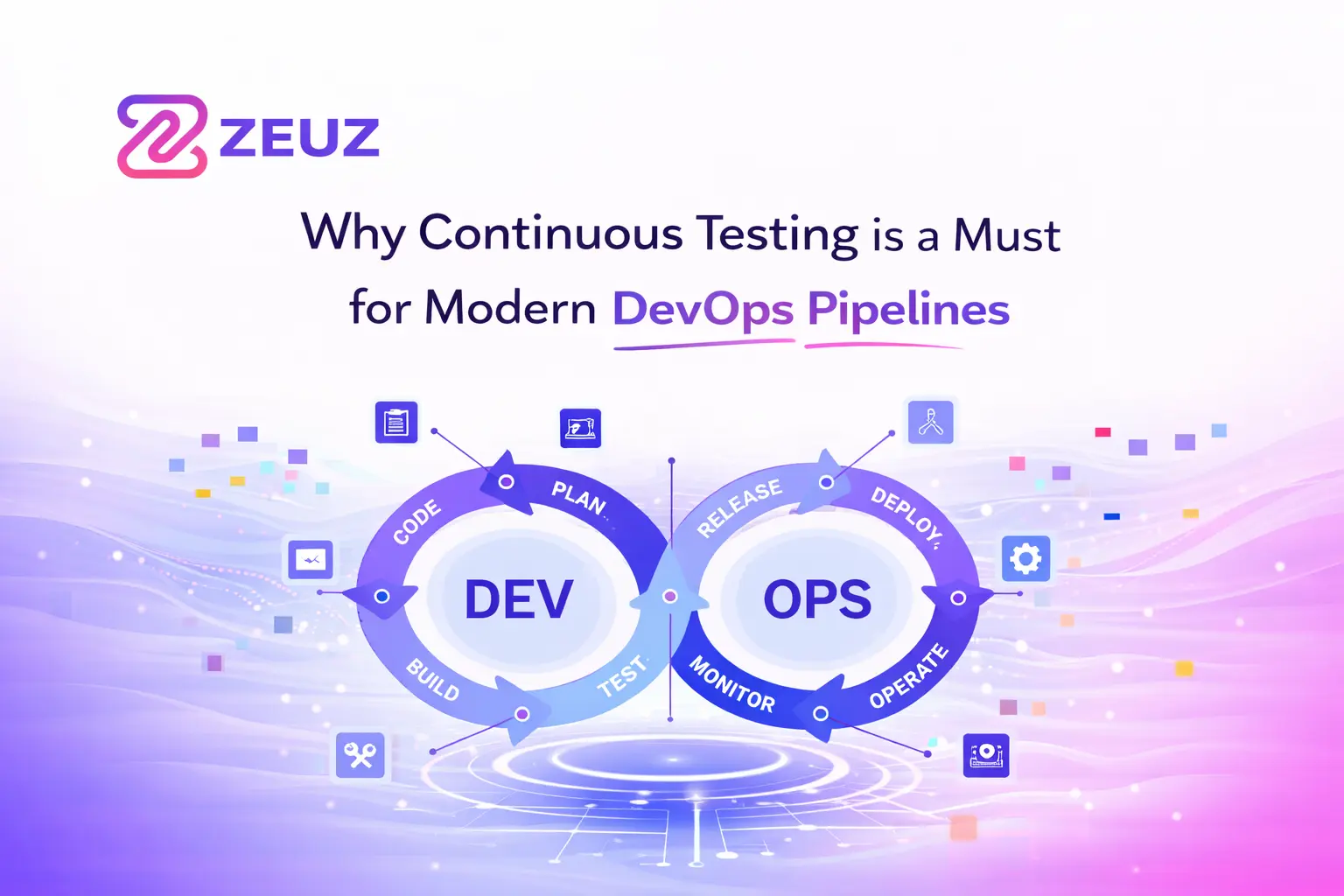
Why Continuous Testing is a Must for Modern DevOps Pipelines
What Is Continuous Testing in DevOps?
Understanding CI/CD in Automation Testing
Why Manual Testing Alone Fails in CI/CD Pipelines
Where Automation Tests Fit in the CI/CD Pipeline
Types of Tests to Include in Continuous Testing for DevOps
Why Continuous Testing Is a Must for Modern DevOps Pipelines
Challenges in Implementing Continuous Testing in DevOps
Key Takeaways
Speed without testing creates risk
Continuous testing embeds quality into CI/CD
Manual testing alone cannot keep up with DevOps
Automation is the backbone of reliable pipelines
Early feedback reduces cost and complexity
Continuous testing scales with modern architectures
Confidence comes from visibility and trust in results
Share with your community!
Why Continuous Testing is a Must for Modern DevOps Pipelines
DevOps promised speed. But speed without safety is reckless. But speed without safety is basically just chaos. Too many teams zoom ahead with releases while testing gets left in the dust. Continuous testing is what keeps your whole process from falling apart. Without it, your CI/CD pipeline becomes a guessing game. And in software, guessing is expensive.
What Is Continuous Testing in DevOps?
Continuous testing = no code sneaks through unchecked. Every update gets validated and measured before it even dreams of hitting production. The logic is straightforward: the sooner you catch a glitch, the less it costs you—in time, money, and sanity. In real life, that means baking automated tests right into your daily development flow so code quality’s always on your radar.
Every push, every merge, every deployment attempt sends signals through the system. Instead of waiting days or weeks for QA to run their checks, feedback loops shrink to minutes. Teams don’t guess whether their app still works; they know. That confidence is what separates pipelines that deliver value daily from pipelines that grind to a halt at the first sign of failure.
Understanding CI/CD in Automation Testing
CI/CD pipelines are meant to make life smoother—code gets merged all the time, builds itself, and ships way faster than those old-school release marathons.
But here’s the thing: Continuous testing is what actually holds it all together. It’s the safety net that makes sure your shiny new feature doesn’t break everything that was already working, your APIs still play nice, and your app doesn’t suddenly crawl to a halt.
Why Manual Testing Alone Fails in CI/CD Pipelines
Manual testing has its place, but it simply can’t keep up with the pace of DevOps. Pipelines move in minutes, not days. Relying solely on people to validate changes creates bottlenecks and slows everything down. And worse: human fatigue creeps in, and things slip through the cracks. Here’s why manual-only pipelines don’t stand a chance:
→ Repetition fatigue: Running the same regression checks manually leads to errors over time.
→ Scale issues: As applications grow, the number of test scenarios explodes. Humans can’t cover them all.
→ Inconsistent results: Different testers approach cases differently, leading to gaps in coverage.
→ Delayed risk discovery: Bugs found late in the cycle cost more to fix and often derail releases.
That doesn’t make manual testing useless. It makes it limited. Exploratory testing, edge cases, usability quirks—humans shine there. But without automation woven into CI/CD, the pipeline breaks under its own weight.
Where Automation Tests Fit in the CI/CD Pipeline
Think of a DevOps pipeline without automated testing like a leaky dam—it might seem fine today, but it’s only a matter of time before it bursts. CI/CD gives you all these built-in checkpoints, but automation is what makes them actually useful.
Right after a commit, unit tests run—if they fail, that code goes nowhere. Then integration tests check that new features mesh with existing ones.Functional tests make sure the system acts like users expect. Performance tests throw real traffic at it, catch slowdowns, and expose bottlenecks early. Security scans even dig for vulnerabilities hiding in plain sight.
And it doesn’t end at deployment. Continuous monitoring catches issues in real time, feeding results back into the loop. Finally, everything feeds into test reporting, giving teams visibility into failures, trends, and risks.
Types of Tests to Include in Continuous Testing for DevOps
Not every test belongs in a CI/CD automation testing pipeline. Some are too heavy, some too slow. The right mix matters.
Unit tests: Fast, focused, and run with every commit. They’re the first line of defence.
Integration tests: Validate connections across services. With modern systems full of Integrations, skipping these is asking for trouble.
Functional tests: They answer the question: “Does the system behave the way the user expects?”
Performance testing: Stress, load, and scalability checks. Speed is useless if your app collapses under real traffic.
Security tests: Automated scans that catch weak spots before attackers do. Security can’t be an afterthought.
Test Case Management: Organizing, updating, and reusing tests across environments. Without it, pipelines turn messy fast.
Why Continuous Testing Is a Must for Modern DevOps Pipelines
Continuous testing is what makes DevOps work in reality. Pipelines move fast, but without checks, you don’t know if you’re shipping value or shipping bugs. Here’s why it matters:
1. It matches the pace of delivery
Push code, get instant clarity. Thanks to continuous testing, devs don’t have to wait days for QA or guess if their changes broke something. Feedback comes in minutes, not weeks—which means teams can stay speedy without losing their mind.
2. It scales with complexity
Modern systems are all over the place—cloud, mobile, APIs, you name it. Trying to test all that manually? Good luck. You need continuous automation just to keep up. But with AI-powered QA tools and smart flow control, scaling your testing actually feels manageable (dare we say… easy?).
3. It improves results
When teams get CI/CD right, the numbers speak for themselves: half the deployment time, 20% more dev output, and 70% fewer production blowups. Why? Because continuous testing acts like an early-warning system—it spots regressions, integration fails, and speed bumps long before users do.
4. It shifts human effort
Machines are great at doing the same thing over and over—like regression tests, API validations, and simulating thousands of users. So let them! That gives your team room to do what humans excel at: creative testing, spotting UX hiccups, and thinking up smart ways to improve the product.
5. It builds confidence
You don’t have to stress every time you deploy anymore. Clean test reports and trend-spotting analytics make it obvious what’s working well and what needs a second look. That way, when new features go out, it’s a confident move backed by solid, automated validation.
Challenges in Implementing Continuous Testing in DevOps
Continuous testing sounds straightforward, but the rollout is rarely smooth. Teams run into walls, and those walls usually look like this:
■ Tool complexity: Teams often juggle too many tools. One for test case management, another for project management, another for builds. Without cohesion, pipelines turn messy.
■ Flaky tests: When tests fail randomly, they create more confusion than confidence. And nobody trusts a flaky safety net.
■ Skill gaps: Automation requires a different skill set than traditional manual QA. Teams struggle to adapt unless they invest in training or lean on professional services.
■ Resource crunch: Running massive test suites fast needs serious compute power—and budget. Go cheap, and performance tanks.
■ Cultural resistance: This whole thing only clicks when dev, QA, and ops act like one team. But changing how people work isn't easy.
Final Words
You don’t need more releases. You need fewer regrets. Every untested commit is a silent apology waiting to happen—in Slack, in sprint retros, in customer support tickets. Which is why continuous testing is the bare minimum if you want your pipeline to survive real-world stress. Without it, you’re moving fast but blindly. Sure, features go out quickly…until the first bug takes down your whole release.
AI-powered QA tools like ZeuZ fix that. It makes your entire CI/CD flow make sense. With support for web, API, performance, and mobile testing, ZeuZ shows what shipping really looks like: less chaos, quicker insights, and teams that aren’t constantly on edge.