Agentic AI Across the Software Development Lifecycle (SDLC)
The Most Important Agentic AI Tools for Software Engineers in 2026
Challenges and Risks: What Nobody Tells You About Deploying Agentic AI
India's Unique Position in the Agentic AI Era
The Future of Agentic AI in Software Engineering: What Comes Next
How zeuz Supports Agentic AI Workflows for Engineering Teams
Key Takeaways
What Is Agentic AI in Software Engineering, And Why Should Every Developer Care Right Now?
The Numbers Behind the Agentic AI Revolution
Understanding Agentic AI: How It Actually Works
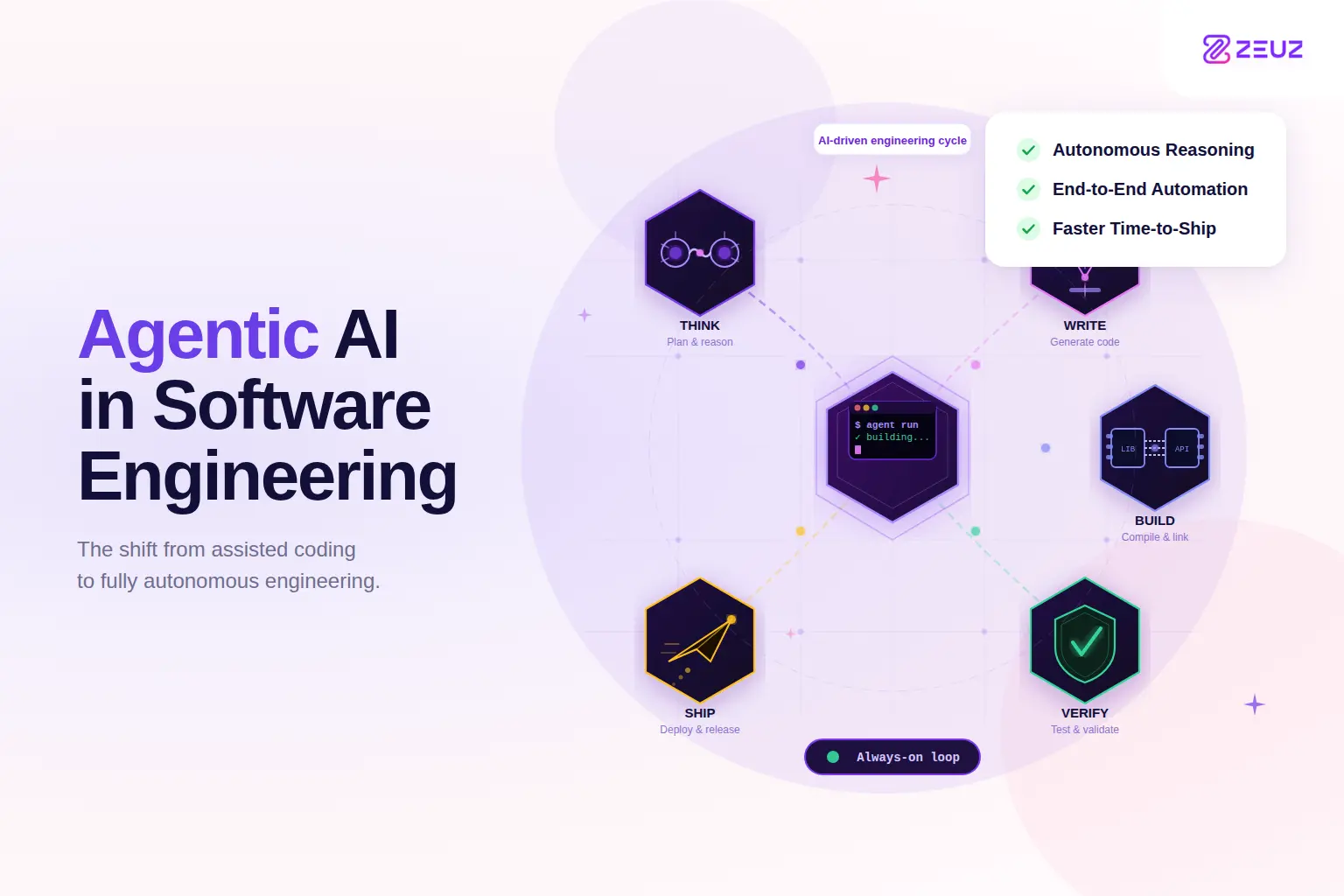
Agentic AI Across the Software Development Lifecycle (SDLC)
The Most Important Agentic AI Tools for Software Engineers in 2026
Challenges and Risks: What Nobody Tells You About Deploying Agentic AI
India's Unique Position in the Agentic AI Era
The Future of Agentic AI in Software Engineering: What Comes Next
How zeuz Supports Agentic AI Workflows for Engineering Teams
Share with your community!
Agentic AI in Software Engineering: 2026 Guide
What Is Agentic AI in Software Engineering, And Why Should Every Developer Care Right Now?
Agentic AI in software engineering is not just another buzzword. It represents a fundamental shift in how software is planned, built, tested, and deployed, where AI systems no longer wait for instructions but autonomously reason, plan, and execute complex multi-step engineering workflows with minimal human intervention. If you are a developer, engineering manager, or tech leader in India, understanding this shift is no longer optional. It is the difference between leading the next decade of software development and being left behind by it.
Think of traditional AI tools like GitHub Copilot or ChatGPT as very smart autocomplete. They respond when you ask. Agentic AI, on the other hand, behaves more like an autonomous team member, one that can read a ticket, write the code, run the tests, fix the failures, open a pull request, and even flag architectural concerns, all without being prompted at every single step. This is the transformation that is already happening across the global software industry, and India, with its 5.8 million-strong tech workforce, sits at the center of it.
Understanding Agentic AI: How It Actually Works
The Core Architecture of an Agentic System
Agentic AI systems are built on a foundation of large language models (LLMs), but what makes them "agentic" is a layer of architecture that enables autonomous goal-directed behavior. At its core, an agentic system has four key capabilities: perception (reading inputs from its environment), reasoning (planning how to achieve a goal), action (executing tools, writing code, calling APIs), and iteration (evaluating results and trying again if something fails).
The underlying engine is typically a powerful LLM like Claude, GPT-4, or Gemini, but the agentic behavior comes from wrapping that model in a loop. Instead of responding once and stopping, an agentic system keeps running, breaking tasks into subtasks, using tools, evaluating outputs, and continuing until the goal is met or a human decides to intervene. This is sometimes called a "ReAct" loop (Reasoning + Acting), and it is what separates a chatbot from a true AI agent.
Modern agentic systems also rely on a growing ecosystem of protocols and standards. Model Context Protocol (MCP), introduced by Anthropic in November 2024, has become the universal standard for connecting AI agents to external tools, data sources, and environments. MCP enables agents to read files, call APIs, query databases, and interact with browsers through a standardized client-server architecture, essentially giving agents hands and eyes beyond the chat window. You can learn more about how ZeuZ leverages MCP in our [agentic integrations documentation].
Single-Agent vs. Multi-Agent Architectures
Not all agentic systems are built the same way. Understanding the difference between single-agent and multi-agent setups is essential for any engineering team evaluating agentic AI.
Single-agent workflows process tasks sequentially through one context window. One agent receives a goal, executes a series of steps, and delivers an output. This works well for well-defined, bounded tasks, writing a unit test, refactoring a function, generating boilerplate code for a new module.
Multi-agent architectures, which dominate 66.4% of the enterprise market, use an orchestrator agent that coordinates multiple specialized sub-agents working in parallel. Each sub-agent has a dedicated context and specialization, one for code generation, one for security review, one for documentation, one for testing. The orchestrator synthesizes their outputs into integrated results. This mirrors how high-performing human engineering teams work: specialists collaborating under a project manager. Multi-agent systems are far more powerful for complex, end-to-end software engineering tasks, and they are increasingly the architecture of choice for serious engineering deployments.
Agentic AI Across the Software Development Lifecycle (SDLC)
Requirements and Planning: From Ambiguity to Architecture
The first place agentic AI is transforming software engineering is in requirements analysis and planning, a phase that traditionally consumed enormous amounts of senior engineer time. Agentic systems can now ingest product briefs, customer feedback, market data, and existing codebase context to produce structured requirements documents, identify edge cases, flag technical constraints, and even propose initial architecture diagrams.
GenAI tools already analyze extensive data, including customer requests, market trends, and user feedback, for software requirement planning. Agentic versions of these tools go further: they do not just surface insights, they make decisions, prioritize features, and create actionable engineering tickets ready for sprint planning. For Indian GCCs (Global Capability Centers), which are rapidly redefining themselves as AI-first intelligence hubs, this capability is proving transformative.
Code Generation and Development: Writing Code That Actually Works
This is where most people first encounter agentic AI, and where the productivity numbers are most dramatic. Gartner estimates that by 2028, 75% of enterprise software engineers will use AI coding assistants, up from less than 10% in early 2023. But AI coding assistants and agentic coding systems are different animals.
An AI coding assistant (like Copilot) completes lines. An agentic coding system (like Cursor in agent mode, Devin, or Claude Code) implements features. You describe what you want at a high level "add OAuth login with Google, store tokens in Redis, write the tests" and the agent plans the implementation, writes the code across multiple files, installs the necessary packages, and runs the tests, fixing failures as they come up.
Google reported that AI contributes to over 25% of its new code, with human oversight. This number is expected to grow rapidly across the industry. In India, where software services firms like Infosys, TCS, and Wipro handle enormous volumes of routine application development, agentic coding systems have the potential to fundamentally change delivery economics. The same quality of output that once required a three-person team could increasingly be produced by one senior engineer working alongside agentic AI tools. ZeuZ's [AI-powered development features] are specifically designed for teams navigating this transition.
Testing and Quality Assurance: Agents That Find Bugs You Missed
Agentic AI is arguably most mature and most immediately valuable in testing and QA. Tests are, by their nature, verifiable outputs, you know if a test passes or fails, which makes them ideal for autonomous AI systems. One senior engineering director described his agentic setup this way: he no longer needs to instruct the agent to write tests. The system instructions tell the agent that any time it writes a new feature, it must also write tests, run them, and fix any failures, automatically.
Tools like Cognition's Devin are marketed as capable of handling complex engineering workflows, writing apps, debugging, running test suites, and learning new technologies from documentation. In QA pipelines, agentic systems can automatically update regression test suites when new features ship, analyze test failures and propose root-cause fixes, prioritize which tests to run based on the scope of changes, and generate test data that covers edge cases humans might miss.
According to Gartner estimates, 33% of enterprise software apps will have agentic AI capabilities by 2028, many of which will include automated QA and testing agents. For India's quality engineering services sector, which has long been a global leader, this creates both a challenge and an opportunity to move up the value chain from test execution to test strategy.
DevOps and Deployment: Autonomous Operations
Beyond the development phase, agentic AI is reshaping DevOps and deployment pipelines. Agentic systems can monitor deployment health, detect anomalies, roll back problematic releases, and open incident reports, all without waiting for a human to notice something went wrong. This is the vision of "AIOps," and agentic systems are finally making it a practical reality.
The adoption of MCP in 2025 accelerated this dramatically, particularly among NetOps and SecOps teams. MCP enables AI agents to interact with infrastructure through natural language interfaces, querying SD-WAN configurations, analyzing log streams, and triggering automated remediation workflows. McKinsey research shows that AI-centric DevOps organizations are achieving some of the most dramatic EBITDA improvements seen in any industry segment, driven by automation, faster incident response, and more efficient resource allocation.
The Most Important Agentic AI Tools for Software Engineers in 2026
Cursor: The Agent-Native IDE
Cursor emerged as the most widely discussed agentic coding tool in multiple 2024–2025 surveys, and for good reason. It is built as an agent-native code editor, not an IDE with a chatbot bolted on. Cursor can read your entire codebase, understand the architecture, implement features across multiple files, and run tests in a continuous feedback loop. For daily development work, it has become the tool of choice for a growing wave of engineers worldwide, including a rapidly growing community in India.
Claude Code: Anthropic's Terminal-Native Agent
Claude Code, developed by Anthropic (the same company behind zeuz's underlying AI capabilities), is a command-line tool for agentic coding that lives in the terminal. It is particularly powerful for complex refactoring tasks, codebase exploration, and automated PR creation. Unlike browser-based tools, Claude Code integrates directly with your local environment and version control system, making it ideal for professional engineering workflows. You can explore how zeuz integrates with Claude Code through our [developer tools page].
Devin: The First AI Software Engineer
Launched in 2024, Devin from Cognition AI is often cited as the first true AI software engineer. Devin can set up development environments from scratch, implement multi-file features, debug across layers of the stack, and even deploy applications. While it is not a replacement for senior engineering judgment on complex architectural decisions, it represents a credible autonomous agent for a wide range of well-specified software tasks.
LangChain and LangGraph: The Orchestration Layer
For teams building their own agentic workflows, LangChain and its graph-based cousin LangGraph have emerged as the dominant open-source orchestration frameworks. LangGraph is particularly important for multi-agent systems, enabling teams to define complex workflows where multiple agents collaborate, check each other's work, and route tasks based on outcomes. For Indian engineering teams at product companies or GCCs building proprietary agentic systems, LangGraph proficiency is fast becoming a core competency.
AutoGen and CrewAI: Multi-Agent Collaboration
Microsoft's AutoGen and CrewAI are two other frameworks gaining serious traction for multi-agent software development workflows. AutoGen enables agents to have structured conversations with each other to solve problems collaboratively, one agent writes the code while another reviews it and a third writes the tests. CrewAI takes a "crew" metaphor, assigning distinct roles to agents and enabling them to collaborate on shared tasks. Both frameworks are seeing rapid adoption in India's enterprise tech sector.
Challenges and Risks: What Nobody Tells You About Deploying Agentic AI
The Failure Rate Is Real
Here is something the hype cycle does not advertise enough: agentic AI projects fail at a significant rate, and Gartner is direct about this. Gartner predicts that over 40% of agentic AI projects will be canceled by the end of 2027, due to escalating costs, unclear business value, or inadequate risk controls. A January 2025 Gartner poll found that while 19% of organizations had made significant investments in agentic AI, 42% had made only conservative investments, and 31% were still in "wait and see" mode.
The failure modes are instructive. Integrating agents into legacy systems is technically complex and costly. 40% of agentic AI project failures are attributed to inadequate infrastructure, meaning platform selection and architecture decisions made at the start can doom a project before it ships. And there is a widespread problem of "agent washing" vendors rebranding existing chatbots and RPA tools as agentic AI without the genuine autonomous capabilities the term implies.
Security and Trust Are Non-Negotiable
Cybersecurity is the top barrier to agentic AI adoption for 35% of organizations, according to research compiled by Landbase. This is not paranoia, it is rational caution. Agentic systems that can browse the web, call APIs, execute code, and access databases represent a qualitatively different attack surface than traditional software. Prompt injection attacks (where malicious content in the environment manipulates agent behavior), data exfiltration risks, and the challenge of auditing autonomous decisions are all real concerns that engineering teams must address.
A robust agentic AI governance framework should include human-in-the-loop checkpoints for critical decisions, comprehensive audit trails for all agent actions, circuit breakers that halt agents if anomalous behavior is detected, and clear scope boundaries that limit what any given agent can access or modify. Building trust in agentic systems is not about black boxes, it is about transparency, explainability, and control.
The Data Engineering Iceberg
Perhaps the most underappreciated challenge in agentic AI deployment is data engineering. MIT Sloan research on healthcare agentic AI found that 80% of the actual implementation work was consumed not by model fine-tuning or prompt engineering, but by data engineering, stakeholder alignment, governance, and workflow integration. This "iceberg" effect, where the hard work is invisible until you start building, catches many teams off guard. Converting data into standard, structured formats and ensuring agents can reliably identify and access the right data sources is foundational work that cannot be shortcut.
India's Unique Position in the Agentic AI Era
Why India Has a Structural Advantage
India is not just a consumer of agentic AI, it is positioned to be one of its most important global producers and innovators. Several structural advantages make India's tech workforce uniquely suited to lead in this transition.
First, India's AI talent pipeline is exceptional. With the highest AI skill penetration score globally in the Stanford AI Index 2024, India already has the foundational human capital to build on. Second, India's $1.2 billion government AI mission is creating institutional momentum, regulatory clarity, and infrastructure investment that accelerates enterprise adoption. Third, India's GCC ecosystem, which manages software development for many of the world's largest enterprises, creates a natural laboratory for deploying agentic AI at scale on real-world engineering problems.
NASSCOM estimates India has 5.8 million tech workers. 37% of entry-level IT jobs will be redefined by agentic AI, but rather than disappearing, these roles are evolving toward higher-value activities. The developers who learn to work effectively with agentic systems, directing them, reviewing their outputs, designing their architectures, will command significant salary premiums. Current data shows AI-skilled engineers in India commanding salaries in the 15–22 LPA range at mid-level, with senior AI-focused engineers at top firms reaching 35–60 LPA total comp.
The Skills Gap That Must Be Closed
India's advantage is real but not guaranteed. NASSCOM's latest research identifies a critical agentic AI skills gap that must be addressed urgently. The gap is not in foundational programming skills, it is in the skills specific to designing, deploying, governing, and iterating on agentic systems: prompt engineering at scale, multi-agent orchestration, LLM evaluation, tool-use design, agent security, and human-AI collaboration workflow design.
For Indian developers looking to future-proof their careers, the immediate priority is gaining hands-on experience with agentic frameworks like LangChain, LangGraph, and AutoGen; building familiarity with MCP and agent tool design; and developing intuitions for the tasks that agents handle well versus the tasks that still require human judgment. Platforms like zeuz offer [practical agentic AI workflows] designed specifically to help engineering teams build these skills through real-world use cases.
The Future of Agentic AI in Software Engineering: What Comes Next
Autonomous SDLC: From Concept to Deployment Without Human Bottlenecks
The near-term trajectory of agentic AI in software engineering points toward increasingly autonomous end-to-end software development lifecycles. By 2028, Gartner predicts at least 15% of day-to-day work decisions will be made autonomously by agentic AI, up from 0% in 2024. At least 33% of enterprise software applications will include agentic capabilities. The vision of "dynamic surge staffing" where businesses can rapidly scale engineering capacity on specific tasks using agentic systems is already beginning to take shape.
Tasks that once required weeks of cross-team coordination can become focused working sessions as agentic systems compress planning, implementation, and testing into continuous loops. This is not science fiction; the 2026 Agentic Coding Trends Report from Anthropic documents how senior engineers are already describing a qualitative change in their relationship with software development: they are spending less time executing and more time deciding, designing, and directing.
Multi-Agent Specialization: Teams of AI Engineers
The next evolution of multi-agent systems will move toward persistent teams of specialized AI agents that develop deep expertise in specific parts of a codebase or problem domain. Rather than spinning up a generic agent for each task, engineering teams will maintain agent "crews" with accumulated context and specialized knowledge: one agent that deeply understands the payment processing module, another that is expert in the front-end component library, another that specializes in database optimization.
This mirrors how elite human engineering teams work: specialists with deep context, coordinated by shared goals and communication protocols. The orchestration layer (likely evolving versions of LangGraph, AutoGen, or proprietary frameworks) will become the engineering management layer allocating tasks, managing handoffs, and ensuring quality across the multi-agent workflow.
Human-AI Collaboration: The New Engineering Paradigm
Despite the remarkable capabilities of agentic systems, the dominant paradigm will be human-AI collaboration rather than AI replacement. A 2025 MIT Sloan Management Review and BCG survey found that 89% of organizations emphasize human-AI collaboration rather than AI replacement as their model for agentic deployment. The most valuable engineers of the next decade will be those who can effectively direct, evaluate, and improve agentic systems, combining domain expertise with AI literacy.
This is also the most honest framing. Agentic AI is extraordinarily powerful for tasks that are well-specified, verifiable, and bounded. It struggles with tasks that require deep contextual judgment, novel architectural thinking, stakeholder negotiation, and creative problem decomposition, precisely the highest-value activities that distinguish excellent engineers from adequate ones. The barrier between "people who code" and "people who don't" is becoming more permeable, but the ceiling for expert engineers who understand how to work with AI is also rising.
How zeuz Supports Agentic AI Workflows for Engineering Teams
At ZeuZ, we are building specifically for engineering teams navigating the transition to agentic AI. Our platform is designed around the insight that the hardest part of agentic AI adoption is not access to models, it is building the orchestration, tooling, context management, and governance infrastructure that makes autonomous agents reliably useful in production environments.
Our core features for agentic software engineering teams include:
Agentic workflow builder: Design and deploy multi-step autonomous workflows without building custom orchestration from scratch. Drag-and-drop agent pipelines that integrate with your existing CI/CD and project management tools.
MCP-native integrations: Connect your agents to code repositories, issue trackers, deployment pipelines, and monitoring systems through zeuz's MCP-compatible integration layer, giving your agents the context they need to act effectively.
Human-in-the-loop controls: Define exactly where human review is required in your agent workflows. Set confidence thresholds, scope boundaries, and approval gates that give your team confidence without sacrificing the speed benefits of automation.
Audit and observability: Full audit trails for every agent action, decision, and output. Understand exactly what your agents did, why they did it, and how to improve their behavior over time.
Team collaboration: Multi-agent systems work best when they mirror team structures. zeuz supports collaborative agentic workflows where different agents handle different roles, and different human engineers oversee different parts of the pipeline.
Explore our [agentic AI features], browse our [engineering blog], or try zeuz.ai's [developer sandbox] to see how agentic AI can transform your team's development velocity.
Key Takeaways
Agentic AI is not a distant future: it is a present reality reshaping software engineering right now. The market is growing at nearly 44% CAGR, adoption is crossing the majority threshold, and the productivity gains for early movers are real and measurable. For India's tech workforce, the combination of exceptional AI talent, government investment, and GCC-scale deployment opportunities creates a structural window to lead this transition rather than adapt to it.
The path forward requires honesty about both the opportunity and the challenges. Agentic projects fail when they lack clear business value, adequate infrastructure, and robust governance. They succeed when engineering teams understand the technology deeply, design workflows that match agents' genuine strengths, and build the human-AI collaboration models that combine the best of autonomous execution with human judgment at the right points.
The engineers, teams, and organizations who invest now in understanding agentic AI systems, not just using them, but genuinely understanding how they work, where they fail, and how to design around their limitations, will be the ones who define what software engineering looks like in 2030 and beyond.