Multi-agent systems coordinate complex engineering tasks.
Governance and security are critical for AI adoption.
AI-driven SDLC delivers faster and more reliable releases.
Agentic AI boosts productivity and reduces defects.
ZeuZ AI enables autonomous software quality management. Select 93 more words to run Humanizer.
Share with your community!
What Is Agentic AI? Autonomous Decision-Making
A New Kind of Intelligence Is Already Running Inside Software Teams
Something fundamental has changed in how the best engineering teams build, test, and ship software.
It's not just that developers use AI assistants to write code faster. It's that AI is beginning to manage work, setting goals, designing test plans, triggering deployments, analyzing failures, and adapting its own behavior based on what it observes. Without being told exactly what to do at every step.
This is agentic AI. And if you build software, lead engineering teams, or make technology decisions, it's the most important shift in your industry right now.
Gartner identifies agentic AI as one of its top 10 strategic technology trends for 2025. The market for agentic AI systems is projected to grow from $5.25 billion in 2024 to over $199 billion by 2034, a 43.84% compound annual growth rate. By the end of 2026, 40% of enterprise applications will be integrated with task-specific AI agents, up from less than 5% in 2025.
But behind those numbers is a more important story: the relationship between humans and software systems is being fundamentally rewritten.
This pillar guide will explain exactly what agentic AI is, how it works inside modern software systems, why it represents a genuine paradigm shift from everything that came before it, and what it means for the future of software development, quality assurance, and DevOps.
What Is Agentic AI? A Plain-Language Definition
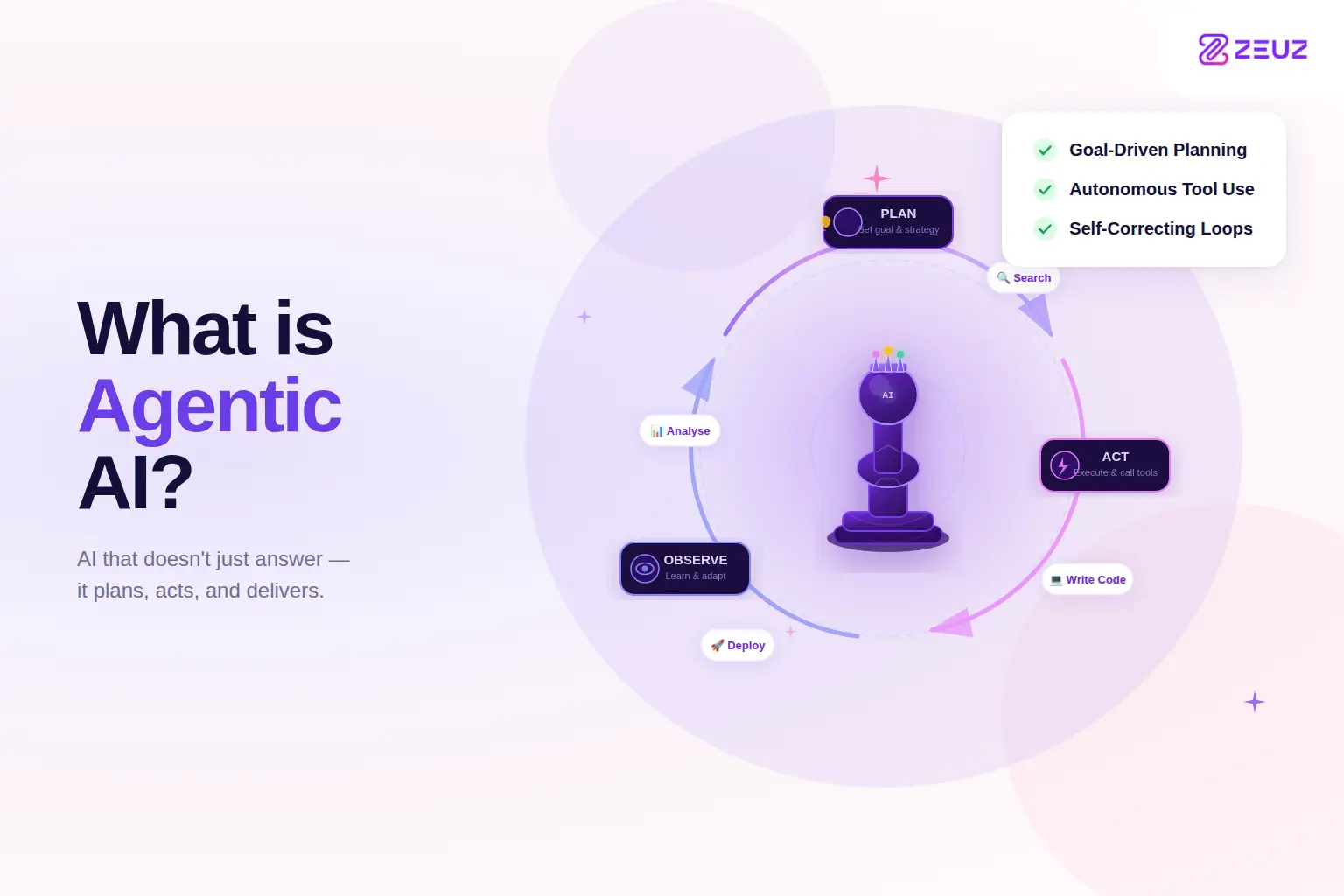
Agentic AI refers to artificial intelligence systems that can autonomously perceive their environment, reason about it, plan multi-step actions, execute those actions using tools, evaluate results, and adapt their behavior, all in pursuit of a defined goal, with minimal human intervention at each individual step.
The word "agentic" comes from the concept of agency, the capacity to act independently in the world. An agentic AI system doesn't just respond when prompted. It initiates, reasons, decides, and acts.
Think of the difference like this:
A traditional AI assistant (like a chatbot or code suggestion tool) waits for you to ask a question, generates a response, and stops. You drive every step.
An agentic AI system receives a high-level goal, "ensure this release is production-ready", and independently breaks it down into tasks: run the test suite, analyze failing tests, propose fixes, validate the fixes, check security compliance, and report results. It keeps working until the goal is met.
That distinction, from reactive tool to autonomous goal-pursuer, is what makes agentic AI a genuinely different category of technology.
Key Characteristics of an Agentic AI System
An agentic AI system typically exhibits four defining characteristics:
1. Goal-Directed Behavior The system is given an objective, not a script. It determines how to achieve the goal rather than following a predefined sequence of steps.
2. Multi-Step Reasoning and Planning The system can decompose complex goals into subtasks, sequence those subtasks logically, and maintain context and memory across extended workflows that may span minutes, hours, or longer.
3. Tool Use and Action Execution Agentic AI can interact with external systems, running code, querying APIs, writing to databases, triggering CI/CD pipelines, reading logs, executing test cases, using tools the system has been given access to.
4. Self-Monitoring and Adaptation The system evaluates its own outputs, recognizes when something has gone wrong, and adjusts its approach. If a test fails, it doesn't stop, it reasons about why, tries a different approach, and continues toward the goal.
How Agentic AI Differs from Generative AI and Traditional Automation
Before exploring what agentic AI does, it's worth being precise about what it isn't, because the category is frequently misrepresented.
Agentic AI vs. Generative AI
Generative AI (like large language models) is powerful at generating text, code, images, and analysis in response to a prompt. It's reactive, it responds when you talk to it. It doesn't plan ahead, execute actions in external systems, or pursue ongoing goals autonomously.
Agentic AI uses generative AI as its reasoning engine. The LLM does the thinking; the agent does the acting. An agentic system adds memory, tool access, goal pursuit, and autonomous execution on top of language model intelligence. This is not a subtle distinction, it's the difference between a knowledgeable consultant who gives you advice and a skilled contractor who takes ownership of a project and delivers results.
Agentic AI vs. Traditional Automation (RPA, Scripts, Pipelines)
Traditional automation, whether robotic process automation, shell scripts, or rule-based CI/CD pipelines, follows fixed, predefined logic. It does exactly what it was programmed to do, in exactly the sequence it was programmed to do it. When something unexpected happens, it fails or escalates to a human.
Agentic AI handles ambiguity, adapts to changing conditions, and makes judgment calls within its defined parameters. It can handle exceptions, reason about novel situations, and self-correct without needing a human to redesign the workflow each time something changes.
Dimension
Traditional Automation
Generative AI
Agentic AI
Trigger
Rule/schedule
Human prompt
Goal or event
Reasoning
None
Response generation
Multi-step planning
Action scope
Predefined steps only
Text/code output only
External tools, systems, APIs
Adaptation
None — fails on exceptions
Reprompt required
Self-monitors and adjusts
Goal persistence
Single task
Single conversation turn
Sustained pursuit of objectives
Human involvement
Every step designed upfront
Each prompt requires human
High-level goal setting only
Learning
No
No
Yes - within context
A key warning from Gartner: many vendors are engaging in "agent washing", rebranding existing chatbots, RPA tools, and AI assistants as agentic AI without genuine autonomous capability. True agentic AI demonstrates real goal-directed, multi-step, self-adapting behavior. If the system needs a human to prompt every action, it isn't agentic.
The Core Components of an Agentic AI System
Understanding what an agentic AI system is made of helps engineering leaders make more informed decisions about adoption, architecture, and tooling.
A well-designed agentic AI system has five interconnected components:
1. The Reasoning Engine (LLM Core)
The large language model, such as GPT-4o, Claude 3, or Gemini, acts as the cognitive core of the agent. It handles natural language understanding, logical reasoning, code generation, plan formation, and output interpretation. The quality of reasoning directly determines how effectively the agent can handle complex, ambiguous situations.
2. Memory and Context Management
Agents need to remember what they've done, what they've discovered, and what they're trying to achieve. Memory systems typically include:
Short-term (in-context) memory: The active working window of the current task
Long-term memory: Vector databases, semantic stores, or structured logs that persist across sessions
Episodic memory: Records of past actions, outcomes, and lessons learned
Memory is what transforms a stateless language model into a persistent agent capable of managing long-running workflows.
3. Tool Access and Integration Layer
An agent without tools can only generate text. The power of agentic AI comes from what it can do in the world. Tool access typically includes:
Code execution environments
Browser and web interfaces
API connectors (to Jira, GitHub, Slack, test runners, monitoring platforms)
File systems and databases
CI/CD pipeline triggers
Testing frameworks
In software engineering contexts, the richer the tool layer, the more of the SDLC the agent can actively participate in.
4. The Planning and Orchestration Layer
This is the "project manager" component of the agent. It receives the high-level goal, breaks it down into a sequence of subtasks, assigns tasks (to itself or to sub-agents), monitors progress, handles failures, and adapts the plan as new information arrives. Modern orchestration frameworks include LangGraph, AutoGen, CrewAI, and Anthropic's Claude-based orchestration patterns.
5. Guardrails, Governance, and Human-in-the-Loop Controls
A well-designed agentic system is not fully autonomous by default. It has defined boundaries: what it can and cannot do, when it must pause for human approval, how its actions are logged and auditable, and how it handles uncertainty. As Gartner projects, 40% of agentic AI projects will be canceled by end of 2027 primarily due to inadequate risk controls, making governance a first-class concern, not an afterthought.
Why Agentic AI Matters Right Now: The Market Moment
The timing of this technology shift is not accidental. Several converging forces have created the conditions for agentic AI to become practical, not just theoretically impressive, at enterprise scale.
The Data Is Stark
Gartner's research shows that by 2028, at least 15% of day-to-day work decisions will be made autonomously through agentic AI, up from essentially 0% in 2024. The enterprise software market is moving at an equally dramatic pace: agentic AI is projected to drive approximately 30% of enterprise application software revenue by 2035, surpassing $450 billion, up from 2% in 2025.
From McKinsey's most recent organizational research, early adopters of agentic AI have seen productivity at minimum double, and the length of tasks that AI can reliably complete has been doubling approximately every four months since 2024, reaching roughly two hours of sustained autonomous work as of mid-2025.
For software teams specifically, McKinsey research finds that enterprises embedding AI into software development are seeing 20–30% faster delivery, 40% fewer defects, and 25% greater release predictability.
And yet adoption of genuine agentic AI, not AI assistants, but true autonomous agents, is still in its early innings. McKinsey's State of AI 2025 found that 73% of organizations are not using AI agents in product development at all. This gap between the competitive advantage available and current adoption is where strategic opportunity lives.
Why Software Engineering Is Ground Zero
Of all the domains where agentic AI is being applied, software engineering is where the impact is most immediate and most measurable.
Software development is already a digital-native process, everything happens in structured, tool-accessible environments where an AI agent can observe, reason about, and take action. Code repositories, CI/CD pipelines, test runners, monitoring dashboards, issue trackers, these are all API-accessible surfaces that agentic systems can interact with directly.
This is why technology companies are appearing at the top of every early-adopter list. The tools already exist. The data is already structured. The actions are already automatable. What was missing was the reasoning layer that could decide what to do, and that is what modern agentic AI provides.
How Agentic AI Works in Software Development: A Step-by-Step View
Here's what it actually looks like when an agentic AI system operates inside a software engineering workflow, not in theory, but in practice.
Scenario: A QA engineering team is managing a regression test suite for a large enterprise application. A new feature release is scheduled for tomorrow. The test suite has 2,400 test cases.
Without Agentic AI: A human QA engineer selects which tests to run (based on intuition and change impact analysis done manually), triggers the test run, waits for results, manually analyzes failures, writes up defect reports, assigns them to developers, and tracks resolution. This process takes 6–8 hours with multiple human touchpoints.
With an Agentic AI Testing System (like ZeuZ AI):
Perception: The agent monitors the code repository, detects the incoming pull request, reads the changed files, and identifies which parts of the application have been modified.
Planning: Based on the change analysis, the agent plans a targeted test execution strategy: prioritize the 340 tests most relevant to the changed code paths, then run the full suite in parallel.
Execution: The agent triggers the test runner, allocates test environments, manages parallel execution across environments, and monitors progress in real time.
Analysis: When 17 tests fail, the agent doesn't just log them. It reads the error messages, traces the failures back to root causes, cross-references the failures against the recent code changes, and classifies each failure as either a genuine regression or a test environment issue.
Adaptation: For the 3 environment-related failures, the agent retries in a clean environment and marks them as resolved. For the 14 genuine regressions, it generates defect reports with root cause analysis, affected code paths, reproduction steps, and severity classification.
Reporting: The agent generates a release readiness report, flags the 14 regressions as blockers, and sends a summary to the development team and release manager via Slack, with the full details linked in Jira.
Total autonomous execution time: under 90 minutes. Human involvement: reviewing the final report.
This is the practical reality of agentic AI in software testing. Not magic, structured autonomy applied to a well-defined engineering domain.
Agentic AI Across the Software Development Lifecycle
The impact of agentic AI isn't confined to one stage of the SDLC. Autonomous agents are beginning to reshape every phase of how software is conceived, built, tested, deployed, and maintained.
Requirements Engineering and Planning
Traditionally, requirements gathering is a slow, document-heavy process. AI agents are beginning to change this by:
Analyzing stakeholder documents, meeting transcripts, and user feedback to extract structured requirements
Identifying inconsistencies or gaps in requirements before development begins
Generating user stories, acceptance criteria, and functional specifications from high-level business goals
Mapping requirements to test cases and traceability matrices automatically
Atlassian's Jira AI can now automatically break down epics into subtasks, a small preview of what fully agentic planning will look like at scale.
Code Development and Review
AI agents in the development phase go significantly beyond autocomplete:
Analyzing codebases and proposing implementation approaches for new features
Writing complete functions, modules, or microservices from specification
Performing autonomous code review, checking for bugs, security vulnerabilities, and style compliance
Suggesting refactoring opportunities based on complexity and maintainability analysis
The Qodo 2025 AI Code Quality Report found that AI-assisted code reviews increased quality improvements to 81% (up from 55% without AI). An Atlassian RovoDev 2026 study found that 38.7% of comments left by AI agents in code reviews led to additional code fixes.
Autonomous Software Testing and QA
This is where agentic AI is currently having its most significant impact in engineering. Autonomous testing agents can:
Generate test cases from specifications and user stories
Execute end-to-end test runs across web, mobile, and API surfaces
Self-heal broken test scripts when the UI or API changes
Analyze test failures and distinguish genuine bugs from environmental noise
Maintain and update test suites as the codebase evolves
Prioritize test execution based on risk and code change impact
This is the core of what ZeuZ AI's agentic testing platform delivers, the ability to take autonomous ownership of quality across the entire application surface, without requiring human-written test scripts for every new feature or change.
(See our supporting article: [Agentic AI in Autonomous Software Testing] for a deep dive on this topic.)
CI/CD Pipeline Management and DevOps
Agentic AI is becoming an active participant in DevOps workflows rather than a passive observer:
Monitoring build pipelines and predicting failures before they occur
Automatically identifying and resolving configuration drift
Managing deployment rollouts with dynamic canary analysis
Triggering rollbacks when post-deployment monitoring detects anomalies
Generating incident summaries and suggesting remediation actions during outages
IDC projects that by 2025, 70% of DevOps teams will rely on AI agents to manage at least half of their daily delivery tasks. McKinsey research indicates AI-integrated DevOps pipelines are already achieving 40% faster build times and 30% fewer deployment rollbacks.
(See our supporting article: [How Agentic AI Improves DevOps and Release Management] for detailed workflow examples.)
Maintenance, Monitoring, and Incident Response
The post-deployment phase is traditionally reactive, teams respond to alerts after things go wrong. Agentic AI shifts this from reactive to proactive:
Continuously monitoring application health and performance signals
Detecting anomalies before they become user-visible failures
Correlating signals across logs, metrics, and traces to identify root causes
Generating runbooks and remediation steps for common failure patterns
Initiating self-healing actions within defined parameters
Agentic AI in QA and Autonomous Software Testing: The Deepest Opportunity
Quality assurance is the domain where agentic AI is delivering the most concrete, measurable value in software engineering today, and the reasons are structural.
Manual testing doesn't scale. Modern applications release multiple times per day, span web, mobile, and API surfaces, integrate with dozens of third-party services, and serve users with dramatically different contexts. A human QA team cannot test everything that needs to be tested at the speed modern development demands.
Traditional test automation helps, but it creates its own problems. Test scripts break when UIs change. Maintaining large test suites requires dedicated engineering effort. Coverage gaps emerge as new features are added faster than test cases. And even with high automation coverage, human judgment is still required to analyze results and make release decisions.
Agentic AI addresses all of these problems simultaneously:
Self-Healing Tests: When a UI element changes location or an API signature updates, an agentic testing system can identify the breakage, understand the intent of the original test, and update the test to match the new implementation, without human intervention.
Intelligent Test Generation: Rather than requiring engineers to manually write test cases for every feature, agentic systems can read specifications, user stories, or even observe application behavior and generate comprehensive test cases, including edge cases human testers frequently miss.
Autonomous Execution and Analysis: Agentic testing platforms execute tests, monitor results in real time, classify failures by root cause, distinguish environmental issues from genuine defects, and produce actionable defect reports, compressing hours of manual analysis into minutes.
Release Decision Support: Instead of a QA lead manually reviewing test results and making a judgment call about release readiness, an agentic system can synthesize all available quality signals, test results, code coverage, security scan findings, performance benchmarks, and generate a release readiness assessment with clear recommendations.
This is the vision behind ZeuZ AI's agentic testing platform: AI that doesn't just execute tests, but actively manages software quality as an autonomous, intelligent system.
Agentic AI in DevOps and Release Management
The DevOps domain presents a particularly compelling opportunity for agentic AI, because the operations environment already generates the kind of structured, machine-readable signals that agents can interpret and act on.
Intelligent Pipeline Orchestration
Static CI/CD pipelines run the same steps in the same order regardless of context. Agentic orchestration makes pipelines dynamic:
Agents analyze each commit to determine the minimum viable test and validation scope
Pipeline steps are dynamically ordered based on risk and dependency
Agents predict which builds are likely to fail based on historical patterns and current code changes
Resources are allocated dynamically to optimize pipeline throughput and cost
Autonomous Incident Response
When production incidents occur, the initial minutes determine how quickly resolution happens. Agentic systems compress that timeline dramatically:
An anomaly in application metrics triggers the agent
The agent correlates the anomaly with recent deployments, log patterns, and infrastructure changes
The agent generates a hypothesis about root cause and tests it against available data
The agent either initiates a defined remediation action (rollback, scale-up, cache flush) or escalates to on-call engineering with a complete situational summary
Throughout the incident, the agent maintains a real-time timeline for the post-mortem
Release Orchestration and Risk Management
Before a major release, an agentic system can:
Aggregate test results across all test tiers (unit, integration, end-to-end, performance, security)
Check compliance requirements against release artifacts
Compare the current build's quality metrics against defined release criteria
Identify which known issues are present and classify them by severity and user impact
Generate a go/no-go recommendation with supporting evidence
Real-World Applications: Agentic AI in Enterprise Software Teams
Use Case 1: Autonomous Regression Testing at Scale
A large financial services company runs 15,000 regression tests per release cycle. Historically, this required three QA engineers working in shifts and took 36–48 hours. With an agentic testing platform, AI agents analyze each release's code changes, identify the highest-priority test coverage, execute tests in parallel across distributed environments, self-heal broken test scripts, and deliver a complete quality report, in under four hours, with one QA engineer reviewing the final output rather than managing the process.
Use Case 2: Intelligent Sprint Planning
An agentic AI connected to a team's Jira instance, code repository, and historical velocity data can analyze the upcoming sprint's backlog, identify dependencies, estimate complexity based on similar past work, flag items with unclear requirements, and suggest a sprint plan, giving the engineering manager a starting point that would previously require two hours of manual analysis.
Use Case 3: DevSecOps Pipeline Intelligence
An agent embedded in a CI/CD pipeline monitors every code commit for security vulnerabilities, compliance violations, and quality regressions. When an issue is detected, the agent doesn't just fail the build, it explains the specific vulnerability, links to the relevant security policy, suggests a code fix, and creates a Jira ticket assigned to the responsible developer. Remediation time drops by 60% compared to traditional SAST tooling that only generates reports.
Use Case 4: Multi-Agent Software Delivery Coordination
In the most advanced current implementations, multiple specialized agents collaborate: a requirements agent analyzes and structures incoming feature requests; a planning agent breaks work down and assigns it; a development agent proposes code implementations; a testing agent validates the implementations; a DevOps agent manages deployment. Human engineers act as orchestrators and reviewers rather than executors.
Benefits of Agentic AI in Software Engineering
The practical benefits of deploying agentic AI across the SDLC are measurable and significant:
Speed: Teams using AI-integrated development pipelines see 20–30% faster overall delivery velocity according to McKinsey, with individual tasks like test analysis and defect triage compressed from hours to minutes.
Quality: Agentic systems that continuously monitor code quality and test coverage consistently identify defects earlier in the development cycle, where they cost significantly less to fix. McKinsey research points to 40% fewer defects in AI-integrated development environments.
Coverage: Autonomous test generation ensures that new features are tested comprehensively without requiring manual test script development, addressing one of the most persistent gaps in test automation programs.
Cost Efficiency: AI-centric organizations are achieving 20–40% reductions in operating costs according to McKinsey, driven by automation of repetitive tasks, faster cycle times, and more efficient use of skilled engineering talent.
Developer Experience: When AI agents handle the most repetitive and draining parts of engineering work, debugging, test maintenance, incident triage, human engineers can focus on the work that genuinely requires their creativity and judgment. This has a measurable impact on retention and job satisfaction.
Reliability: Autonomous release orchestration and pre-deployment validation reduce deployment rollbacks by approximately 30% (McKinsey), improving the reliability of production systems.
Challenges and Limitations: What You Need to Know Before Adopting
Agentic AI is genuinely powerful, but responsible adoption requires clear-eyed awareness of its current limitations and the risks of poor implementation.
The Governance Gap
Gartner's most striking prediction is not about adoption, it's about failure. Over 40% of agentic AI projects are predicted to be canceled by end of 2027, primarily due to escalating costs, unclear business value, and inadequate risk controls. The lesson: agentic AI projects fail when governance is treated as an afterthought. Audit trails, human-in-the-loop controls for high-stakes decisions, clear definitions of agent authority, and rollback mechanisms need to be designed before deployment, not added later.
Trust and Verification
Agentic systems can be confidently wrong. Current LLM-based reasoning systems can make plausible-sounding errors, especially in novel or complex situations. Every agentic deployment in software engineering needs defined verification checkpoints, moments where a human reviews and approves the agent's conclusions before consequential actions are taken.
Legacy System Integration
Integrating agentic AI with legacy applications, monolithic codebases, and fragmented toolchains is technically complex. Organizations that have invested in clean APIs, modern DevOps tooling, and structured data are far better positioned to benefit quickly. Those with significant technical debt will face a longer path to meaningful agentic AI integration.
The Skills Shift
Agentic AI changes what engineering teams need to be good at. The most valuable engineering skills shift toward systems design, AI orchestration, output validation, and strategic judgment, and away from the manual execution of repetitive tasks. This is a genuine transition that requires deliberate investment in upskilling.
Security and Prompt Injection
Agents that can take real actions in real systems are also attack surfaces. Malicious inputs designed to manipulate agent behavior, known as prompt injection attacks, are a real security concern. Agentic deployments in security-sensitive environments (financial services, healthcare, regulated industries) need specific security controls around what agents can access and what actions they can initiate.
The Future of Agentic AI: What's Coming in the Next Three to Five Years
The current state of agentic AI is already impressive, but the trajectory of capability growth is what makes this a genuinely transformative technology.
Longer Autonomous Work Horizons
The length of tasks that AI agents can reliably complete has been doubling approximately every four months since 2024, reaching roughly two hours of sustained autonomous work in mid-2025 (per McKinsey). As this continues, agents will be capable of managing multi-day, multi-system workflows without human checkpoints, overseeing entire feature development cycles from specification to deployment.
True Multi-Agent Software Engineering
We're moving from single-agent assistance to coordinated multi-agent teams. By 2026, Forrester and Gartner project that multi-agent architectures, where specialized agents collaborate under orchestration, passing context and work products between them, will become standard in leading engineering organizations. The 66.4% of current implementations that already use multi-agent designs is just the beginning.
Self-Improving Engineering Systems
The most sophisticated future agentic systems will not just execute within defined parameters, they will analyze their own performance, identify patterns in where they succeed and fail, and propose improvements to their own workflows. Engineering platforms that incorporate this kind of system-level feedback loop will continuously improve their effectiveness without requiring manual reconfiguration.
Agentic AI as Standard Engineering Infrastructure
Gartner's projection that 33% of enterprise software applications will include agentic AI by 2028 (up from less than 1% in 2024) suggests that agentic capability will be a standard feature of enterprise engineering platforms, not a specialized add-on. Organizations that build their engineering infrastructure around agentic capabilities now will have a significant structural advantage over those that retrofit it later.
How ZeuZ AI Is Built for the Agentic Era
ZeuZ AI is an AI-native software testing and automation platform built from the ground up for the agentic era, not retrofitted with an AI layer on top of legacy architecture.
The ZeuZ platform embodies the core principles of agentic software quality:
Autonomous Test Orchestration: ZeuZ agents can autonomously plan, generate, execute, and analyze test suites across web, mobile, and API surfaces, adapting dynamically to application changes without requiring manual test maintenance.
Self-Healing Test Automation: When applications change, ZeuZ agents identify broken tests, understand their original intent, and update them to work correctly, maintaining test coverage without human intervention.
Intelligent Release Gates: Rather than simple pass/fail metrics, ZeuZ synthesizes quality signals across the entire test suite to generate release readiness assessments, giving engineering and product teams the information they need to make confident, data-driven release decisions.
End-to-End SDLC Integration: ZeuZ connects with your existing development toolchain, Jira, GitHub, GitLab, Slack, Jenkins, and more, enabling agentic quality intelligence to flow through every stage of your software delivery process.
Multi-Agent Testing Architecture: ZeuZ supports coordinated multi-agent testing workflows where specialized agents handle test generation, execution management, failure analysis, and reporting in parallel, dramatically compressing the time from test trigger to actionable quality intelligence.
For software teams moving toward agentic development workflows, ZeuZ provides the quality foundation that makes autonomous software delivery trustworthy and reliable.
FAQ: What Is Agentic AI?
Q: What is the simplest definition of agentic AI?
Agentic AI is an AI system that can pursue goals autonomously, perceiving its environment, making decisions, taking actions using tools, and adapting based on results, without requiring human direction at each individual step.
Q: How is agentic AI different from a chatbot or AI assistant?
A chatbot or AI assistant responds to prompts, you ask, it answers. Agentic AI can pursue multi-step goals autonomously, take real actions in real systems (running code, calling APIs, triggering pipelines), maintain context across extended work sessions, and self-correct when things don't go as planned. The difference is between a tool you use and a system that works.
Q: Is agentic AI the same as autonomous AI?
The terms are often used interchangeably. "Autonomous AI" emphasizes the independence of operation; "agentic AI" emphasizes the goal-directed, action-taking nature of the system. Most practitioners treat them as equivalent.
Q: What are examples of agentic AI in software testing?
Examples include: AI agents that automatically generate test cases from user stories; agents that execute end-to-end test runs and analyze failures without human direction; agents that self-heal broken test scripts when the application changes; and agents that synthesize test results into release readiness recommendations. ZeuZ AI's platform delivers all of these capabilities.
Q: What is the difference between agentic AI and RPA (robotic process automation)?
RPA follows fixed, predefined rules and fails when conditions change. Agentic AI reasons, adapts, and handles novel situations. RPA automates repetitive tasks along fixed paths; agentic AI pursues goals along dynamic, self-determined paths. Many vendors are "washing" RPA products with agentic AI labels, the key test is whether the system genuinely reasons and adapts or simply follows a script.
Q: What are the risks of agentic AI in software development?
Key risks include: agents taking incorrect actions with confidence (LLM hallucination in action contexts); security vulnerabilities from prompt injection attacks; loss of auditability if governance is poorly designed; over-automation of decisions that require human judgment; and integration complexity with legacy systems. These risks are manageable with proper governance design but should not be underestimated.
Q: How much does agentic AI improve software development productivity?
McKinsey research indicates enterprises embedding AI into software development are achieving 20–30% faster delivery velocity, 40% fewer defects, and 25% greater release predictability. Early adopters of genuine agentic workflows have seen productivity at minimum double. Individual task categories, like test analysis, defect triage, and incident response, can see time reductions of 60–90%.
Q: When will agentic AI be mainstream in software engineering?
It already is in early-adopter organizations. Gartner projects 40% of enterprise applications will be integrated with task-specific AI agents by end of 2026. For software engineering specifically, the transition is moving faster than the overall enterprise average, expect agentic AI to be standard infrastructure in leading engineering organizations within two to three years.
Q: Can agentic AI replace QA engineers and DevOps teams?
No, at least not in the near or medium term, and arguably not in the long term either. Agentic AI is best understood as transforming what QA engineers and DevOps teams do, not eliminating the need for them. The work shifts from manually executing repetitive tasks to designing, orchestrating, and validating AI agent workflows. The most effective human-AI teams are those where humans focus on judgment, creativity, and governance while agents handle execution and analysis.
Q: How do I get started with agentic AI for software testing?
The most practical starting point is identifying one high-value, well-defined workflow where autonomous AI would have clear impact, such as regression test execution and analysis, or defect triage and reporting. Pilot an agentic system in that workflow, measure results rigorously, and expand from a proven foundation. ZeuZ AI offers a platform specifically designed to make this transition structured and measurable.
Conclusion: The Inflection Point Is Now
Agentic AI is not a future technology. It is a present-day reality that is already reshaping how the most competitive software engineering teams build, test, and deploy applications.
The core insight is straightforward: software development is a goal-directed, tool-mediated, information-rich process, and those are exactly the conditions under which agentic AI systems thrive. The opportunity to apply autonomous reasoning to planning, coding, testing, deployment, and operations is not just real; it is already being realized by the organizations competing hardest for engineering excellence.
For technology leaders, the strategic question is no longer whether to engage with agentic AI, but where to start and how to build a foundation that scales. The organizations that move deliberately and thoughtfully now, choosing the right workflows, building proper governance, and measuring outcomes rigorously, will establish compounding advantages that will be difficult for later movers to close.
At ZeuZ AI, we believe that software quality is the most natural and highest-value starting point for agentic AI in engineering organizations. Quality is everywhere in the SDLC, quality signals are measurable, and the cost of quality failures is unambiguous. An agentic quality platform creates the trustworthy foundation that makes the rest of autonomous software delivery possible.
The agentic era of software development has begun. The question is where you'll be standing when it arrives at full force.