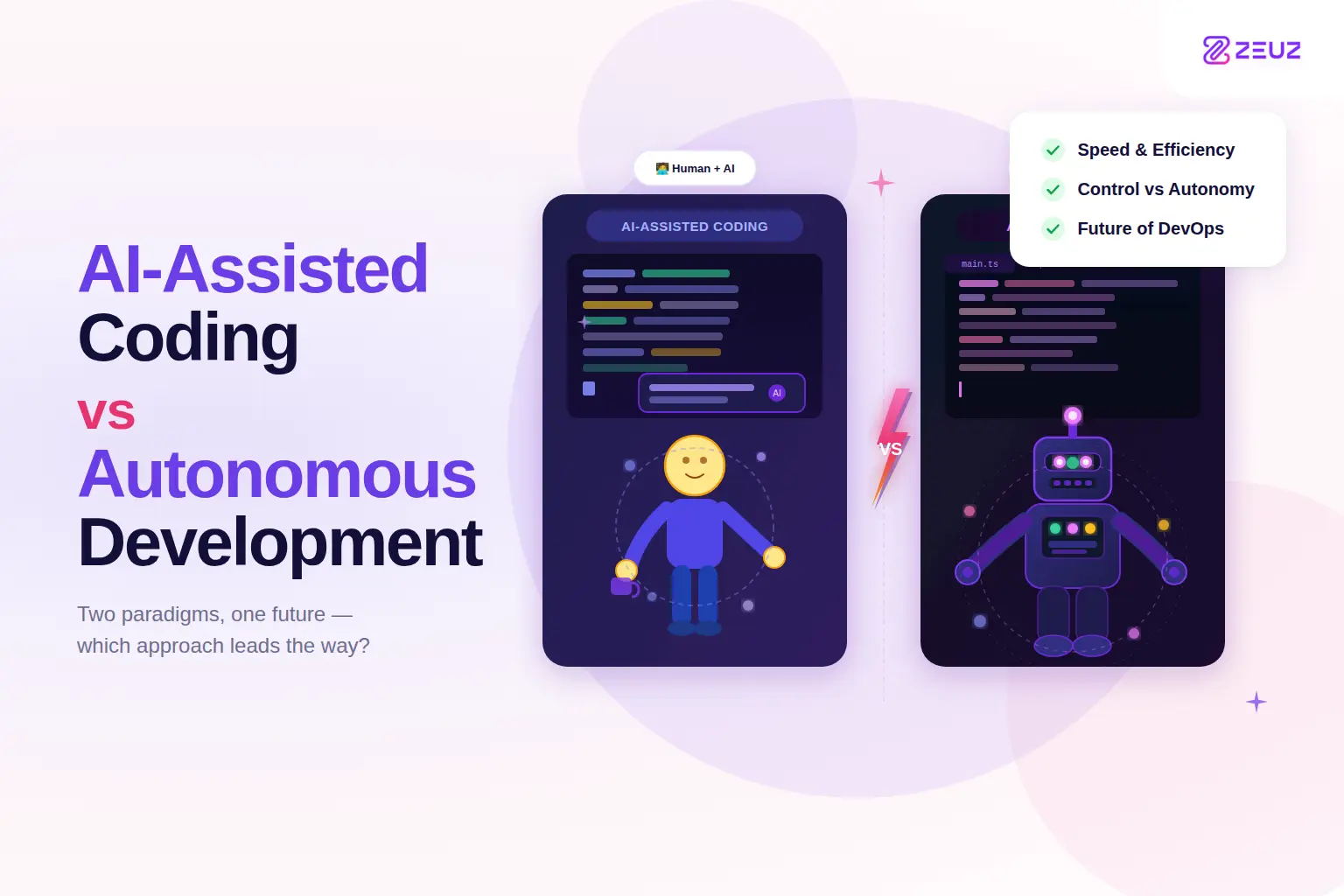
AI-Assisted Coding vs Autonomous Development: What’s the Real Difference?
The Simple Difference (Before We Go Deep)
Where AI-Assisted Coding Falls Short
Key Capabilities of Autonomous Development
Is Fully Autonomous Development Possible Today?
FAQs
Key Takeaways
AI-assisted coding speeds up development but keeps humans in control
Autonomous development adds system awareness and decision-making power
AI tools today mostly assist, not fully automate software creation
Autonomous systems improve SDLC with smarter planning and testing
System intelligence is the core difference between both approaches
Future development relies on collaboration between AI and humans
Share with your community!
AI-Assisted Coding vs. Autonomous Development
AI is already changing how developers write code.
From auto-complete suggestions to full code generation, tools are getting smarter every day. But as AI evolves, a bigger question is starting to come up:
Autonomous software development means AI is not just assisting, it is actively participating in the development process.
This includes:
Understanding requirements
Generating code
Creating test cases
Evaluating risks
Supporting release decisions
→ It’s not full automation. → It’s intelligent coordination.
How Autonomous Development Works
Autonomous systems rely on:
AI software development platforms
System intelligence layers
Continuous data from across the SDLC
This allows AI to:
Understand the system
Predict outcomes
Recommend actions
Key Capabilities of Autonomous Development
1. Context-Aware Code Generation
Unlike basic tools, AI understands:
System dependencies
Existing architecture
Business requirements
So the generated code fits the system, not just the function.
2. Integrated Testing
Autonomous systems combine development with:
→ autonomous software testing
They can:
Generate test cases
Identify high-risk areas
Validate code automatically
3. Intelligent Planning
Using AI sprint planning, the system can:
Break down tasks
Prioritize work
Optimize resource allocation
4. Risk-Aware Decisions
AI evaluates:
Change impact
Failure probability
System stability
This is where AI-driven software development becomes powerful.
AI-Assisted vs Autonomous: Side-by-Side
AI-Assisted Coding
Autonomous Development
Focuses on code
Focuses on the entire system
Suggests solutions
Recommends and coordinates actions
No system awareness
Deep system understanding
Developer-driven
AI + human collaboration
Improves speed
Improves speed + decisions
Why This Shift Matters
Software complexity is growing.
Faster than teams can manage manually.
AI-assisted coding helps, but only at the surface level.
Autonomous development addresses:
Coordination problems
System complexity
Risk management
The Role of System Intelligence
The key difference comes down to one thing:
→ System intelligence
AI-assisted tools:
Work locally (code level)
Autonomous systems:
Work globally (system level)
Using engineering intelligence tools, AI can:
Map dependencies
Understand architecture
Predict system behavior
Impact on the SDLC
Autonomous development transforms the entire SDLC.
Development
Smarter, context-aware coding
Testing
Intelligent, risk-based testing
Deployment
Safer releases using AI DevOps platforms
Maintenance
Continuous learning and optimization
Where AI Product Development Fits In
This shift also impacts AI product development.
Instead of disconnected workflows:
Product → Dev → QA
AI connects everything.
Using:
business intelligence tools
User data
System insights
This leads to AI-driven product development that is aligned with real user needs.
Is Fully Autonomous Development Possible Today?
Let’s be realistic.
→ Fully autonomous development is not here yet.
But partial autonomy is already happening:
AI generates code
AI creates tests
AI suggests improvements
AI supports decisions
The trend is clear.
Human + AI: The Real Model
The future is not:
❌ AI replacing developers
It is:
✅ AI + developers working together
Humans define goals
AI handles complexity
This balance is what makes autonomous systems practical.
Challenges to Consider
1. Trust in AI
Teams must trust AI-generated code and decisions.
2. Data Quality
AI needs accurate system data.
3. Control vs Automation
Teams must balance autonomy with oversight.
The Future Direction
We are moving toward:
Smarter AI systems
More autonomous workflows
Less manual coordination
AI-assisted coding was the first step.
Autonomous development is the next.
Final Thoughts
AI-assisted coding improves how developers write code.
Autonomous development changes how software gets built.
That’s the difference.
One Clear Takeaway
AI-assisted coding helps developers. Autonomous development helps the entire system.
FAQs
1. What is the difference between AI-assisted coding and autonomous development?
AI-assisted coding helps developers write code faster by suggesting snippets and improvements, while autonomous development enables AI to participate in the entire software development lifecycle, including planning, testing, and decision-making.
2. Is autonomous software development fully automated?
No, autonomous software development is not fully automated yet. It supports developers by handling complex tasks and providing insights, but human oversight and decision-making are still essential.
3. What are the benefits of AI-assisted coding?
AI-assisted coding improves developer productivity, reduces repetitive tasks, speeds up coding, and helps identify errors early. However, it does not manage system-level decisions or workflows.
4. How does autonomous development improve the SDLC?
Autonomous development enhances the software development lifecycle by enabling smarter planning, automated testing, risk analysis, and better coordination across development, deployment, and maintenance.
5. Will AI replace software developers in the future?
AI is unlikely to replace developers. Instead, it will augment their capabilities by handling complex processes and allowing developers to focus on strategy, creativity, and problem-solving.