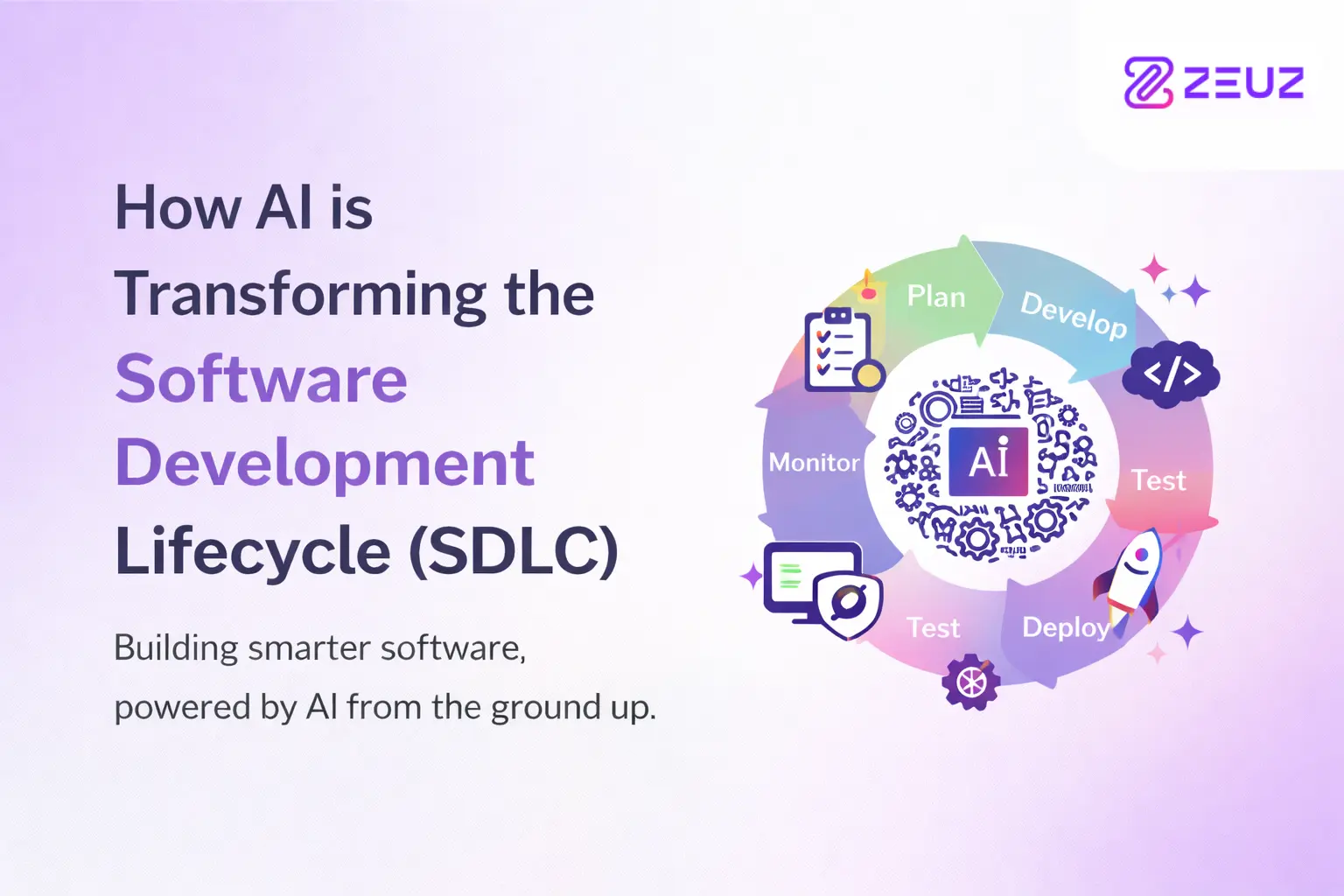
SDLC evolves into an adaptive, intelligent, and connected system
Share with your community!
How AI is Transforming the Software Development Lifecycle (SDLC)
Software development used to be predictable. Not easy, but predictable.
You had a flow: Requirements → Development → Testing → Release
Each stage had its own process, its own tools, and its own team.
That model worked, until software became too complex.
Today, applications are built across multiple services, APIs, cloud environments, and user interactions. The old way of managing the software development lifecycle (SDLC) is starting to crack under that complexity.
And this is exactly where AI in software development is stepping in, not just to improve parts of the process, but to reshape the entire lifecycle.
Let’s break down how this transformation is actually happening.
What is the Traditional SDLC (and Where It Falls Short)?
Before we talk about AI, we need to be honest about the current system.
The traditional SDLC includes:
Requirement gathering
Planning
Development
Testing
Deployment
Maintenance
Each phase is important. But here’s the problem:
→ They operate in silos.
Common Issues in Traditional SDLC
Delayed feedback loops → Problems are found late
Manual coordination → Teams depend on meetings, not systems
Static planning → Plans don’t adapt to real-time changes
Reactive workflows → Bugs are fixed after they appear
Even with modern tools, many teams are still dealing with these challenges.
Enter AI: From Automation to Intelligence
Most people think AI just automates tasks.
That’s only half the story.
→ AI is now enabling intelligent SDLC systems
Instead of just speeding things up, AI is helping teams:
Predict outcomes
Optimize workflows
Connect fragmented processes
This is the foundation of AI-driven software development.
How AI Transforms Each Stage of the SDLC
Let’s go step by step.
1. Requirements: From Assumptions to Intelligence
Traditionally, requirements are based on stakeholder input and assumptions.
One of the biggest gaps in traditional SDLC is between product and engineering.
AI bridges that gap through:
AI product development insights
AI-driven product design recommendations
Data from sales intelligence tools and user behavior
This ensures that what gets built actually aligns with business goals.
AI + System Intelligence = Better Decisions
AI does not just process data. It understands relationships.
Using engineering intelligence tools, it can:
Map dependencies
Identify bottlenecks
Highlight risk areas
This allows teams to make decisions based on system-level insight, not assumptions.
Why This Matters for Modern Teams
The impact is real.
1. Faster Delivery
Less rework, better planning, smarter execution.
2. Higher Quality
AI predicts and prevents defects before release.
3. Better Collaboration
All teams work from the same data and insights.
4. Reduced Complexity
AI handles coordination, teams focus on value.
AI-Powered vs AI-Native SDLC (Quick Recap)
Let’s connect this with what you learned earlier.
AI-Powered SDLC
Improves individual stages
Still fragmented
AI-Native SDLC
Connects all stages
Driven by system intelligence
→ This is where the real transformation happens.
Challenges You Should Expect
No system is perfect.
1. Data Dependency
AI needs clean, consistent data.
2. Adoption Resistance
Teams may hesitate to trust AI insights.
3. Integration Complexity
Moving from fragmented tools to a unified platform takes effort.
But the long-term gains outweigh these challenges.
The Future of the Software Development Lifecycle
We are moving toward:
Autonomous workflows
Predictive systems
Real-time decision intelligence
The SDLC will no longer be managed manually.
It will be guided by intelligence.
Final Thoughts
AI is not just improving the SDLC.
→ It is redefining it.
From:
Static processes to
Adaptive systems
From:
Manual coordination to
intelligent automation
And from:
reactive development to
predictive delivery
One Clear Takeaway
AI transforms the SDLC from a linear process into an intelligent, connected, and continuously evolving system.
Frequently Asked Questions
1. How is AI transforming the software development lifecycle (SDLC)?
AI is transforming SDLC by turning it from a linear, manual process into a connected, intelligent system that predicts outcomes, automates workflows, and improves decision-making across all stages
2. What are the biggest problems in the traditional SDLC?
Traditional SDLC suffers from siloed workflows, delayed feedback, manual coordination, and reactive bug fixing, making it inefficient for modern complex systems.
3. How does AI improve software testing in the SDLC?
AI improves testing by identifying high-risk areas, generating relevant test cases, and enabling autonomous testing, reducing unnecessary test execution and improving quality.
4. What is an AI-driven SDLC?
An AI-driven SDLC is a software development process where AI continuously analyzes data, predicts risks, optimizes workflows, and connects all stages from requirements to maintenance.
5. How does AI help in software development planning and requirements?
AI analyzes user behavior and historical data to suggest requirements, prioritize tasks, estimate effort, and improve sprint planning accuracy.
6. What is the future of the software development lifecycle with AI?
The future of SDLC is autonomous, predictive, and continuously evolving, where AI drives real-time decisions, reduces manual work, and improves overall software delivery.