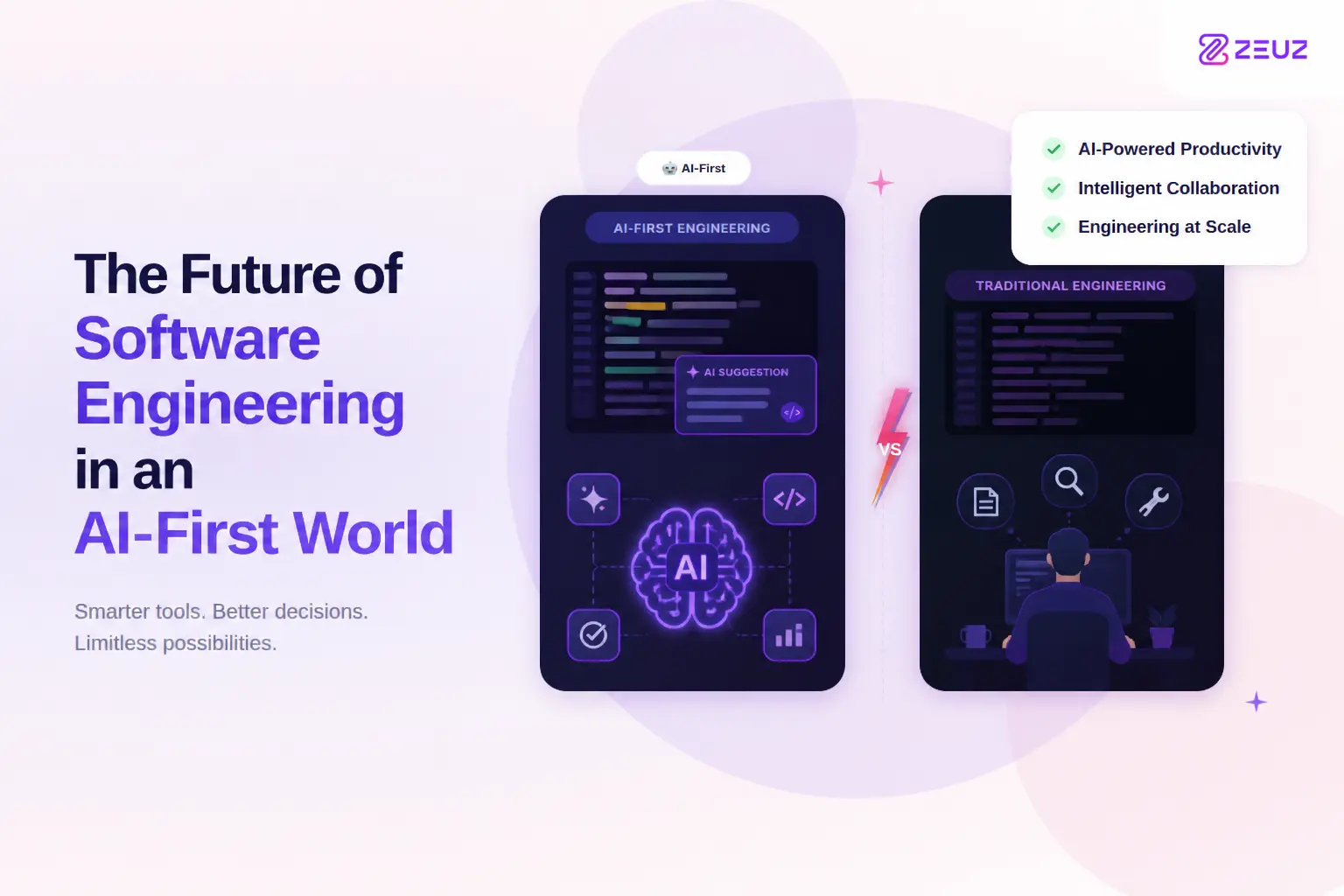
The Future of Software Engineering in an AI-First World
From Code-Centric to System-Centric Engineering
The Evolution of the Developer Role
The Rise of AI-Assisted and Autonomous Development
Generative AI Will Change Coding Forever
What Will Matter Most in the Future
Frequently Ask Question
Key Takeaways
AI is transforming software engineering, shifting focus from code to systems.
Developers' roles are evolving, with more emphasis on system design and problem-solving.
AI-assisted and autonomous development will coexist, improving productivity and decision-making.
The future of software engineering involves AI-driven, seamless workflows across the SDLC.
System intelligence is becoming essential for understanding complex systems and predicting risks.
Developers will collaborate with AI to design intelligent systems, not just write code.
The shift to AI-first development requires new skills, trust in AI, and high-quality data integration.
Share with your community!
The Future of Software Engineering in an AI-First World
Software engineering is at a turning point.
Not a small shift. Not just another tool upgrade.
A real transformation.
For years, developers focused on writing code, fixing bugs, and shipping features. Tools evolved, frameworks changed, but the core workflow stayed mostly the same.
Now AI is changing that foundation.
We’re moving into an AI-first world, where software is no longer just built, it’s guided, optimized, and continuously improved by intelligence.
And that raises a big question:
→ What does the future of software engineering actually look like?
Let’s break it down.
From Code-Centric to System-Centric Engineering
Traditionally, software engineering has been code-centric.
→ Automation helps you move faster → Intelligence helps you move in the right direction
Challenges in an AI-First World
Let’s not ignore the challenges.
1. Skill Shift
Developers need to learn:
System thinking
AI collaboration
Architecture design
2. Trust in AI
Teams must trust:
AI-generated code
AI-driven decisions
3. Data Dependency
AI systems rely on:
High-quality data
Integrated systems
But these are growing pains, not blockers.
What Will Matter Most in the Future
If you’re thinking long-term, focus on this:
1. System Thinking
Understanding how everything connects.
2. Problem Solving
Not just writing code, but solving real problems.
3. Collaboration with AI
Working with intelligent systems, not against them.
The Bigger Picture
This is not just a technical shift.
It’s a mindset shift.
From:
Writing code
To:
Designing intelligent systems
From:
Managing tools
To:
Leveraging intelligence
Final Thoughts
The future of software engineering is not about replacing developers.
It’s about evolving them.
AI will:
Handle complexity
Reduce repetitive work
Improve decision-making
But humans will still:
Define goals
Design systems
Drive innovation
One Clear Takeaway
In an AI-first world, software engineers don’t just write code, they guide intelligent systems to build better software.
Frequently Ask Question
1. How is AI changing the future of software engineering?
AI is shifting software engineering from code-centric to system-centric, enabling smarter, AI-driven workflows, better decision-making, and continuous system optimization.
2. What is the difference between AI-assisted coding and autonomous development?
AI-assisted coding helps developers by suggesting improvements and automating repetitive tasks, while autonomous development handles entire processes like testing, dependencies, and workflow optimization.
3. How does AI-driven software development improve the software lifecycle?
AI-driven development streamlines workflows, predicts risks, supports decision-making, and optimizes testing, creating a more efficient and intelligent software development lifecycle (SDLC).
4. What role does system intelligence play in AI-first development?
System intelligence helps developers understand complex systems by mapping dependencies, analyzing architecture, and predicting risks, ultimately improving decision-making in software development.
5. Will AI replace software developers in the future?
AI will not replace developers but will evolve their role, shifting from writing code to designing systems, guiding intelligent systems, and focusing on high-level problem-solving.
6. What are the main challenges in adopting AI in software engineering?
Challenges include a shift in required skills, trust in AI-generated code and decisions, and reliance on high-quality, integrated data. However, these are considered growing pains in the AI transition.