What Is an Autonomous Agent in AI? A Complete Guide (2026)
What Is an Autonomous Agent in AI? It is a software system that perceives its environment, makes decisions, and takes actions independently to achieve a defined goal without human direction at each step.
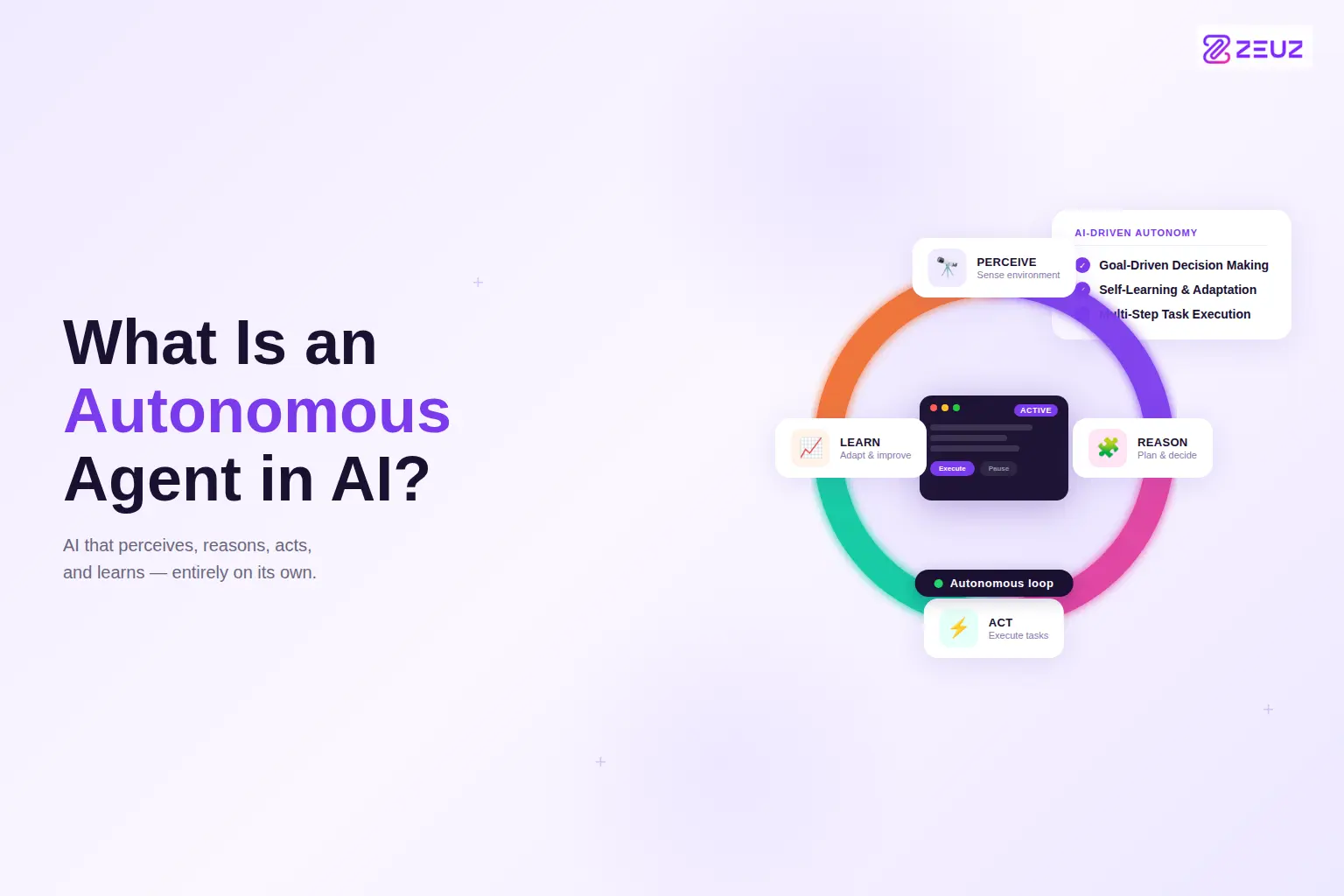
How Does an Autonomous Agent Actually Work? It follows a continuous Perceive → Reason → Plan → Act → Learn loop, running autonomously until the goal is fully achieved.
What Are the Key Components That Make an AI Agent Autonomous? Five components working together: a reasoning engine, memory, tool access, a planning layer, and governance controls.
Where Are Autonomous Agents Being Used Right Now in 2026? Software testing and DevOps lead enterprise adoption, followed by customer service, finance, and healthcare with India emerging as a top growth market.
Why Is India One of the Most Important Markets for Autonomous Agents in 2026? India is now the world's second-largest AI consumer market, with 80%+ of enterprises exploring autonomous agents and $1.3B+ in government-backed AI investment.
How Do You Spot Genuine Autonomy vs. "Agent Washing"? Ask these five specific questions; a "no" to any one of them means the product is not truly autonomous.
What Does the Market Trajectory Mean for Indian Teams in 2026 and Beyond? The window for early-mover advantage is still open, but it is closing; mainstream adoption arrives by 2027.
Key Takeaways
What Is an Autonomous Agent in AI? It is a software system that perceives its environment, makes decisions, and takes actions independently to achieve a defined goal without human direction at each step.
How Does an Autonomous Agent Actually Work? It follows a continuous Perceive → Reason → Plan → Act → Learn loop, running autonomously until the goal is fully achieved.
What Makes an Autonomous Agent Different from Regular Automation? Agents reason and adapt; traditional automation follows fixed scripts and simply fails when anything unexpected happens.
What Are the Key Components That Make an AI Agent Autonomous? Five components working together: a reasoning engine, memory, tool access, a planning layer, and governance controls.
What Are the Different Types of Autonomous Agents in AI? There are five main types: reactive, deliberative, learning, multi-agent, and hybrid, each suited to different levels of task complexity.
Where Are Autonomous Agents Being Used Right Now in 2026? Software testing and DevOps lead enterprise adoption, followed by customer service, finance, and healthcare with India emerging as a top growth market.
Why Is India One of the Most Important Markets for Autonomous Agents in 2026? India is now the world's second-largest AI consumer market, with 80%+ of enterprises exploring autonomous agents and $1.3B+ in government-backed AI investment.
What Are the Real Benefits of Autonomous Agents in Software Engineering? Faster delivery, dramatically fewer defects, lower maintenance cost, and quality that scales without proportional headcount growth.
What Are the Real Risks You Need to Know About? Governance failures are the #1 cause of project cancellations; agent overconfidence, security vulnerabilities, and legacy integration are the other key risks.
How Do You Spot Genuine Autonomy vs. "Agent Washing"? Ask these five specific questions; a "no" to any one of them means the product is not truly autonomous.
Share with your community!
What Is an Autonomous Agent in AI? A Complete Guide (2026)
Imagine assigning a task to a team member and genuinely never needing to follow up. They understand the goal, break it into steps, pick the right tools, deal with obstacles along the way, and hand you a finished result all on their own. No hand-holding. No status updates required. Just outcomes.
That is the exact promise of an autonomous agent in AI. And in 2026, that promise is no longer a research concept, it is a production reality reshaping how software teams build, test, and ship products across India and the world.
The numbers are hard to ignore. The global AI agents market has hit USD 10.91 billion in 2026, up from USD 7.63 billion in 2025, nearly a 43% jump in a single year, the steepest growth curve in enterprise software since the arrival of cloud computing, according to Grand View Research. And India is right at the centre of this story: over 80% of Indian organisations are actively exploring the development of autonomous agents, according to Deloitte's State of GenAI report (India perspective).
Whether you are a QA engineer, a DevOps lead, an engineering manager, or a CTO at an Indian software company, understanding what an autonomous agent in AI actually is and what it can do inside your engineering workflows has become a professional necessity in 2026.
This guide covers everything: the definition, the mechanics, the types, the real-world use cases, the risks, and what it all means specifically for Indian software teams.
What Is an Autonomous Agent in AI? It is a software system that perceives its environment, makes decisions, and takes actions independently to achieve a defined goal without human direction at each step.
An autonomous agent in AI is a software system that can observe its environment, reason about what it finds, plan a course of action, execute that plan using real tools, evaluate results, and adapt when things change all in pursuit of a defined goal, without a human needing to direct each individual step.
The word to focus on is autonomous. Traditional software, including most automation tools, does exactly what it is programmed to do no more, no less. When something unexpected happens, it stops. An autonomous agent, by contrast, reasons about what is happening and decides how to continue moving toward the goal. It does not just execute instructions; it pursues outcomes.
Google Cloud's definition captures this well: AI agents are "software systems that use AI to pursue goals and complete tasks on behalf of users. They show reasoning, planning, and memory and have a level of autonomy to make decisions, learn, and adapt."
Here is a concrete example from software testing. A traditional test automation script runs a fixed set of tests in a fixed order. When a UI element changes, the script breaks, an alert fires, and a QA engineer manually updates the script before the next run can happen. That cycle repeats every sprint, consuming hours of engineering time that adds zero business value.
An autonomous testing agent the kind ZeuZ AI delivers handles the same situation differently. It detects the UI change, understands the original purpose of the affected test, updates the script to match the current application state, re-executes, and continues toward the goal of validating release quality. No humans are paged. No sprint is delayed. The self-healing test automation runs in the background and keeps coverage current automatically.
That is the practical gap between traditional automation and genuine autonomous agency.
How Does an Autonomous Agent Actually Work? It follows a continuous Perceive → Reason → Plan → Act → Learn loop, running autonomously until the goal is fully achieved.
Every autonomous agent, regardless of what it is applied to, operates through the same fundamental feedback loop. Understanding this loop is the key to understanding why agents behave so differently from conventional tools.
Step 1: Perceive The agent observes its environment
The agent collects input from its environment. In a software engineering context, this means reading code repositories, scanning test logs, monitoring CI/CD dashboards, parsing API responses, reading Jira tickets, or observing application behaviour. This is the equivalent of a developer opening their laptop in the morning and surveying the current state of the project before deciding what to work on.
Step 2: Reason The agent thinks about what it has observed
Using its underlying large language model GPT-4o, Claude, Gemini, or similar, the agent analyses the information it has perceived. It draws inferences, identifies patterns, recognises problems, and builds an internal understanding of the current situation. The quality of this reasoning step is what separates a capable agent from a brittle one.
Step 3: Plan The agent decides what to do next
Rather than following a predetermined script, the agent generates a plan. It decomposes the high-level goal into a sequence of subtasks, sequences them logically, identifies which tools it will need at each step, and anticipates likely obstacles. This planning capability is what most clearly separates an autonomous agent from any form of rule-based automation.
Step 4: Act The agent executes using real tools in your real environment
The agent interacts with external systems. It can call APIs, execute test cases, write to databases, create Jira tickets, trigger CI/CD pipelines, push Slack notifications, update code files, or navigate a web interface. These are real actions with real effects not text outputs waiting for a human to copy and apply them manually.
Step 5: Learn The agent evaluates outcomes and refines future behaviour
After acting, the agent evaluates whether the outcome matched its expectation. If it did, it moves to the next step. If it does not, it revises its approach and tries again. Over time, with persistent memory across sessions, the agent builds knowledge of your specific environment, your application's typical failure patterns, your team's quality standards, the code areas most likely to introduce regressions.
This loop runs continuously and autonomously. The agent keeps working until the goal is achieved, not until a timer runs out, a human checks in, or an unexpected input causes a failure.
What Makes an Autonomous Agent Different from Regular Automation? Agents reason and adapt; traditional automation follows fixed scripts and simply fails when anything unexpected happens.
This distinction matters enormously when evaluating tools, because many vendors in 2026 are using "autonomous" as a marketing label for products that are fundamentally still rule-based automation. Gartner has formally named this as "agent washing" and it is rampant across the testing and DevOps tooling market.
Here is the honest comparison:
Dimension
Traditional Automation (Scripts / RPA)
Autonomous AI Agent
How it starts
Triggered by schedule or predefined rule
Triggered by goal, event, or detected condition
Decision-making
None executes fixed logic only
Reasons about context and decides next action
Handles unexpected situations
Fails or escalates to human
Adapts, adjusts plan, and continues
Tool use
Limited to pre-configured integrations
Dynamically uses any available tool
Memory between runs
None stateless
Persistent learns from past actions
Improves over time
Never same behaviour every run
Yes, refines approach based on observed outcomes
Goal orientation
Task-level (do this specific action)
Outcome-level (achieve this result)
When app or environment changes
Breaks requires manual update
Detects change and self-adjusts
Human involvement required
At every step or it breaks
Only to set goals and review outcomes
The practical difference plays out clearly in software testing. Traditional automation builds a large suite of test scripts over months, only for 20–30% of them to break with every major release because UI elements or API schemas changed. A QA engineer spends the first few days of every sprint manually fixing the broken scripts before actual testing can resume.
An autonomous testing platform eliminates this cycle entirely. The self-healing test automation feature in ZeuZ AI means that when your application changes, the agent identifies affected scripts, reasons about the intent behind each test, updates the script automatically, and keeps the suite running without any human involvement.
That is not a better version of automation. It is a structurally different category.
What Are the Key Components That Make an AI Agent Autonomous? Five components working together: a reasoning engine, memory, tool access, a planning layer, and governance controls.
When a vendor claims their product is an "autonomous agent," these five components are what you should be looking for. If any of them are missing or superficial, the product is not genuinely autonomous.
1. The Reasoning Engine (LLM Core)
The large language model at the heart of the agent handles everything cognitively: understanding context, interpreting goals, generating plans, analysing outputs, and making decisions. A strong reasoning engine can handle ambiguous situations, unexpected inputs, and complex multi-step logic. A weak one produces plausible-sounding but unreliable outputs, especially in novel situations.
2. Memory Short-term, Long-term, and Episodic
Memory is the difference between a stateless tool and a stateful agent. Autonomous agents maintain:
Short-term memory: The active working context of the current task what has been done, what was found, what remains
Long-term memory: Stored knowledge about your application, your codebase, historical quality patterns, and past decisions persistent across sessions
Episodic memory: A log of specific past actions and their outcomes, enabling the agent to reason about what approaches have worked before
In a QA context, this memory layer is what allows an agent to become increasingly accurate at predicting which code areas are highest-risk for regressions, and to calibrate its testing strategy based on real historical data from your specific application.
3. Tool Access The Agent's Ability to Act in the World
Without tool access, even the most sophisticated reasoning engine can only generate text. Tool access is what gives the agent the ability to actually do things: run a test suite, read log files, call a REST API, file a bug report, send a Slack message, trigger a deployment, or update a Jira ticket. The richer and more deeply integrated the tool layer, the more of your workflow the agent can genuinely own.
ZeuZ AI's AI testing features are built around deep integration with the tools Indian engineering teams already use Jira, GitHub, GitLab, Azure DevOps, Jenkins, and Slack so the agent can take real actions inside your existing workflow rather than operating in isolation.
4. The Planning and Orchestration Layer
When given a goal, the agent does not randomly execute actions. The planning layer decomposes the goal into a logical sequence of subtasks, determines which tools are needed at each step, monitors progress, handles failures gracefully, and dynamically adjusts the plan as new information arrives. This is the "project management" brain of the agent the component that turns a high-level objective into a coordinated sequence of actions.
5. Governance and Human-in-the-Loop Controls
A well-designed autonomous agent is not a black box operating without accountability. Governance controls define what the agent can do independently versus what it must escalate, ensure all decisions are logged in an auditable trail, and provide clear mechanisms for human review at critical decision points. In 2026, 94% of respondents in India said being able to explain how AI reached a decision is important to their business, according to IBM. This makes transparency and auditability non-negotiable features not optional add-ons.
What Are the Different Types of Autonomous Agents in AI? There are five main types: reactive, deliberative, learning, multi-agent, and hybrid, each suited to different levels of task complexity.
Not all autonomous agents are architecturally the same. They vary in sophistication, capability, and the types of problems they handle best.
1. Reactive Agents Fast, simple, immediate-response systems
Reactive agents respond directly to stimuli without planning or memory. They perceive an event and trigger a predefined response. A basic monitoring alert system or a simple FAQ chatbot are examples. They are fast and predictable but break down entirely when faced with anything outside their programmed responses.
2. Deliberative Agents Thoughtful, goal-oriented, planning-capable systems
Deliberative agents maintain an internal model of their environment and construct plans before acting. They reason about consequences, evaluate alternative approaches, and sequence actions toward a goal. Most enterprise-grade autonomous agents deployed in 2026 are deliberative; they need to handle the complexity and variability of real business workflows.
3. Learning Agents Systems that improve their performance through experience
Learning agents adapt their behaviour based on feedback from past actions. They get better over time, building knowledge from accumulated experience. An agentic testing system that learns to prioritise tests covering historically defect-prone code areas is a learning agent in practice. Each release cycle, its test prioritisation becomes more accurate.
4. Multi-Agent Systems Specialised agents collaborating on complex shared goals
In a multi-agent system (MAS), multiple specialised agents work together toward a shared objective, each owning one domain of expertise. One agent analyses requirements, another reviews code, another manages testing, another coordinates deployment. According to MarketsandMarkets, the Multi-Agent Systems segment is currently the fastest-growing category in the entire AI agents market, driven by enterprise demand for collaborative, distributed autonomous problem-solving.
Gartner reports that 50% of organisations have identified multi-agent workflows as a key focus area for 2026, reflecting the mainstream recognition that complex engineering workflows require coordinated agent teams, not single-agent solutions.
5. Hybrid Agents Combining reactive speed with deliberative depth
Hybrid agents blend reactive and deliberative capabilities. They respond quickly to time-critical events while also maintaining longer-term planning, memory, and goal orientation. Most production autonomous agents in software engineering are hybrid by design; they must react immediately to a test failure or a deployment anomaly while also maintaining a broader quality strategy across the sprint.
Where Are Autonomous Agents Being Used Right Now in 2026? Software testing and DevOps lead enterprise adoption, followed by customer service, finance, and healthcare with India emerging as a top growth market.
Autonomous agents have moved well beyond pilot programmes. As of 2026, 51% of enterprises have AI agents in production, with another 23% actively scaling their deployments, according to ringly.io's 2026 AI agent statistics report. Here is where they are making the biggest impact:
Software Testing and QA The Highest-ROI Enterprise Use Case
This is where autonomous agents are delivering the clearest and most measurable returns in technology organisations right now. The combination of high repetition, pattern-driven decision-making, and well-structured data makes software testing the ideal environment for autonomous agents to operate.
Agentic testing platforms can:
Detect code changes and intelligently select the most relevant test coverage
The productivity impact is significant. Enterprises integrating AI agents into CI/CD pipelines report developer productivity gains of 35–55% for routine tasks and up to 72% reduction in mean-time-to-resolve for software bugs, according to marketintelo.com's autonomous AI coding agent market research.
This is the core of what ZeuZ AI delivers: an agentic AI approach to software testing that takes full autonomous ownership of the QA lifecycle.
CI/CD Pipeline and DevOps Intelligence
Autonomous agents embedded in delivery pipelines analyse incoming code changes to determine optimal test coverage, predict which builds are likely to fail before they run, handle transient infrastructure failures without escalating to a human, and monitor deployment rollouts with dynamic rollback capability. 70% of enterprises are expected to deploy agentic AI as part of IT infrastructure operations by 2029, with many teams already beginning this transition in 2026, according to ringly.io's 2026 statistics.
Customer Support and Service Management
Autonomous customer service agents are resolving complex multi-step support interactions, querying databases, processing transactions, and escalating to humans when appropriate. Gartner projects that agentic AI will autonomously resolve 80% of common customer service issues without human intervention by 2029.
Financial Services BFSI Leads Enterprise Deployment in India
Fraud detection, compliance monitoring, portfolio management, and claims processing are all being transformed by autonomous agents in India's BFSI sector. This is the sector with the highest AI adoption maturity in India right now, according to IBM's enterprise AI research.
Healthcare
Clinical decision support, patient journey management, diagnostics assistance, and drug discovery are high-potential but carefully governed applications. AI applications in healthcare are projected to generate up to USD 150 billion in annual savings globally by 2026, according to Accenture research cited in onereach.ai's 2026 agentic AI statistics.
Why Is India One of the Most Important Markets for Autonomous Agents in 2026? India is now the world's second-largest AI consumer market, with 80%+ of enterprises exploring autonomous agents and $1.3B+ in government-backed AI investment.
India's position in the autonomous AI landscape in 2026 is not just significant, it is extraordinary. The Zinnov, Z47, and OpenAI joint report The India AI Adoption Edge 2026 describes India as now the second-largest AI consumer market on the planet, with weekly active ChatGPT users second only to the United States and India ranked #1 globally in AI skill penetration.
The enterprise adoption data from India is particularly striking:
Over 80% of Indian organisations are actively exploring the development of autonomous agents (Deloitte State of GenAI, India perspective)
87% of Indian companies are in the Enthusiast or Expert stages of AI adoption, according to IndiaAI reporting
59% of enterprise-scale organisations in India have AI actively in use, with 27% more actively exploring it (IBM)
74% of Indian early AI adopters had accelerated their AI investment in the prior 24 months (IBM)
India's AI market is expected to grow at 25–35% annually over the next 3–4 years (IndiaAI)
India AI funding in 2025 hit a 2× year-on-year increase, with vertical AI growing 2.5× and now accounting for 37% of the total funding mix (Zinnov/OpenAI/Z47 report)
The government commitment backing this growth is equally significant. The Indian government approved a USD 1.25 billion investment in AI projects in March 2024, targeting computing infrastructure, large language models, AI startups, and public-sector AI applications (Global Market Insights). India's Ministry of Electronics and Information Technology (MeitY) projected that the country's AI spending would reach USD 880 million by end of 2025, accelerating further into 2026.
For software development specifically, India's 5.4 million-strong IT developer workforce spread across Infosys, TCS, Wipro, and thousands of product and service companies in Bangalore, Hyderabad, Pune, and beyond represents one of the largest and most concentrated opportunities for productivity enhancement through autonomous agents anywhere in the world (marketintelo.com).
The Asia Pacific agentic AI market where India is a primary growth driver is expected to reach USD 2.4 billion in 2026, up from USD 1.86 billion in 2025, according to Fortune Business Insights. India specifically is projected to reach USD 0.59 billion in agentic AI market value in 2026.
For QA engineers and engineering leaders at Indian software companies, this context matters directly. The organisations building autonomous testing and DevOps capabilities now are establishing the institutional knowledge and operational experience that will define competitive advantage in the next phase of India's technology growth story. Platforms like ZeuZ AI are designed for exactly this environment enabling autonomous test lifecycle management at the speed and scale Indian engineering teams require.
What Are the Real Benefits of Autonomous Agents in Software Engineering? Faster delivery, dramatically fewer defects, lower maintenance cost, and quality that scales without proportional headcount growth.
The ROI case for autonomous agents is well-established in 2026. Here is what the data actually shows:
1. Faster Delivery Velocity 20–30% improvement
Enterprises embedding AI agents into software development workflows report 20–30% faster overall delivery velocity, according to McKinsey research. The speed gain comes primarily from eliminating manual coordination overhead: test analysis that used to take a full day happens in under an hour; defect triage that occupied a morning now runs automatically in the background.
2. Substantially Fewer Defects 40% reduction
McKinsey reports 40% fewer defects reaching production in AI-integrated development environments. Autonomous agents catch issues earlier in the development cycle where fixing them costs a fraction of production-stage remediation.
3. Faster Bug Resolution Up to 72% reduction in MTTR
Enterprises integrating AI agents into CI/CD pipelines report up to a 72% reduction in mean-time-to-resolve for software bugs (marketintelo.com). Intelligent root cause analysis and automated defect reporting features of ZeuZ AI's Fail Analysis capability compress the time from "test failed" to "developer has full context to fix it" from hours to minutes.
4. Significant Cost Savings
AI agents have demonstrated the ability to reduce manual work and operational costs by at least 30% while simultaneously increasing speed and productivity (citrusbug.com AI agents statistics). Forrester research on AI agent deployments documents payback periods under six months and 210% ROI over three years for well-implemented projects.
5. Average ROI of 3.5x Leaders Achieving 8x
Enterprises are seeing an average return of USD 3.50 per USD 1 spent on AI agents, with leading organisations hitting 8x, according to ringly.io's 2026 AI agent statistics. ROI compounds over time: 41% in year one, 87% in year two, 124%+ by year three.
6. Quality That Scales Without Proportional Headcount Growth
This is the most strategically valuable benefit for Indian IT organisations operating under talent constraints and rapid growth pressure. An autonomous testing platform scales with the application as the codebase grows, the agent's coverage expands automatically. Human QA engineers shift from execution tasks to quality strategy, enabling the organisation to maintain high quality standards without growing the QA team proportionally to application complexity.
What Are the Real Risks You Need to Know About? Governance failures are the #1 cause of project cancellations; agent overconfidence, security vulnerabilities, and legacy integration are the other key risks.
Honest adoption requires clear awareness of what can go wrong. In 2026, the failure modes are well-documented.
Governance Failures Kill More Projects Than Technical Problems
Gartner predicts that over 40% of agentic AI projects will be cancelled by the end of 2027, primarily due to inadequate risk controls, escalating costs, and unclear business value. The pattern is consistent: organisations deploy agents without defining authority boundaries, without audit trails for agent decisions, and without human-in-the-loop checkpoints for consequential actions. When something goes wrong and it will they have no mechanism to understand what the agent did or why, and no clean way to roll it back.
The fix is simple but requires discipline: design governance before deployment. Define what the agent can do autonomously, what it must escalate, how all decisions are logged, and how the system can be paused or rolled back. This is not bureaucracy, it is the engineering foundation that makes production deployment safe and trustworthy.
Agent Overconfidence Acting on Incorrect Reasoning
Large language models can produce confident, plausible-sounding outputs that are factually incorrect or contextually wrong. An autonomous agent acting on such an output does not just generate a bad text response it takes a real action based on a bad conclusion. This makes human review of agent outputs essential at high-stakes decision points, particularly around release gates, deployment approvals, and defect severity classifications.
Security: Prompt Injection Attacks
Agents with broad tool access, especially those reading from external data sources, processing user-submitted content, or parsing third-party API responses are vulnerable to prompt injection attacks, where malicious input is crafted to manipulate agent behaviour. For enterprise deployments in sensitive environments (BFSI, healthcare, government), specific input validation and access control mechanisms are essential, not optional.
Legacy System Integration Complexity
Integrating autonomous agents with monolithic codebases, legacy test environments, and fragmented toolchains is technically demanding. Indian enterprises running large-scale legacy systems alongside modern microservices architectures need to plan integration carefully. Organisations with modern, API-first infrastructure benefit more quickly; those with significant technical debt face a longer path.
Not Every Implementation Delivers Value
A 2025 study found that while 79% of organisations had implemented AI agents, only 66% reported tangible productivity gains. The gap reflects poor implementation: vague success metrics defined after deployment, insufficient integration with actual workflows, unrealistic ROI timelines, and over-reliance on vendor claims without independent validation. Define your baselines and success criteria before you start, not after.
How Do You Spot Genuine Autonomy vs. "Agent Washing"? Ask these five specific questions; a "no" to any one of them means the product is not truly autonomous.
With "autonomous" becoming the most overused word in enterprise software marketing in 2026, the ability to evaluate vendor claims critically is a core skill for engineering leaders. Here are the five questions that separate genuine autonomous agents from rebadged automation:
1. Does the system maintain memory between sessions? A system that starts fresh every time — no knowledge of past runs, past failures, or past decisions is stateless automation, not an autonomous agent.
2. Can it take real actions in external tools without a human manually applying its outputs? If the system generates recommendations or reports that a human must then act on, it is a generative AI tool. An autonomous agent takes the action itself.
3. Does it detect and handle unexpected situations rather than stopping and alerting? If novel inputs cause the system to fail or escalate to a human, it is rule-based. Genuine autonomy means adapting when things go off-script.
4. Can it sustain multi-step workflows toward a goal without human prompting at each step? If every action requires a human to review and approve before the next one starts, it is an assisted workflow tool not an autonomous agent.
5. Does its performance improve over time based on accumulated experience? If the system behaves identically on its 100th run as on its first, it lacks the learning capability that defines genuine autonomous agency.
ZeuZ AI's agentic QA platform answers yes to all five. The platform maintains persistent memory of your quality history, takes direct actions in your test runner and issue tracker, self-heals when tests break unexpectedly, manages the complete test lifecycle without step-by-step human prompting, and improves its failure analysis accuracy as it accumulates knowledge of your application.
How Does ZeuZ AI Apply Autonomous Agent Technology to Software Testing? ZeuZ agents own the full testing lifecycle: from intelligent test selection and self-healing execution through failure analysis and release readiness reporting.
Understanding autonomous agents in theory is useful. Seeing how they operate inside an actual software testing workflow makes the concept concrete.
ZeuZ AI is an AI-native software testing platform built around autonomous agent technology from the ground up not a legacy tool with an AI feature layer bolted on. Here is what a ZeuZ autonomous testing agent actually does when a new code commit arrives:
Goal defined: "Validate the quality of this release before deployment."
The ZeuZ agent takes ownership of that goal autonomously:
Detects the incoming code commit in the connected repository
Analyses the changed code paths to identify the highest-risk coverage areas
Selects relevant tests from the existing suite, prioritised by risk and impact
Executes the full test run across the appropriate environments
Monitors execution in real time, distinguishing genuine failures from infrastructure noise
For tests that broke due to UI or API changes not genuine defects the agent self-heals the scripts automatically using ZeuZ's self-healing test automation
For genuine defects, runs automated root cause analysis and classifies severity
Files defect reports directly in Jira with reproduction steps, affected code paths, and severity
What the QA engineer does: Reviews the release readiness report and makes the deployment decision.
What previously required a QA team 6–8 hours of active effort now runs autonomously in under 90 minutes. The zAI Mode on the Test Case Create Page lets engineers describe what they want to test in plain English and generates a complete, structured test case ready for execution. The Automatability Report gives your team a live picture of automation coverage, velocity, and quality health automatically, not built by hand. And the zAI Page Assistant provides real-time contextual guidance throughout the testing workflow.
For Indian software teams navigating rapid growth, compressed delivery timelines, and talent constraints, this is what scaling quality without scaling headcount actually looks like in practice.
What Does the Market Trajectory Mean for Indian Teams in 2026 and Beyond? The window for early-mover advantage is still open, but it is closing; mainstream adoption arrives by 2027.
The pace of market growth makes the strategic timeline clear:
The global AI agents market is at USD 10.91 billion in 2026, projected to reach USD 50.31 billion by 2030 at a 45.8% CAGR (Grand View Research)
40% of enterprise applications will feature task-specific AI agents by end of 2026, up from less than 5% in 2025 (Gartner)
50% of enterprises using generative AI are expected to have deployed autonomous agents by 2027 double the 2025 figure (Deloitte)
93% of IT leaders report intentions to introduce autonomous agents within the next 2 years, with nearly half already having implemented (MuleSoft and Deloitte Digital, 2025 Connectivity Benchmark)
More than 80% of organisations believe "AI agents are the new enterprise apps" triggering a reconsideration of investments in packaged applications (IDC FERS Survey)
For Indian engineering teams, this trajectory means the window for building genuine operational expertise with autonomous agents before it becomes table stakes is measured in months, not years. The organisations deploying autonomous testing platforms now are building institutional knowledge, governance frameworks, and quality baselines that will compound into structural advantages.
The organisations waiting for the technology to be more mainstream before engaging will arrive at a field where their competitors have 18–24 months of production experience ahead of them.
Summary: What Is an Autonomous Agent in AI?
An autonomous agent in AI is a software system that perceives its environment, reasons about a defined goal, plans and executes multi-step actions using real tools, evaluates outcomes, and adapts its behaviour all without requiring human direction at each individual step.
The five characteristics that define genuine autonomy:
Goal-directed behaviour: it pursues outcomes, not just tasks
Multi-step planning: it sequences actions intelligently toward a goal
Tool access: it takes real actions in real systems
Self-correction: it detects unexpected situations and adapts
Persistent memory: it learns from past actions across sessions
In software engineering, the most immediate and measurable application in 2026 is autonomous testing and QA: where platforms like ZeuZ AI enable teams to hand over the full testing lifecycle to an agent, and focus human expertise on quality strategy and outcome validation instead of manual execution.
For Indian software teams, the data is unambiguous: the market is moving fast, India is positioned at the centre of it, and the organisations building autonomous agent capabilities now are establishing advantages that will be difficult for later movers to close.
FAQ
Q: What is an autonomous agent in AI in simple words?
An autonomous AI agent is a software system that pursues a goal by itself. It decides what steps to take, uses available tools to take those steps, handles problems when they come up, and keeps working until the goal is achieved without needing a human to direct each individual action. It is the difference between a tool you use and a system that works for you.
Q: How is an autonomous agent different from a chatbot or AI assistant?
A chatbot or AI assistant responds when you ask it something. An autonomous agent acts when it detects something that needs doing. Assistants need a prompt each time and complete one task. Agents take a high-level goal, plan multi-step actions, call tools autonomously, and keep working until the objective is reached. This is the shift from "prompt-and-respond" to "delegate-and-supervise."
Q: What is the difference between an autonomous AI agent and RPA?
RPA follows fixed, predefined scripts. When something unexpected happens, it fails. An autonomous agent reasons about unexpected situations and adapts its approach. RPA automates a specific path; an autonomous agent pursues a goal via whatever path is currently most effective. In practical terms: RPA breaks when your application changes; an autonomous testing agent self-heals when your application changes.
Q: Is the autonomous AI agent market growing in India in 2026?
Significantly. Over 80% of Indian organisations are exploring autonomous agent development (Deloitte). India is now the world's second-largest AI consumer market (Zinnov/OpenAI/Z47). India's agentic AI market is projected at USD 0.59 billion in 2026. The Asia Pacific region as a whole has the highest CAGR of any region globally for autonomous AI through 2034. Indian government AI investment exceeded USD 1.25 billion, with MeitY projecting AI spending of USD 880 million by end-2025.
Q: What are the biggest risks of deploying autonomous AI agents?
The top risks are governance failures (the #1 cause of project cancellations according to Gartner), agent overconfidence (acting on incorrect reasoning), prompt injection security vulnerabilities, legacy system integration complexity, and poorly defined success metrics leading to unclear ROI. All are manageable with proper design, but none should be treated as afterthoughts.
Q: How do I evaluate whether a vendor's "autonomous agent" claim is genuine?
Ask five questions: Does it maintain memory between sessions? Can it take real actions in external tools without human copy-paste? Does it adapt when things go wrong rather than stopping? Can it sustain multi-step workflows without prompting at each step? Does its performance improve over time? A genuinely autonomous system answers yes to all five.
Q: How does ZeuZ AI use autonomous agents in software testing?
ZeuZ AI's autonomous testing platform detects code changes, selects and generates test coverage, executes tests across environments, self-heals broken scripts, performs intelligent failure analysis, files defect reports directly in Jira, and produces release readiness assessments, all autonomously. The QA engineer's role shifts from orchestrating the workflow to reviewing the outcome and making the release decision.