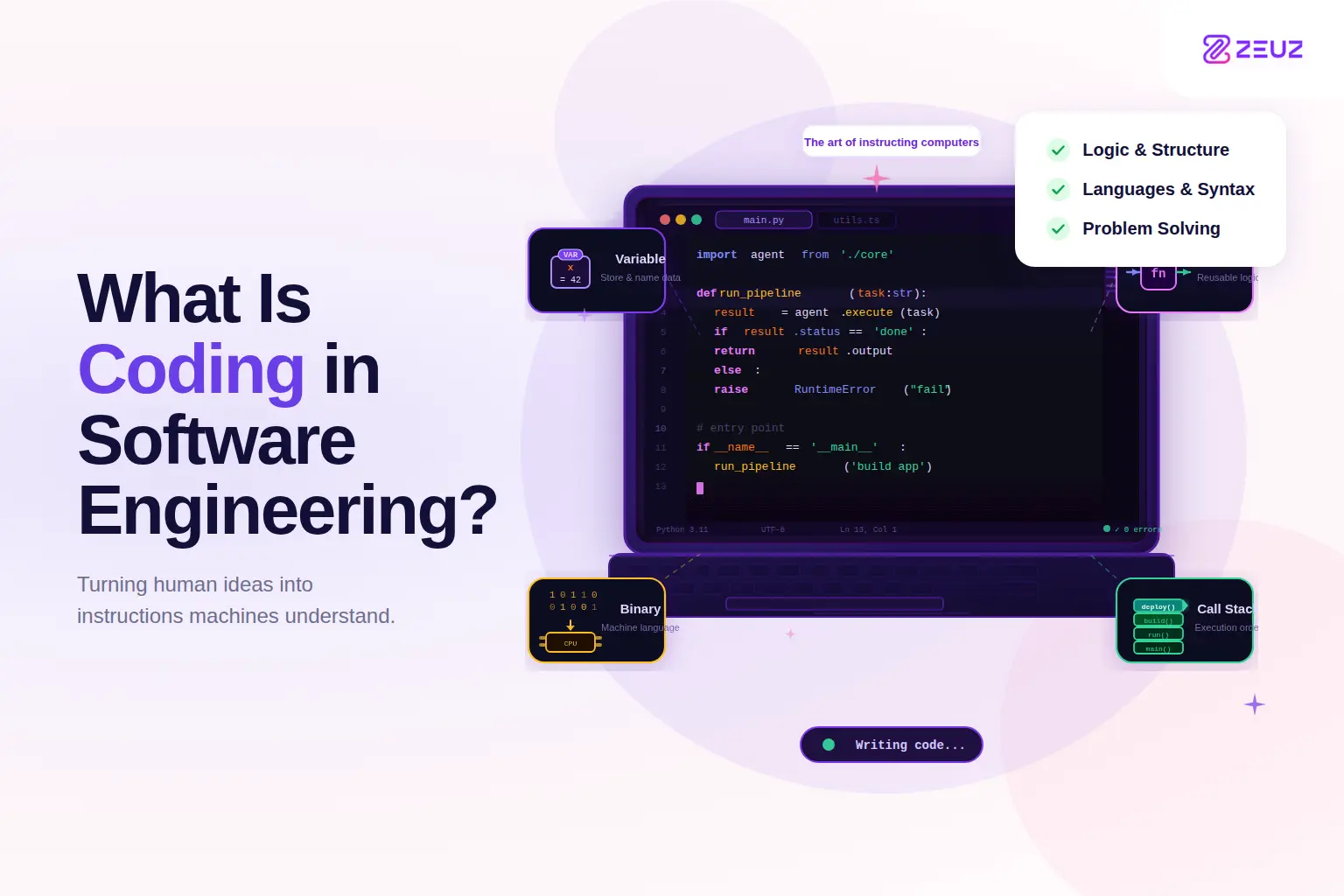
What Is Coding in Software Engineering? The Complete Guide for 2026
What Is Coding, Exactly? It's the Language Computers Understand
Coding vs Programming vs Software Engineering: These Are Not the Same Thing
The Software Development Lifecycle: Where Coding Actually Lives
The Most Important Programming Languages in 2026
What Makes Code "Good"? The Principles That Separate Professional Engineering from Amateur Hacking
The State of Coding in 2026: What the Data Actually Shows
How AI Is Changing What "Coding" Means for Software Engineers
How ZeuZ Fits Into the Modern Software Engineering Stack
Getting Started: What It Takes to Learn Coding for Software Engineering in 2026
Key Takeaways
What Is Coding, Exactly? It's the Language Computers Understand
Coding vs Programming vs Software Engineering: These Are Not the Same Thing
The Software Development Lifecycle: Where Coding Actually Lives
The Most Important Programming Languages in 2026
What Makes Code "Good"? The Principles That Separate Professional Engineering from Amateur Hacking
The State of Coding in 2026: What the Data Actually Shows
How AI Is Changing What "Coding" Means for Software Engineers
How ZeuZ Fits Into the Modern Software Engineering Stack
Getting Started: What It Takes to Learn Coding for Software Engineering in 2026
Coding Is the Foundation, But Software Engineering Is the Discipline
Share with your community!
What Is Coding in Software Engineering? The Complete Guide for 2026
Introduction: Every App You Touch Began With Someone Writing Code
Coding in software engineering is the act of writing precise instructions in a programming language that tells a computer exactly what to do and it is the foundational skill upon which every piece of software in the world is built, from the UPI app on your phone to the satellite navigation system guiding a spacecraft.
Think about your morning. You woke up to an alarm on a smartphone. You checked the news through an app. You ordered breakfast through a food delivery platform. You opened your email. Every single one of those interactions was made possible by millions of lines of code instructions written by software engineers, tested for correctness, refined for performance, and maintained over years of updates.
And yet, despite being this foundational, coding is frequently misunderstood even by people working in technology. It is often confused with software engineering as a whole, or reduced to "just typing commands into a computer." Neither is accurate. Coding is one critical stage in a much larger engineering process, and understanding exactly what it is, how it works, how it fits into the bigger picture, and how it is changing in 2026 is valuable for anyone building, managing, or investing in software.
In this guide, we break down everything you need to know: what coding actually is, how it differs from software engineering, what the coding process looks like in practice, which languages matter and why, what the data says about the industry's direction, and how the rise of AI-powered software development and autonomous software testing is changing the role of coding for engineers today.
Let's start at the beginning.
What Is Coding, Exactly? It's the Language Computers Understand
Coding is the process of writing instructions in a programming language using structured, formal syntax that a computer can interpret and execute to perform a specific task. It is the act of translating human intent into machine-readable logic.
Computers are extraordinarily capable machines, but they are fundamentally simple in one important way: they can only do exactly what they are told, expressed in a language they can process. Natural human language "please display a list of products sorted by price" is too ambiguous for a machine. Coding creates the precision layer. In Python, that same instruction might look like sorted(products, key=lambda x: x['price']). The machine executes it exactly, every time, without interpretation.
This is why coding is often described as a "universal language" not in the sense that all programming languages are the same (they are not), but in the sense that code is the one input format that translates intent into action across every computing device on Earth.
At its core, coding involves three fundamental components:
Syntax, the grammar rules of the programming language. Just as English has rules about where verbs and nouns go, Python, JavaScript, Java, and every other language have specific rules about how statements must be structured. A syntax error, a missing bracket, an incorrectly indented line stops the program from running entirely.
Logic, the reasoning structure that determines how the program behaves. Conditionals (if this, then that), loops (do this until a condition changes), and functions (named blocks of reusable logic) are the building blocks of program behaviour. Good logic produces software that handles both the expected path and the unexpected ones.
Data, the information the program processes. Variables store data temporarily. Databases store it persistently. APIs exchange it between systems. Almost every interesting thing a program does involves reading, transforming, or writing data in some form.
Together, these three components, syntax, logic, and data, are what a developer is working with every time they write code.
Coding vs Programming vs Software Engineering: These Are Not the Same Thing
Coding is writing the instructions; programming includes the problem-solving and logic design behind those instructions; software engineering encompasses the entire disciplined process of designing, building, testing, deploying, and maintaining software systems at scale.
This distinction matters practically because it defines what skills are needed at each level, and it helps explain why experienced developers who can "code" are not automatically experienced software engineers.
Coding is the tactical act. You write a function that validates an email address. You implement a sorting algorithm. You write the API call that fetches weather data. These are coding tasks, specific, bounded, implementable.
Programming adds the problem-solving layer. A programmer does not just write the function they think about what the function needs to do, what edge cases it needs to handle (what if the email contains Unicode characters? what if the input is null?), and how it should interact with the rest of the system. Programming is coding plus design thinking at the function level.
Software engineering is the discipline-level practice. A software engineer considers the function within the context of the entire system: How will this scale to 10 million users? How will it behave when the network fails? How will the next developer (or the developer's future self) understand it six months from now? How will it be tested, deployed, monitored, and updated? Software engineering applies systematic, repeatable processes to building software that is reliable, maintainable, and scalable.
According to the O'Reilly book Fundamentals of Software Engineering (2026 edition), "software engineering is about more than coding." It is the application of engineering principles, systematic design, rigorous testing, continuous maintenance to the creation of software that works reliably over time.
For India's 3.85 million software developers (the second-largest developer population globally, per JetBrains 2025), this distinction is increasingly important. The global market is not just looking for people who can write code, it is looking for engineers who can design systems, reason about trade-offs, and build software that survives contact with the real world.
The Software Development Lifecycle: Where Coding Actually Lives
Coding occupies the "implementation" stage of the software development lifecycle, typically the third of six stages meaning it represents only a portion of the total engineering work, even though it is the most visible.
Many people, including many junior engineers, assume that software development is mostly coding. The reality is quite different. The Software Development Lifecycle (SDLC) is a structured process that software engineering teams follow to build, test, and maintain software reliably. Coding the actual writing of code is just one stage within that process.
Here is how the SDLC stages map to real work:
Stage 1: Requirements and Planning: Understanding What Needs to Be Built
The first stage of the SDLC is understanding the problem before writing a single line of code defining what the software must do, for whom, under what constraints, and according to what quality standards.
This stage is the most frequently undervalued and the most frequently responsible for project failure when done poorly. According to the IBM Systems Sciences Institute, the cost of fixing a defect introduced during requirements is 100 times cheaper than fixing the same defect found in production using the famous "Rule of 100." Requirements errors that survive into production carry the highest possible cost of correction.
Requirements gathering involves stakeholder interviews, user story mapping, technical feasibility analysis, and capacity planning. The output is typically a requirements document, a set of user stories, and an agreed definition of what "done" looks like for the project. Only when this output is clear and agreed upon does it make sense to move to design.
Modern AI-powered platforms like ZeuZ are transforming this stage with AI Product Strategy Intelligence continuously monitoring market signals, competitive data, and user feedback to inform requirements generation, reducing the requirements-to-reality gap that causes so much downstream rework.
Stage 2: System Design: Architecting the Solution Before Building It
Design is the stage where requirements are translated into a technical blueprint defining the architecture, technology choices, data models, API contracts, and component structure that will guide the actual coding.
Good design decisions made here pay dividends for the entire lifetime of the software. Poor design decisions made here compound in complexity and cost with every new feature added. Architecture decisions monolith vs microservices, SQL vs NoSQL, synchronous vs event-driven are hard to reverse once coding has begun at scale.
This is the stage where software engineering most clearly distinguishes itself from coding. Writing code without prior design is the engineering equivalent of constructing a building without blueprints. It may produce something that stands initially, but it will be expensive to modify, fragile to stress, and impossible to explain to the next team who inherits it.
Stage 3: Coding (Implementation): Translating Design Into Working Software
Coding is the implementation stage where developers translate the system design into actual working software, using programming languages, frameworks, and development tools to build the components, modules, and features defined in the design phase.
This is the stage most people picture when they think about software development developers writing code, reviewing each other's work, committing to repositories, and running builds. And it is genuinely where a large portion of engineering effort goes. But the quality of code written here is directly determined by the quality of the requirements and design that preceded it. Code written against vague requirements or a poorly considered architecture will require constant rework, regardless of how technically skilled the developers are.
Key practices in the coding stage include:
Version control (Git) tracking every change to the codebase so that changes can be reviewed, reverted, and merged safely
Code reviews: having other engineers examine new code for correctness, security, readability, and compliance with team standards before it is merged
Pair programming: two engineers working together on the same code, catching errors in real time and sharing knowledge
Clean code principles: writing code that is readable, logically structured, and self-documenting, following conventions established by the team
Test-driven development (TDD): writing tests before writing the code they test, ensuring that every new component has defined correctness criteria from the start
In 2026, this stage is undergoing its most significant transformation in decades. Reports show that 41% of all code written in 2025 is AI-generated, and 85% of developers regularly use AI tools for coding, debugging, and code review. Developers are shifting from writing every line by hand to directing, reviewing, and optimising AI-generated code, a change that accelerates implementation speed but places new demands on code review discipline and quality assurance.
Stage 4, Testing: Verifying That the Code Does What It's Supposed to Do
Testing is the stage where the software is systematically verified against the requirements, checking that it works correctly, performs under load, handles edge cases, and behaves securely, before it reaches users.
Testing is not optional, and it is not a final checkbox before deployment. According to the Consortium for Information & Software Quality (CISQ), the cost of poor software quality in the United States alone has reached an estimated $2.41 trillion driven by bugs that survive into production, failed projects, legacy system failures, and cybersecurity incidents. The same research documents that a bug fixed during design costs 100 times less than the same bug fixed in production.
The main categories of testing in software engineering are:
Unit testing: testing individual functions or components in isolation to verify they behave correctly
Integration testing: testing how components work together, checking that interfaces and data flows behave as designed
Functional testing: testing that the application meets its specified requirements from a user perspective
Regression testing: testing that new changes have not broken existing functionality
Performance testing: verifying that the application performs acceptably under expected and peak load conditions
Security testing: checking for vulnerabilities that could be exploited by malicious actors
Traditional software testing, writing and maintaining test scripts manually has historically been one of the most time-consuming and fragile parts of the SDLC. Tests break when the application changes. Coverage gaps open when new features are added faster than new tests are written. QA engineers spend more time maintaining test suites than running meaningful quality analysis.
This is precisely the problem that autonomous software testing platforms like ZeuZ are designed to solve. ZeuZ's AI-Agentic Test Automation generates test cases from natural language requirements, executes them across web, mobile, desktop, API, and performance environments, and self-heals broken tests when the application changes, achieving 90% test coverage with 80% less maintenance overhead. The testing bottleneck that has plagued software teams for decades is now solvable without proportionally scaling QA headcount.
Stage 5, Deployment: Releasing Software to Users
Deployment is the process of moving tested, approved software from the development environment into production making it available to the users it was built for, safely and reliably.
Modern deployment practices centre on continuous integration and continuous delivery (CI/CD) automated pipelines that run tests, validate builds, and deploy code with minimal manual intervention. A well-designed CI/CD pipeline allows engineering teams to deploy multiple times per day with confidence, rather than treating deployment as a high-risk, infrequent event.
Key deployment concepts include containerisation (packaging software with its dependencies using Docker), orchestration (managing containers at scale using Kubernetes), blue-green deployment (running old and new versions simultaneously to enable zero-downtime releases), and feature flags (enabling or disabling features without new deployments).
Stage 6, Maintenance: Keeping Software Healthy After Release
Maintenance is the ongoing work of keeping software running correctly, securely, and efficiently after it has been deployed including bug fixes, performance optimization, security patches, and adaptation to changing requirements or environments.
Maintenance is the longest phase of the SDLC, not the shortest. Most production software systems are maintained for years or decades. According to industry research, software maintenance typically consumes 60–80% of the total lifetime cost of a software system. This reality fundamentally shapes how good engineers write code: every line written today will be read, debugged, and modified by someone (possibly a future version of yourself) tomorrow.
The Most Important Programming Languages in 2026
The most important programming languages for software engineers in India in 2026 are Python, JavaScript/TypeScript, Java, and increasingly Rust and Go, each dominant in specific domains, with Python leading for AI/ML work and JavaScript leading for web development.
Language choice is one of the most consequential decisions in any software project. Different languages have different performance characteristics, ecosystem maturity, community size, and use-case suitability. Here is where each major language stands:
Python has become the default language for artificial intelligence, machine learning, and data science powered by a rich ecosystem of libraries (TensorFlow, PyTorch, Pandas, NumPy) that make complex data operations accessible. It is also widely used for backend web development (Django, FastAPI), scripting, and automation. For Indian engineers working on AI-powered software development, Python fluency is essentially a prerequisite.
JavaScript and TypeScript remain the backbone of web development in 2026. JavaScript runs in every browser and is the only language capable of frontend development without a compilation step. TypeScript, a typed superset of JavaScript has become the default choice for production codebases because it catches type errors at compile time rather than runtime. Node.js extends JavaScript to the backend, making full-stack development possible in a single language.
Java remains dominant in enterprise software, particularly in India's large IT services sector. Its strong typing, excellent performance, and mature ecosystem make it the language of choice for large-scale backend systems, Android development, and financial services applications. Java's verbosity often criticised also makes it highly readable at scale, which matters enormously for large teams.
Rust has emerged as the language of choice for performance-critical, memory-safe systems programming. It is increasingly used for operating system components, WebAssembly modules, and any context where C/C++ performance is needed without C/C++'s memory safety vulnerabilities. While Rust's learning curve is steep, demand for Rust engineers is growing rapidly.
Go (Golang) has become the de facto language for cloud-native infrastructure. Its simplicity, excellent concurrency model, and fast compilation make it ideal for microservices, API servers, and DevOps tooling. Kubernetes, Docker, and Terraform are all written in Go which tells you a great deal about where the cloud-native community has placed its trust.
What Makes Code "Good"? The Principles That Separate Professional Engineering from Amateur Hacking
Good code is correct, readable, maintainable, and efficient in that priority order. A program that produces wrong results is worthless, regardless of how elegantly it is written; a program that works but is incomprehensible will destroy team productivity within months.
The software engineering community has developed a set of widely-accepted principles for what constitutes quality code. Understanding these principles is what separates engineers who can write code from engineers who can build systems.
Correctness: the non-negotiable. Code does what it is specified to do, handles edge cases appropriately, and fails gracefully when inputs are unexpected. Correctness is verified by tests. Code without tests has unverified correctness, which is a production risk by definition.
Readability: the most undervalued. Code is read far more often than it is written. Robert Martin's book Clean Code (one of the most influential software engineering books ever written) opens with a simple but profound observation: the ratio of time spent reading code to writing code is over 10 to 1. Code that is difficult to read is code that will be maintained poorly, modified dangerously, and eventually replaced expensively.
Maintainability: the long-term view. Maintainable code is modular (components with single, clear responsibilities), loosely coupled (components that do not depend on each other's internals), and well-documented where documentation adds value. The SOLID principles Single responsibility, Open/closed, Liskov substitution, Interface segregation, Dependency inversion are a widely-used framework for structuring object-oriented code for maintainability.
Efficiency: important, but not at the cost of the above. Code should use computational resources appropriately not consuming unnecessary memory, making unnecessarily expensive database calls, or blocking operations that should be asynchronous. However, premature optimisation (optimising code before proving it is a bottleneck) is widely regarded as one of the most common and costly engineering mistakes. Write clear code first. Optimise when measurement shows it is needed.
The State of Coding in 2026: What the Data Actually Shows
In 2026, the coding landscape is transforming faster than at any point in the industry's history. AI tools are generating nearly half of all production code, developer productivity is rising significantly, but new quality and governance challenges are emerging alongside the gains.
The numbers paint a striking picture of where the industry actually is:
28.7 million software developers globally in 2025 (Statista). India has 3.85 million the second-largest developer population in the world, behind China's 4.04 million (JetBrains 2025 Developer Ecosystem Survey)
$823.92 billion the global software market size in 2025, projected to reach $2,248.33 billion by 2034 at an 11.8% CAGR (Precedence Research, via Keyhole Software 2026)
17% employment growth projected for software engineers through 2033, adding 327,900 new jobs in the US alone (US Bureau of Labor Statistics)
41% of all code written in 2025 was AI-generated (GitHub / Stack Overflow 2025 Developer Survey)
85% of developers now regularly use AI tools for coding, debugging, and code review (JetBrains 2025 Developer Ecosystem Survey of 24,534 developers)
84% of developers use or plan to use AI coding tools (Stack Overflow 2025 Developer Survey)
78% of developers say AI improves their overall efficiency at work (Second Talent 2026)
30–60% time savings on routine tasks like writing test cases, fixing bugs, and documentation when using AI tools (Index.dev Developer Productivity Statistics 2026)
31.4% average productivity increase for developers using AI coding assistants vs traditional approaches (Empirical Analysis of AI-Assisted Code Generation Tools, via Trigi Digital 2026)
$2.41 trillion the estimated annual cost of poor software quality in the United States alone (CISQ / Carnegie Mellon SEI)
68% of users will abandon an application after encountering just two software bugs or glitches (CloudQA 2026 Bug Cost Report)
15–30% of all automated test failures are due to "flaky tests" tests that fail due to instability rather than genuine bugs each requiring engineering time to investigate (CloudQA 2026)
3.6 hours saved per developer per week using AI coding assistants (DX Research, 135,000 developer dataset)
These numbers tell a coherent story. There are more developers than ever, they are more productive than ever, AI tools are generating nearly half of all code, and yet software quality problems remain enormously costly. The productivity gains from AI coding are real but they create new demands downstream, particularly in testing and code review, where the volume of code requiring quality verification is growing faster than manual processes can handle.
How AI Is Changing What "Coding" Means for Software Engineers
AI is not replacing coding in software engineering, it is changing the nature of coding from line-by-line instruction writing to goal-directed development, where engineers define outcomes, review AI-generated implementations, and focus their own effort on the architectural and design decisions that AI cannot yet make reliably.
This is the most important context shift for any software engineer in India to understand in 2026. The skill set that creates value is evolving. Writing boilerplate code, implementing well-understood algorithms, generating repetitive test cases these tasks are increasingly handled by AI. What remains distinctly human, and what is becoming more valuable as AI handles the routine work, are:
System architecture and design. AI can generate a function. It cannot yet reliably design the overall structure of a complex system deciding which components exist, how they communicate, where boundaries should be drawn, and how to ensure the system is testable, deployable, and maintainable at scale. These decisions require the kind of contextual, trade-off-aware reasoning that experienced engineers provide.
Requirements precision. AI tools are only as useful as the instructions they receive. Engineers who can translate ambiguous business requirements into precise, implementable specifications who can ask the right clarifying questions, identify the hidden constraints, and define the edge cases before code is written provide irreplaceable value in an AI-assisted workflow.
Quality judgment. As AI generates more code, the engineer's role as quality reviewer becomes more important. Knowing when AI-generated code is correct, when it is subtly wrong, and when it introduces a security vulnerability requires deep technical understanding. The 91% increase in code review time on high-AI-adoption teams (Faros AI) is a signal that the review function is becoming more critical, not less.
Problem-solving for novel challenges. AI coding tools are trained on existing codebases. They excel at problems that resemble problems that have been solved before. Novel architectural challenges, new technology integrations, and original algorithm design still require original human thinking.
Refonte Learning's 2026 software engineering analysis captures this shift clearly: "Software engineers are no longer evaluated solely on coding ability, but on their capacity to design robust systems that perform reliably at scale."
For Indian engineers, this shift represents a significant career opportunity. India's engineering graduates are among the world's most capable and the skills that become most valuable in an AI-assisted era, systems thinking, architectural reasoning, and quality judgment, are exactly the skills India's top engineering programmes have always developed.
How ZeuZ Fits Into the Modern Software Engineering Stack
ZeuZ is the AI platform that addresses the two biggest downstream consequences of faster coding: the growing demand for autonomous software testing and the need for AI-powered code review that scales with AI-assisted development.
As coding accelerates with AI generating nearly half of all code and developers delivering features faster than ever two bottlenecks intensify: testing and review. More code means more tests needed, more coverage gaps to fill, and more code to review for quality and security. Teams that can only test and review at the speed of human manual effort will see their quality erode in proportion to their velocity gains.
ZeuZ solves this at the architecture level. The AI-Agentic Test Automation platform generates test cases directly from natural language requirements, executes them across all environments, self-heals when the application changes, and achieves 90% test coverage with 80% less maintenance work. The Living Code Review Intelligence learns from a team's actual PR history and applies those team-specific standards to every new code submission, scaling review quality to match development speed without requiring proportionally more senior engineers in the loop.
And because ZeuZ operates across the full AI-powered software development lifecycle from requirements and architecture through coding, testing, and AI-powered project management the intelligence built at each stage informs every other stage. The testing agent's observations about fragile integration points inform the development agent's code generation. The project management agent's risk detection draws on test failure patterns. The architecture is unified, and the gains compound.
For Indian software teams building at scale whether in IT services, product companies, or enterprise engineering this full-lifecycle view is the difference between point-solution AI tools that improve individual tasks and a platform that improves how the entire engineering organisation delivers outcomes.
Getting Started: What It Takes to Learn Coding for Software Engineering in 2026
The best starting point for learning coding in software engineering in 2026 is Python for its readability, versatility, and dominance in AI/ML workloads combined with structured learning of data structures, algorithms, and software design principles before or alongside the language itself.
This is the consistent recommendation from every credible source in the industry, and it reflects both the state of the job market and the nature of professional software engineering.
Here is a realistic progression for someone beginning from zero:
Months 1–2: Programming Fundamentals with Python. Learn syntax, variables, control flow, functions, and basic data structures (arrays, lists, dictionaries). Build simple programs: a calculator, a to-do list, a basic web scraper. The goal is to become fluent in expressing logic in code, not to build production-quality software.
Months 3–4: Data Structures, Algorithms, and Version Control. Invest seriously in understanding how data is organised (stacks, queues, trees, graphs, hash maps) and how algorithms operate on that data (sorting, searching, dynamic programming). These are the building blocks of efficient software and the foundation of technical interviews. Learn Git for version control understanding how to commit, branch, merge, and resolve conflicts is essential from day one of any professional role.
Months 5–6: A Full-Stack Project and Databases. Build something that a real user could interact with: a full-stack web application with a backend API, a database (PostgreSQL or MySQL), and a basic frontend. Deploy it to a cloud provider. The act of building and deploying a real project reveals the SDLC in practice in a way that no tutorial can replicate.
Months 7+: Specialisation and AI Integration. Choose a domain frontend, backend, data engineering, ML, DevOps and go deep. Explore AI integration: prompt engineering, working with LLMs via APIs, building RAG pipelines. Contribute to open source. Build a portfolio of projects that demonstrate real engineering judgment, not just syntax knowledge.
The market signals are clear. According to the US Bureau of Labor Statistics, software engineer employment is projected to grow 17% through 2033 adding 327,900 new roles in the US alone. India's software industry already employs 5.8 million tech workers (NASSCOM), and demand continues to outpace supply at the experienced level. The opportunity is real. The work to get there is structured and learnable.