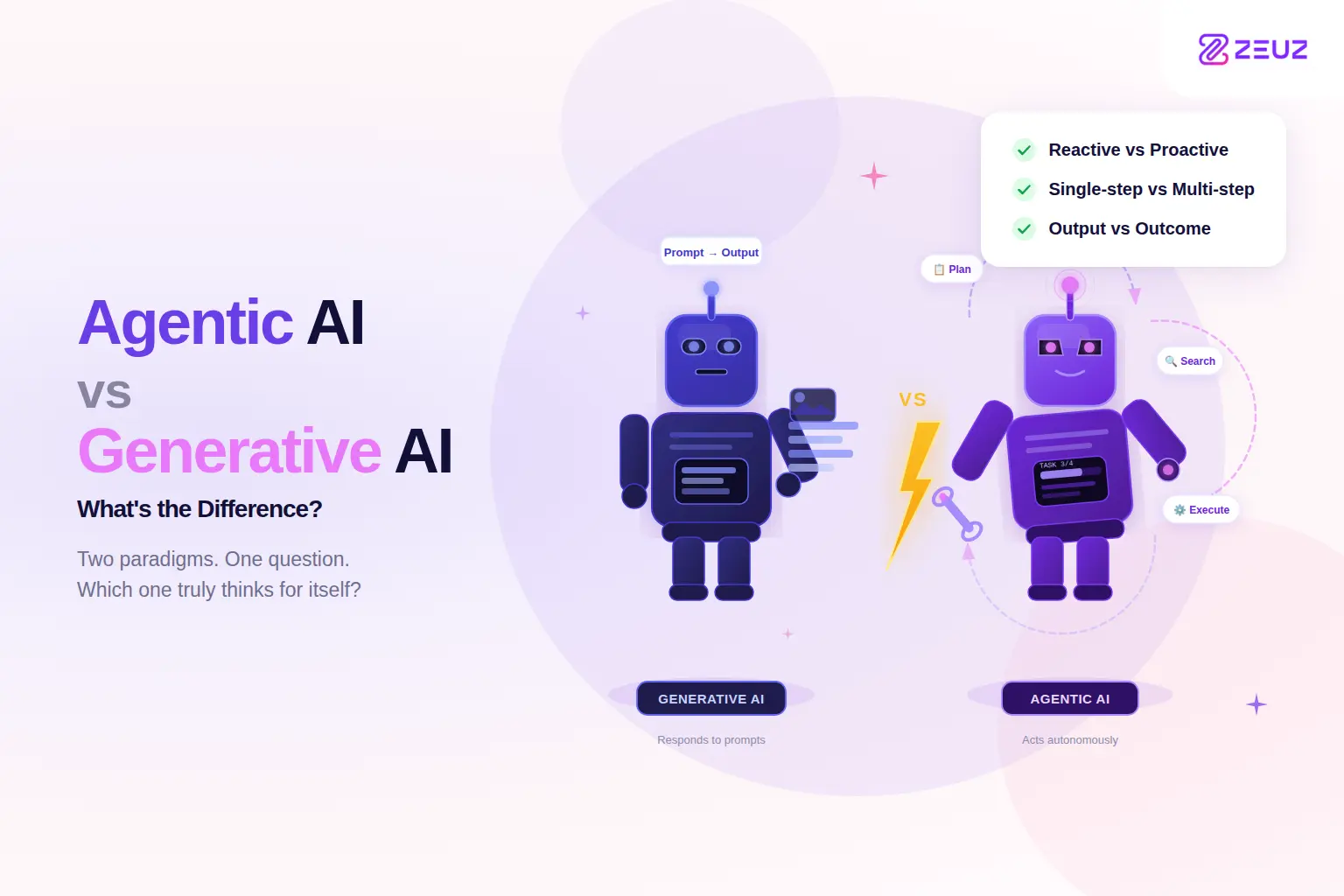
Agentic AI vs Generative AI: What's the Difference?
Topics
Agentic AI vs Generative AI: What's the Difference?
What Is Generative AI? It Creates Content When You Ask for It
What Is Agentic AI? It Pursues Goals and Takes Action Autonomously
The Core Difference: Reactive vs Proactive One Clear Comparison
Agentic AI vs Generative AI in Software Development: What Changes
Agentic AI vs Generative AI in Software Testing: The Biggest Gap
Agentic AI vs Generative AI in Project Management: From Assistance to Orchestration
Which Should Your Team Use in 2026?
Key Takeaways
Agentic AI vs Generative AI: What's the Difference?
What Is Generative AI? It Creates Content When You Ask for It
What Is Agentic AI? It Pursues Goals and Takes Action Autonomously
The Core Difference: Reactive vs Proactive One Clear Comparison
Agentic AI vs Generative AI in Software Development: What Changes
Agentic AI vs Generative AI in Software Testing: The Biggest Gap
Agentic AI vs Generative AI in Project Management: From Assistance to Orchestration
Which Should Your Team Use in 2026?
Share with your community!
Agentic AI vs Generative AI: What's the Difference?
Two Types of AI That Are Reshaping Software Development
Agentic AI acts autonomously to complete multi-step goals, while Generative AI reactively produces content in response to a prompt. Understanding this distinction is no longer academic, it is the defining technology decision for every software team in 2026.
If you have used ChatGPT to write a user story, asked GitHub Copilot to generate a function, or let an AI summarise a requirements document, you have used Generative AI. It is powerful, widely adopted, and genuinely useful. But it has a fundamental limitation: it waits for you. Every output requires a human prompt. The moment you stop asking, it stops working.
Agentic AI removes that dependency. Instead of waiting for instructions at every step, an agentic system receives a high-level goal "run the full regression suite, identify failures, patch the affected modules, and prepare a release report" and executes the entire sequence on its own. It plans, decides, acts, adapts, and loops back when something goes wrong. No human prompt needed at each step.
This is not a subtle difference. It is the difference between a tool and a teammate. And for software teams managing the complexity of modern development pipelines, continuous integration, microservices, multi-platform testing, sprint delivery, stakeholder reporting, the shift from Generative to Agentic AI changes what is actually possible.
This article explains exactly how these two paradigms differ, why it matters specifically for software development and autonomous testing, and where a platform like ZeuZ sits within this new landscape.
What Is Generative AI? It Creates Content When You Ask for It
Generative AI is a class of AI model that produces new content, text, code, images, summaries, or data, based on patterns learned from vast training datasets. It is reactive by design: it receives a prompt from a human and returns an output.
The defining characteristic of Generative AI is that the loop always starts and ends with a human. You ask, it answers. You prompt, it generates. The intelligence is in the generation, the ability to produce coherent, contextually relevant content, but the direction comes entirely from outside the system.
In software development contexts, Generative AI is most commonly encountered as:
Code generation assistants: tools like GitHub Copilot, Amazon CodeWhisperer, or Claude's code mode that write functions, classes, or modules based on natural language descriptions.
Test case generators: AI that produces test scripts when you describe a user flow or paste in source code.
Documentation writers: systems that turn code into comments, README files, or API reference material.
Requirements drafters: AI that takes a brief description of a feature and expands it into structured acceptance criteria.
Each of these is genuinely useful. Teams using Generative AI consistently report productivity gains in the 20–40% range for tasks like code drafting and documentation. But every one of these outputs is a starting point, not an outcome. A generated test script still needs a human to review it, configure the test environment, execute it, interpret the results, file the bug, and retrigger the suite after a fix. The generation is one step in a much longer workflow, and every other step still requires human attention.
This is where Generative AI reaches its ceiling, not in the quality of individual outputs, but in its inability to own an entire workflow end-to-end.
What Is Agentic AI? It Pursues Goals and Takes Action Autonomously
Agentic AI is a system that can independently plan, decide, and execute multi-step workflows to achieve a defined goal, with minimal human instruction at each step. It does not wait for prompts. It acts.
Where Generative AI is reactive, Agentic AI is proactive. Where Generative AI produces a single output per interaction, Agentic AI orchestrates sequences of actions across multiple tools, systems, and decision points. The "agency" in the name refers to this capacity for independent action, the ability to perceive a situation, reason about the best path forward, take an action, observe the result, and adapt.
The architecture behind an agentic system typically includes four components that Generative AI lacks:
1. Goal decomposition. The agent takes a high-level objective "achieve 90% test coverage on the new checkout module" and breaks it into a sequence of sub-tasks: analyse the module, generate test cases for each function, execute them, identify uncovered branches, generate additional tests, re-execute, and report.
2. Persistent memory. Unlike a Generative AI session that resets after each conversation, an agentic system maintains memory across actions. It remembers that a particular function failed three sprints ago, that a specific integration point has been historically fragile, or that the team's code review standards prefer certain patterns. Salesforce describes this as a key differentiator: the ability to "break down a high-level goal, plan a course of action, and execute a series of steps" using both short-term and long-term memory.
3. Tool use and system interaction. Agentic systems can call APIs, write to databases, push to repositories, trigger CI/CD pipelines, send Slack notifications, open browser sessions, and interact with any external system they are authorised to access. They are not confined to generating text, they can take real actions in live systems.
4. Adaptive decision-making. When something unexpected happens, a test fails for an ambiguous reason, a build is broken by a dependency conflict, a code review returns new feedback, an agentic system does not stop and wait. It analyses the new information, decides on a course of action, and continues. Only genuinely ambiguous or high-stakes decisions are escalated to a human.
The Core Difference: Reactive vs Proactive One Clear Comparison
The clearest way to understand the difference between Generative AI and Agentic AI is through the lens of workflow ownership. Generative AI assists within a step; Agentic AI owns the entire workflow across all steps.
Consider a concrete scenario: a software team needs to validate a new payment feature before release.
With Generative AI, a developer prompts the AI to generate test cases for the payment module. The AI produces a test script. The developer reviews it, adjusts edge cases, manually sets up the test environment, runs the script, reads the failure logs, decides which bugs are blockers, files tickets in Jira, and triggers a new build. Each of these steps requires the developer's presence and judgment. The AI contributed one piece, the generated test script, but the human owned the workflow.
With Agentic AI, the team sets a goal: validate the payment feature against the acceptance criteria. The agentic system reads the requirements, generates a comprehensive test suite including edge cases and failure paths, deploys the tests in the configured environment, executes them, analyses every failure with root cause reasoning, categorises failures by severity, auto-patches low-confidence failures for human review, files structured bug reports, and delivers a release-ready summary, all without a human in the loop for each step.
As Databricks describes the distinction in their 2026 analysis: Generative AI "produces content reactively in response to prompts," while Agentic AI "autonomously manages multi-step workflows, maintains memory across steps, and calls external tools to complete tasks with minimal human intervention."
The output is not just faster. It is fundamentally different in kind, because the human is freed from orchestration and can focus on decisions that genuinely require judgment.
Agentic AI vs Generative AI in Software Development: What Changes
In AI-powered software development, Generative AI writes code when asked; Agentic AI plans, writes, reviews, tests, and deploys code as part of an autonomous overnight development cycle.
This distinction transforms the economics of software delivery. A development team using Generative AI still needs the same number of engineers to manage the development lifecycle, they are just more productive at individual tasks. A team using Agentic AI can restructure how work is distributed entirely, because the agent handles the coordination layer that previously consumed 30–40% of every senior engineer's time.
Specifically, Agentic AI in software development enables:
Autonomous architecture planning. An agentic system can read a requirements document, analyse the existing codebase, identify the necessary architecture changes, evaluate trade-offs against historical decisions (what ZeuZ calls a "Decision Ledger"), and produce a complete implementation plan, before a human developer writes a single line.
Overnight code generation and review. Agentic systems can receive a sprint's worth of requirements at the end of the day and return with working frontend, backend, and API code by morning. This is not hypothetical, ZeuZ's platform explicitly describes this capability as "Dev Overnight: Code + UI mockups," with the system running end-to-end without manual orchestration.
Cost-optimised multi-agent collaboration. Rather than routing every task through the same large, expensive model, sophisticated agentic platforms deploy specialised micro-agents, one for planning, one for code generation, one for security scanning, one for testing, each routed to the most efficient model for that specific task. This is why ZeuZ reports up to 80% lower AI token costs alongside 70% faster development cycles: the efficiency comes not just from speed but from intelligent resource allocation.
Tiered human oversight. Not every decision needs human review. Agentic systems can apply confidence scoring, auto-merging high-confidence changes, flagging medium-confidence work for engineer approval, and escalating low-confidence decisions with a full reasoning trace for collaborative review. This keeps humans in control of what matters without burdening them with what doesn't.
Agentic AI vs Generative AI in Software Testing: The Biggest Gap
In autonomous software testing, Generative AI writes test scripts on demand; Agentic AI independently designs test strategies, executes them, interprets failures, self-heals broken tests, and delivers release-ready quality reports, without waiting for a QA engineer at each step.
Software testing is where the difference between these two AI paradigms is most visible and most consequential. Testing has always been the bottleneck in software delivery. It is labour-intensive, repetitive, and fragile: tests break when the UI changes, regression suites grow unmanageable, coverage gaps hide critical bugs, and QA engineers spend more time maintaining test scripts than they do thinking about quality.
Generative AI addressed some of these problems. It made test case generation faster. It reduced the effort required to write test scripts. But it did not remove the bottleneck, it just moved it slightly. A human still needed to review every generated test, manage the execution environment, interpret results, and decide what to do about failures.
Agentic AI for software testing removes the bottleneck entirely. An agentic testing system:
Analyses the application under test to understand its structure, user flows, and risk areas, without being told what to look for.
Designs a complete test strategy based on that analysis, including coverage targets, test types (functional, regression, performance, security, accessibility), and priority order.
Generates and executes tests autonomously, running them in parallel across environments and platforms.
Interprets failures with root cause reasoning, distinguishing between a genuine defect, a flaky test, a data dependency issue, and an environmental problem.
Self-heals broken tests when UI or API changes cause locator failures, updating the test to match the new interface without requiring a human to rewrite it.
Adapts test coverage in real time as new code is committed, ensuring coverage never falls below the defined threshold even as the application evolves.
This is exactly the capability set that ZeuZ describes in its agentic test automation platform: "90% test coverage with 80% less maintenance," "autonomous test case creation and self-executing test runs," and "self-healing, intent-based test automation." These are not Generative AI features, they are the output of a system with genuine agency over the testing workflow.
The market is recognising this shift. As one 2026 analysis from VTestCorp notes, "agentic testing is no longer experimental, it is the new competitive standard." Teams that continue relying on Generative AI for testing will face a growing productivity gap against competitors whose agentic systems are running QA autonomously around the clock.
Agentic AI vs Generative AI in Project Management: From Assistance to Orchestration
In AI-powered project management, Generative AI drafts plans when prompted; Agentic AI autonomously manages sprint planning, task allocation, risk detection, and delivery timeline prediction, adapting in real time as the project evolves.
Project management is another domain where the limitations of Generative AI become clear. A Generative AI tool can help a project manager draft a sprint plan, summarise a standup meeting, or write a status report. All useful. But the project manager is still responsible for monitoring progress, identifying risks, reallocating tasks when blockers emerge, and making judgment calls about deadlines. The AI assists, the human orchestrates.
Agentic AI inverts this relationship. An agentic project management system monitors the entire delivery pipeline, code commits, build statuses, test results, team capacity, stakeholder feedback, and actively manages it. It identifies risks before they become blockers, reallocates work based on real-time capacity signals, and adapts delivery timelines proactively rather than reactively. It doesn't need to be asked whether the sprint is on track. It knows, because it is continuously analysing the signals that determine track status.
ZeuZ's AI-Agentic Project Management module reflects this directly: "60% more predictable delivery timelines," "autonomous sprint planning and task orchestration," and "real-time risk detection and adaptive execution." These capabilities are only possible with a system that has ongoing agency over the project data, not one that produces a plan when asked and then falls silent.
Are They Competing Technologies? No Agentic AI Uses Generative AI as a Component
Agentic AI and Generative AI are not competing approaches, Agentic AI typically uses Generative AI internally as its content and reasoning engine, while adding the orchestration, memory, and action layers that make autonomous execution possible.
This is an important clarification. Many articles frame the two as alternatives, as if a team must choose one or the other. In practice, the most capable agentic systems depend on Generative AI for the intelligence at each individual step.
When an agentic system receives a goal and begins planning, it uses a language model, a Generative AI, to reason through the steps. When it writes a test case, it uses a Generative AI to generate the script. When it writes a bug report, it uses a Generative AI to draft the structured summary. What makes it agentic is not that it replaces Generative AI but that it adds the orchestration layer, the goal-tracking, the memory, the tool use, the decision logic, that allows Generative AI to operate as part of a continuous, goal-directed workflow rather than as a one-shot assistant.
As Databricks' 2026 analysis states: "The two are most powerful in combination, generative AI handles bounded content generation at each step while agentic AI orchestrates sequencing, state, and execution across multiple systems."
For software teams, the practical implication is that moving from Generative AI to Agentic AI is not a replacement decision, it is an augmentation decision. You are adding the layer that turns your existing AI investments into autonomous workflows.
Key Differences Side by Side: A Quick Reference
To make the comparison concrete, here is how the two paradigms differ across the dimensions most relevant to software teams:
Dimension
Generative AI
Agentic AI
Trigger
Human prompt required
Goal-defined; acts autonomously
Scope
Single output per interaction
Multi-step workflow execution
Memory
Resets per session
Persistent across actions and time
Tool access
Generates text/code
Calls APIs, writes to systems, executes code
Decision-making
None — outputs, does not decide
Plans, decides, adapts in real time
Human involvement
Required at every step
Required at confidence thresholds only
Testing capability
Generates test scripts
Designs, executes, self-heals, reports
Development capability
Writes code snippets
Plans, builds, reviews, and deploys overnight
Project management
Drafts plans when asked
Monitors, adapts, and orchestrates continuously
Risk profile
Informational (hallucinations)
Operational (acts on live systems)
What About Risk? Governance Is Different for Agentic Systems
Agentic AI introduces a new category of risk, operational risk from autonomous actions on live systems, that Generative AI does not carry. Governance frameworks for agentic systems must address action scope, escalation thresholds, and audit trails, not just output quality.
This is the dimension most teams underestimate when adopting agentic platforms. Generative AI risk is primarily informational: the AI might hallucinate a function that doesn't exist, write a test that doesn't actually test what it claims, or summarise a document inaccurately. These are real problems, but they are caught by the human who reviews the output before acting on it.
Agentic AI risk is operational: the system is taking actions directly. It is pushing to repositories, triggering builds, executing tests against production-adjacent environments, filing tickets, and making deployment decisions. A governance failure is not "the AI wrote something wrong", it is "the AI did something wrong in a live system."
This does not mean agentic systems are unsafe. It means governance must be architectured from the start, not bolted on afterward. Well-designed agentic platforms address this through:
Confidence scoring with tiered escalation: high-confidence actions proceed autonomously; low-confidence actions require human sign-off before execution.
Scope constraints: the system is explicitly authorised to act within defined boundaries. It cannot push to production without approval; it cannot modify infrastructure without a review gate.
Provenance logging: every action the system takes is logged with the reasoning behind it, creating a full audit trail that compliance and security teams can review.
Human-in-the-loop thresholds: defined at deployment time, not discovered after something goes wrong.
ZeuZ's tiered autonomy model "high confidence → auto-merge; medium confidence → engineer approval; low confidence → full collaborative review with reasoning trace" is a concrete implementation of this governance philosophy. The system is autonomous where it can be trusted and collaborative where it cannot.
Which Should Your Team Use in 2026?
Your team should use Agentic AI for multi-step workflows with defined quality outcomes, like autonomous software testing and continuous delivery and Generative AI as the content engine that powers each individual step within those workflows.
If your current challenge is writing test cases faster, Generative AI is a reasonable starting point. If your challenge is that QA is a bottleneck on every release, that test maintenance consumes more engineering time than test creation, or that your team cannot achieve meaningful coverage without proportionally scaling the QA headcount, you need an agentic system.
The guidance is similar for development and project management. Generative AI improves individual task throughput. Agentic AI transforms workflow economics by removing the orchestration overhead that sits between individual tasks, the planning, coordination, monitoring, and adaptation that currently requires a human's continuous attention.
As enterprise adoption data shows, the industry is moving decisively in this direction. According to BCG's research, 58% of companies had already integrated AI agents into operations by April 2025, and Gartner predicts that by 2028, 33% of all enterprise software applications will include agentic AI capabilities, up from less than 1% in 2024. The teams building agentic capabilities now are not early adopters chasing novelty. They are building a structural advantage that will compound over the next three to five years.
How ZeuZ Brings Agentic AI to the Full Software Lifecycle
ZeuZ is the AI platform that applies agentic AI across the entire software lifecycle, from autonomous software testing and AI-powered software development to AI-powered project management, running as a unified system from requirements to production.
This is where the practical value of understanding the Agentic vs Generative distinction becomes concrete. ZeuZ is not a Generative AI assistant that helps developers write faster. It is an agentic platform that owns workflows across the full SDLC, deploying specialised AI agents for each domain:
AI-Agentic Test Automation: The testing agent independently creates test cases from natural language requirements, executes them across web, mobile, desktop, API, and performance environments, self-heals tests when the application changes, and delivers structured release reports. It achieves 90% test coverage with 80% less maintenance overhead than traditional automation.
AI-Agentic Software Development: The development agent transforms requirements into complete architecture plans, generates frontend, backend, and API code overnight, applies living code review intelligence learned from the team's actual PR history, and uses confidence-scored tiered autonomy to decide what to auto-merge versus what to surface for engineer approval. Development cycles are 70% faster with up to 80% lower AI token costs.
AI-Agentic Project Management: The project management agent handles sprint planning with capacity awareness, monitors delivery progress in real time, detects risks before they become blockers, and adapts execution plans autonomously. Delivery timelines are 60% more predictable.
AI Product Strategy Intelligence: The strategy agent continuously monitors market signals, competitor activity, and customer feedback, feeding context-aware intelligence into requirements generation so the product roadmap stays aligned with real market conditions.
All four agents share a unified context, the Decision Ledger, which maintains persistent memory of architectural decisions, past incidents, and team standards across every workflow. This is what makes the platform genuinely agentic rather than a collection of separate AI assistants: the agents know what each other have done, and every decision benefits from the accumulated intelligence of the full system.
Conclusion: The Question Is Not If, But How Fast
Agentic AI is definitively different from Generative AI: it is the layer that transforms AI from a content assistant into an autonomous execution engine for complex, multi-step workflows. For software teams, the practical translation is straightforward, Generative AI helps you work faster at each step; Agentic AI runs the steps for you.
The shift is already underway. Autonomous software testing, AI-powered software development, and AI-powered project management are no longer competitive advantages reserved for well-resourced enterprises. Platforms like ZeuZ have brought genuine agentic capability within reach of any software team, at pricing designed for teams that are building the future rather than just watching it.
The teams that understand this distinction in 2026 will not just ship faster. They will ship at a fundamentally different quality and predictability level than teams still relying on prompt-based Generative AI for workflow-level problems.
The question is no longer whether to adopt agentic AI. It is how quickly you can move from understanding the difference to deploying the advantage.