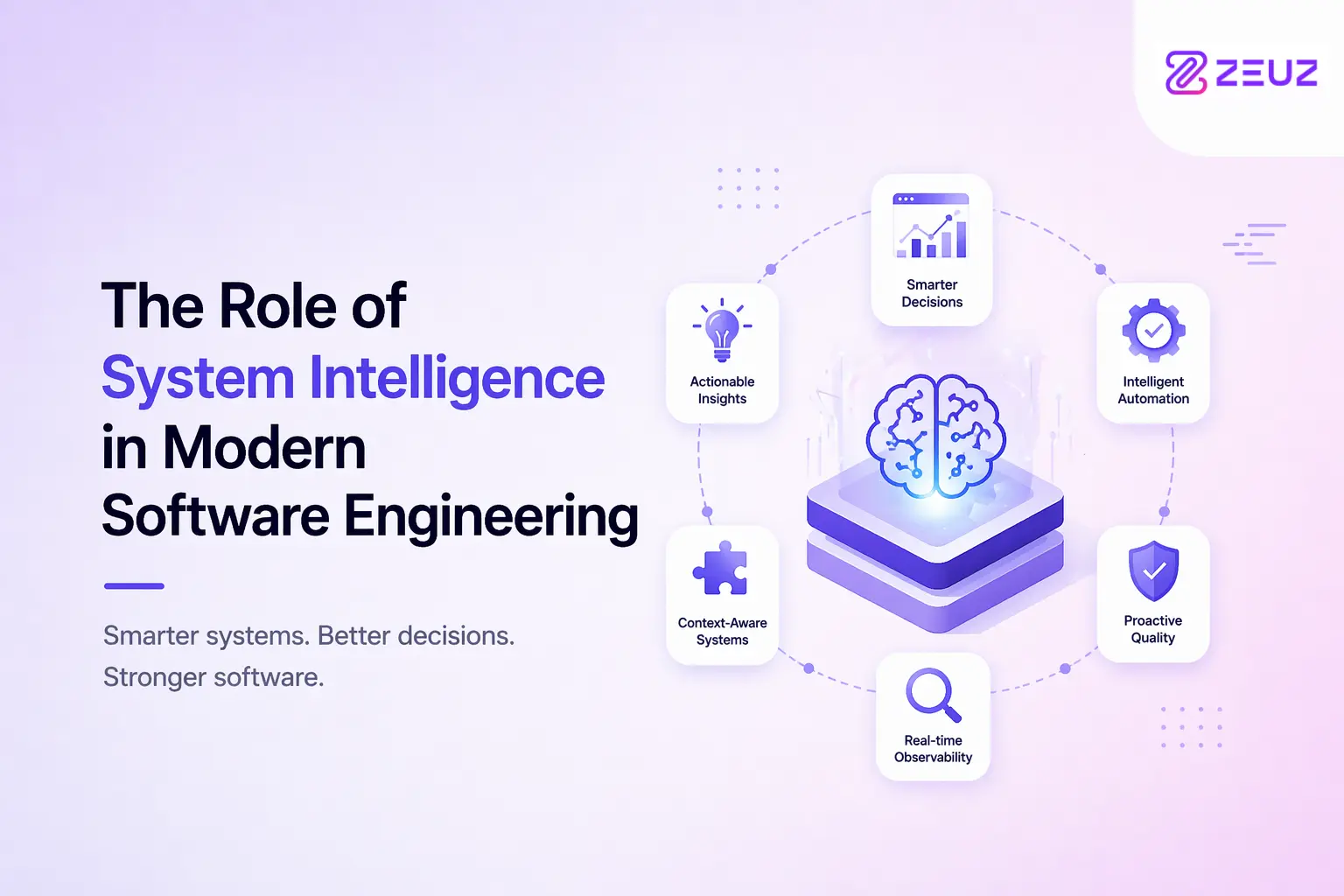
Why Traditional Software Engineering is Struggling
Let’s be direct.
Most software teams today are working with incomplete visibility.
1. Fragmented Tools
Different tools handle:
Code
Testing
Deployment
Monitoring
But none of them understand the full system.
2. Hidden Dependencies
A small change in one service can break another.
But teams often don’t see that until it’s too late.
3. Reactive Problem Solving
Issues are detected after failure, not before.
Even with AI in software engineering, if the system itself is not connected, intelligence remains limited.
System Intelligence vs Traditional Observability
This is where people often get confused.
Observability
Shows logs, metrics, traces
Helps you understand what happened
System Intelligence
Understands relationships
Predicts what will happen
Recommends actions
→ Observability = visibility → System intelligence = understanding
And that difference is huge.
How System Intelligence Actually Works
System intelligence is powered by AI, but not in the way most people think.
It is not just about automation.
It is about building a machine-readable understanding of your system.
Key Inputs
A system intelligence layer collects data from:
Code repositories
APIs and services
Test results
Deployment pipelines
Performance metrics
What It Builds
Using engineering intelligence tools, it creates:
Dependency maps
Risk profiles
Behavior patterns
This becomes a living model of your system.
From Data to System Understanding
Here’s the shift:
Traditional systems store data
Intelligent systems interpret it
For example:
Instead of: → “Test failed in module X”
System intelligence tells you: → “Module X failed because of a recent change in API Y, which affects payment flow and has a high risk of production impact”
→ Everyone works with the same system understanding
Connecting Business and Engineering
System intelligence also connects technical work with business outcomes.
By integrating with:
business intelligence platforms
sales intelligence tools
Teams can understand:
Which features matter most
Where failures impact revenue
How user behavior affects development priorities
This supports smarter AI product development.
System Intelligence vs Manual Expertise
Let’s be real.
Senior engineers still matter.
But even the best engineers:
Cannot track everything
Cannot process all data
Cannot predict every outcome
System intelligence does not replace expertise.
→ It amplifies it.
Challenges of Implementing System Intelligence
It is powerful, but not effortless.
1. Data Integration
You need data from multiple systems.
2. System Complexity
The more complex the system, the harder it is to model.
3. Cultural Shift
Teams must trust AI-driven insights.
But once implemented, the benefits compound quickly.
The Future of Software Engineering
We are moving toward:
Intelligent systems
Autonomous workflows
Predictive decision-making
Software engineering will not just be about writing code.
→ It will be about managing intelligent systems.
Final Thoughts
System intelligence is not a feature.
It is the foundation of modern software engineering.
Without it:
Teams remain reactive
Systems remain fragmented
With it:
Development becomes predictive
Testing becomes focused
Delivery becomes smarter
One Clear Takeaway
System intelligence transforms software engineering from task execution into intelligent system coordination.
Frequently Asked Questions
1. What is system intelligence in software engineering?
System intelligence in software engineering refers to a platform’s ability to understand how an entire software system operates, including dependencies, risks, and interactions between components. Unlike traditional tools, it provides context-aware insights and predictive analysis rather than just raw data.
2. How is system intelligence different from observability?
Observability focuses on monitoring logs, metrics, and traces to explain what has already happened in a system. System intelligence goes further by analyzing relationships, predicting potential issues, and recommending actions, making it proactive rather than reactive.
3. Why is system intelligence important in modern software development?
Modern applications are highly complex, with microservices, APIs, and distributed systems. System intelligence helps teams manage this complexity by providing full system visibility, identifying hidden dependencies, and enabling better decision-making across the software development lifecycle (SDLC).
4. How does system intelligence improve the software development lifecycle (SDLC)?
System intelligence enhances every stage of the SDLC by:
Identifying risks during planning
Highlighting dependencies during development
Focusing testing on high-risk areas
Supporting smarter, data-driven release decisions
This leads to faster, safer, and more efficient software delivery.
5. What role does AI play in system intelligence?
AI powers system intelligence by analyzing data from code repositories, APIs, testing tools, and deployment pipelines. It builds dynamic models like dependency maps and risk profiles, enabling predictive insights and intelligent automation in software engineering.
6. What are the benefits of implementing system intelligence for engineering teams?
System intelligence helps teams:
Reduce system failures and bugs
Make data-driven decisions
Improve collaboration across Dev, QA, and DevOps
Increase efficiency with targeted testing and deployment