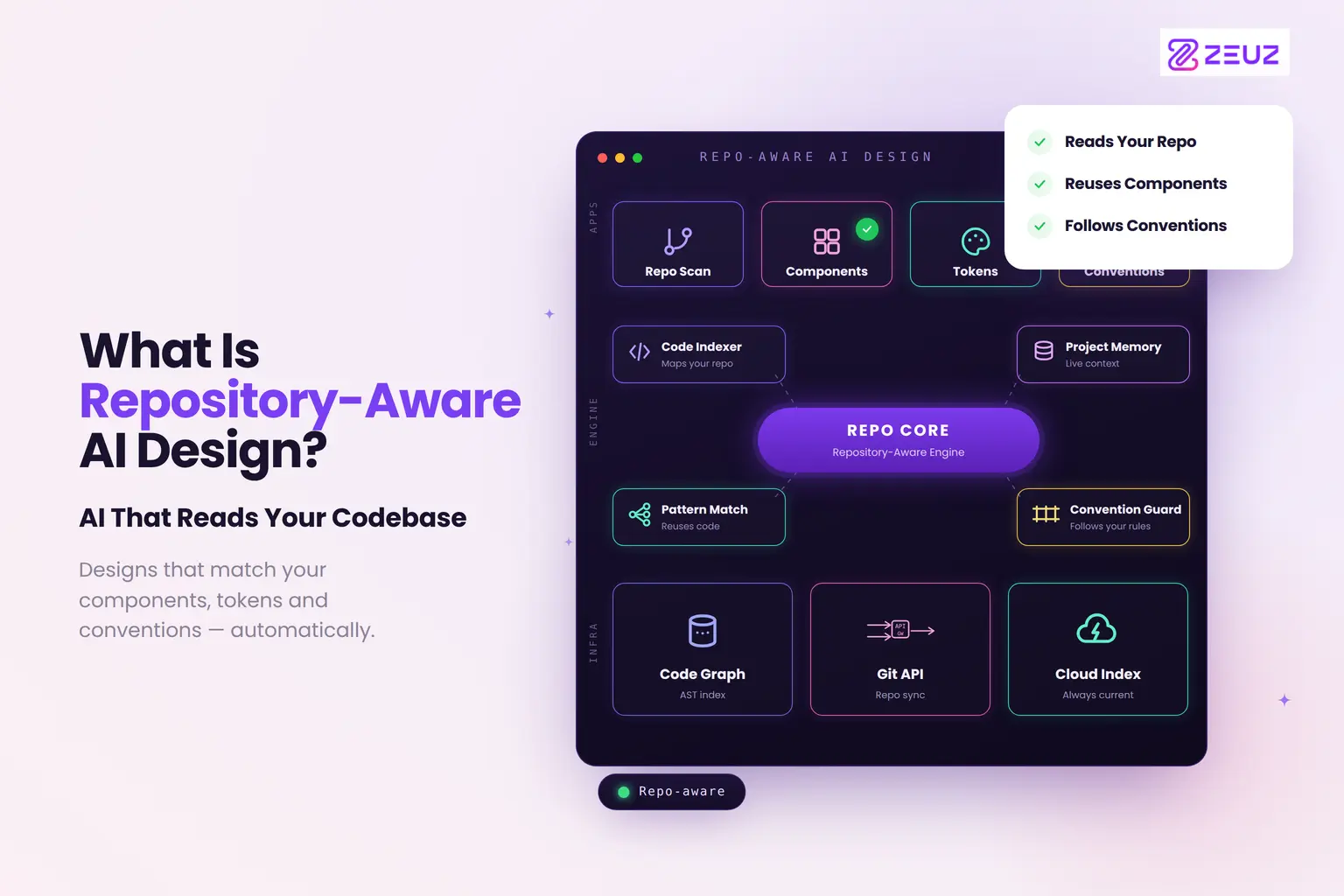
What Is Repository-Aware AI Design? A Definition & Guide
Topics
What Is Repository-Aware AI Design? The Feature That Changes How Product Teams Build
The Definition: What Repository-Aware Actually Means
Why the Distinction Matters: The Three Levels of "Codebase Awareness"
What Repository-Awareness Solves That Nothing Else Can
Connecting Repository Awareness to the Full AI Design Studio Picture
Key Takeaways
The Definition: What Repository-Aware Actually Means
Why the Distinction Matters: The Three Levels of "Codebase Awareness"
The Technical Architecture: How It Works
What Repository-Awareness Solves That Nothing Else Can
Repository-Aware Design vs. Other Approaches: A Direct Comparison
Connecting Repository Awareness to the Full AI Design Studio Picture
Share with your community!
What Is Repository-Aware AI Design? The Feature That Changes How Product Teams Build
Ask most AI design tool vendors whether their product is "connected to your codebase" and you will get a version of yes. The answers range from "we support Figma tokens" to "you can export to GitHub" to "our AI understands design systems." None of these are the same as repository-aware AI design, and the difference between them is the difference between a tool that generates impressive mockups and a tool that generates implementable products.
This article defines repository-aware AI design precisely, explains the architecture that makes it possible, and establishes why it is the single most important capability criterion for enterprise teams evaluating AI design platforms in 2026.
The Definition: What Repository-Aware Actually Means
Repository-aware AI design is the capability of an AI design generation system to read and contextualise a team's GitHub repository, including its component library, architecture conventions, design token structure, UI patterns, and product terminology, before generating any design output.
The operative word is "before." A system that can export to GitHub after generating a design is not repository-aware. A system that can read your repository before generating, and use what it finds to inform every structural decision in the output is.
The practical consequence is this: when a repository-aware AI design system generates a layout, it generates using your components, your naming conventions, your tokens, and your patterns. The output is not a generic approximation of your product. It is your product described in its own design language.
Misalignment between mockups and the codebase is one of the most common reasons AI design output creates downstream friction (UX Planet, 2026). Repository-awareness is the architectural solution to that misalignment.
Why the Distinction Matters: The Three Levels of "Codebase Awareness"
Not all claims of codebase integration are equal. Understanding the levels helps in evaluating what tools actually offer:
Level 1: Export integration The tool can push generated assets to GitHub or export components in formats that developers can consume. This is a workflow convenience, not design intelligence. The AI generated without codebase context; the export step just moves the output to a repository.
Level 2: Design system reading The tool can read your component library (typically your Figma file or a design token file) and use it to inform generation. Figma AI operates at this level — it can read your Figma component library and achieve roughly 70% design system compliance on first-pass output. The limitation: Figma components and code components are not the same thing. The tool is reading the design representation of your system, not the implementation.
Level 3: Repository-level awareness The tool connects directly to your GitHub repository and branch, reads your actual codebase, component structure, naming conventions, token architecture, interaction patterns, and generates designs that are aligned with the implementation reality, not the design file representation.
ZeuZ Studio operates at Level 3. This is the level at which generated designs are immediately implementable rather than requiring engineering translation.
The Technical Architecture: How It Works
Repository-aware design generation requires four technical capabilities working together:
1. Repository Connection and Authentication
The platform connects to your GitHub account and authenticates at the repository and branch level. This is not a one-time export connection, it is a live, read-capable integration that the AI can query during the design generation process.
2. Codebase Parsing and Indexing
The platform indexes the connected repository, identifying:
This indexing creates a structured representation of your product's design language that the AI can query contextually.
3. Context-Informed Generation
When a requirement is submitted, the AI does not generate from general UI knowledge alone. It queries the repository index to understand: what components exist that could serve this requirement? What token values apply? What interaction patterns has this team already standardised? The generation process incorporates these answers structurally, not as post-processing adjustments, but as inputs to the initial layout decisions.
As Boldare's 2026 analysis of AI-assisted design systems notes: "Design tokens are the most critical component for AI-assisted development. They're the only mechanism through which AI tools can generate UI that stays within your visual language rather than inventing its own." Repository-aware systems read these tokens directly, rather than approximating them from a design file export.
4. Branch-Level Alignment
Product teams don't work on a single static codebase. Features are developed in branches, with components evolving alongside the feature work. Repository-aware design generation that operates at the branch level means generated designs reflect the state of the codebase as it will exist when the feature ships, not the state of the main branch when the design was initiated.
What Repository-Awareness Solves That Nothing Else Cana
To understand why this matters, consider the failure scenarios it prevents:
Scenario 1: The missing component problem. An AI design tool generates a data table with custom inline filters. The team's codebase already has a DataTable component with configurable filter options. Without repository awareness, this duplication isn't discovered until engineering begins implementation. With repository awareness, the generated design uses the existing DataTable component from the first output no duplication, no rework.
Scenario 2: The design token drift problem. An AI tool generates a button with a slightly different shade of blue than the team's primary colour token. The visual difference is subtle. Over time, hundreds of similar small deviations accumulate, and the shipped product has a subtly inconsistent visual language that nobody can trace to a single decision. With repository-aware token reading, every generated element uses the team's actual token values, not approximations, and drift is structurally prevented.
Scenario 3: The naming convention problem. A generated mockup describes a "modal" for a team whose codebase uses "Dialog" as the component and concept name throughout. This mismatch creates confusion at the engineering handoff, every reference to "modal" in the design needs to be mentally translated to "Dialog" before implementation. Repository-aware generation inherits the team's terminology, so the design speaks the same language as the codebase.
Repository-Aware Design vs. Other Approaches: A Direct Comparison
Approach
Read Codebase?
Uses Your Components?
Uses Your Tokens?
Branch-Aware?
Standard AI design tools
❌
❌
❌
❌
Design-system-aware tools (Figma AI)
Partial (Figma file only)
Partial
Partial
❌
Repository-aware AI design (ZeuZ Studio)
✅ (GitHub repo)
✅
✅
✅
The Strategic Implications for Enterprise Teams
For enterprise teams managing large, evolving codebases across multiple product lines, repository-aware AI design is not a convenience feature. It is the capability that determines whether AI design tools generate productivity or generate rework.
Design system compliance at scale becomes a built-in output rather than a governance overhead. When every generated design inherits the team's component system and token architecture, compliance is structural rather than procedural, it does not depend on every engineer manually consulting a design system document.
Multi-team consistency improves as a natural consequence. When multiple feature teams are all generating designs against the same repository, the designs share a common foundation in the codebase regardless of which team generated them.
Legacy modernisation velocity increases significantly. For enterprises modernising large legacy systems, repository-aware generation means new UI is generated in the language of the existing architecture rather than against a hypothetical ideal state that the codebase cannot efficiently implement.
Connecting Repository Awareness to the Full AI Design Studio Picture
Repository-aware AI design is one component of a complete AI Design Studio capability set. It solves the alignment problem at the point of generation, but the full value is realised when it is combined with the other capabilities that enterprise product teams need: multi-variant exploration, conversational refinement, SDLC integration, and QA workflow alignment.
For the complete framework of what enterprise teams should evaluate when selecting an AI Design Studio — and how repository awareness fits within that broader capability picture the complete guide to AI Design Studios for product teams is the definitive resource.
And for a practical explanation of why the absence of this capability causes predictable, expensive failure patterns in AI design workflows, Why AI Design Tools Fail Without Codebase Awareness covers the failure mechanics and the fix in full.
Conclusion
Repository-aware AI design is not a feature on a checklist. It is the architectural difference between AI that generates design for a generic product and AI that generates design for your product.
The teams that understand this distinction in 2026 will build significantly faster, with significantly less rework, and with a design-to-implementation alignment that makes their QA, their engineering, and their product reviews more productive at every stage.
The teams that don't will continue generating impressive mockups that require three days of engineering translation before a sprint can begin.
The distinction is not subtle. And it is not going away.