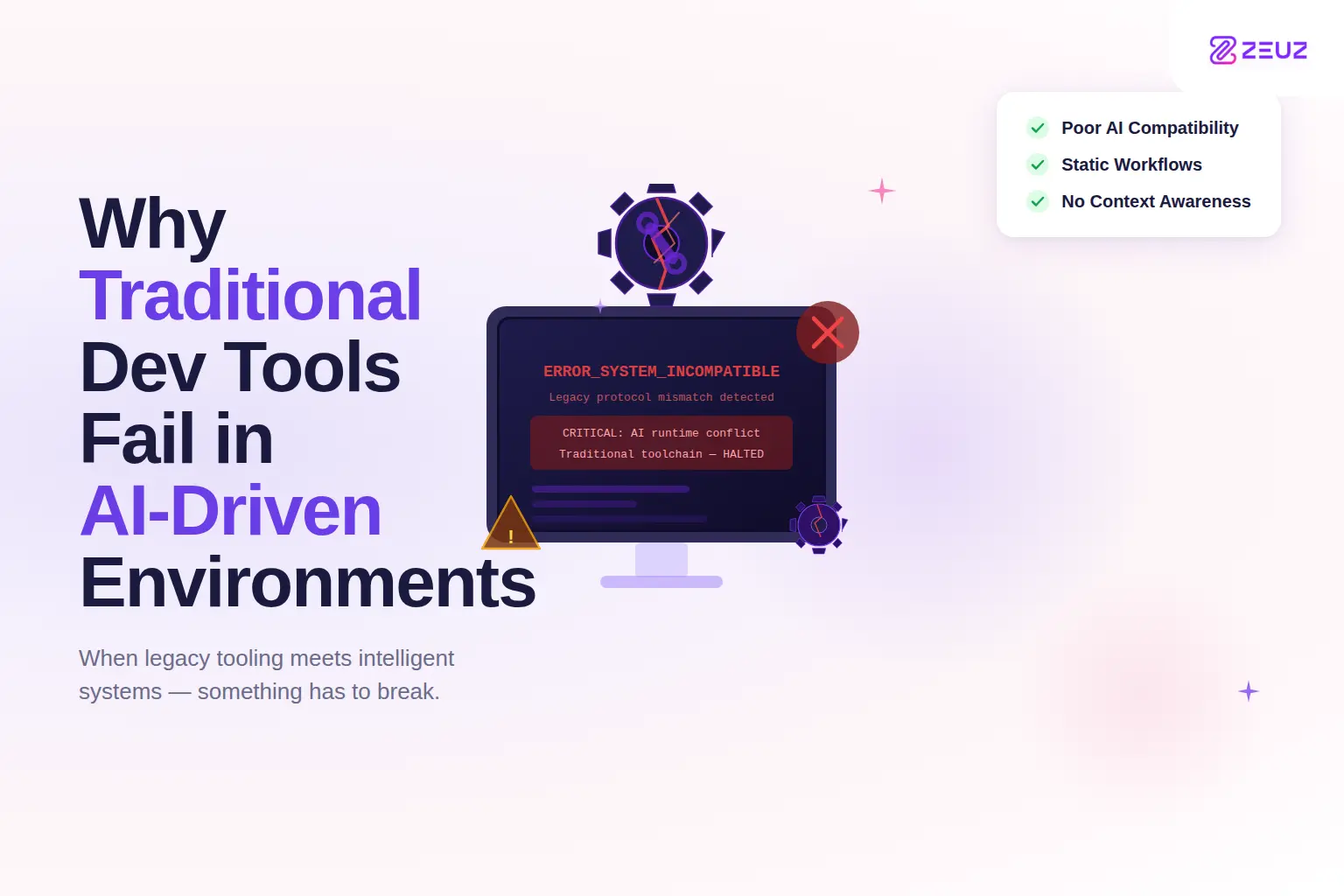
Topics Why Traditional Dev Tools Fail in AI-Driven Environments
5 Reasons Traditional Dev Tools Fail in AI-Driven Environments
AI-Native Systems Solve These Problems
Traditional Tools vs AI-Native Platforms (Quick Comparison)
Can Traditional Tools Be Fixed?
Frequently Asked Questions
Key Takeaways Traditional dev tools fail in AI-driven, complex environments. AI-native platforms unify data for smarter, predictive development. System intelligence is crucial for modern AI-driven software. Traditional tools are reactive; AI-native systems are predictive. AI-native tools automate coordination, reducing delays and inefficiency. Legacy dev tools struggle with fragmented data and siloed systems. AI-native platforms enhance team efficiency and reduce risk. Share with your community! Why Traditional Dev Tools Fail in AI-Driven Environments For years, software teams have relied on a familiar stack.
A tool for code
A tool for tracking
A tool for testing
A tool for deployment
Individually, these tools work fine.
But put them together in a modern, fast-moving environment, and things start to break.
Now add AI into the mix.
That’s where the real problem shows up.
→ Traditional development tools were never designed for AI-driven software development
And that’s exactly why they’re starting to fail.
The Core Problem: Tools Built for a Different Era
Most development tools were created when:
Back then, it made sense to separate everything.
But today?
We have:
And increasingly:
The old toolset is struggling to keep up.
What Happens When You Add AI to Traditional Tools
Many teams try to solve this by adding AI features to existing tools.
For example:
These fall under AI-powered software development.
They help, but they don’t fix the core problem.
Why? Because the system is still fragmented.
Each tool:
Has its own data
Has its own logic
Operates independently
AI cannot see the full picture.
And without that, intelligence is limited.
5 Reasons Traditional Dev Tools Fail in AI-Driven Environments
Let’s break this down properly.
1. Fragmented Data Kills Intelligence
AI depends on data.
But traditional tools store data in silos:
Without a unified view, AI cannot:
This is why AI-native software development platforms focus on unification.
2. No System-Level Understanding
Traditional tools execute tasks.
They don’t understand the system.
For example:
A CI/CD tool runs pipelines
A testing tool executes scripts
A tracking tool logs issues
But none of them know:
How a change affects the entire system
Which components are most fragile
Where failures are likely to happen
This lack of system intelligence is a major limitation.
3. Reactive, Not Predictive
Traditional workflows are reactive.
A bug appears → then you fix it
A test fails → then you investigate
A deployment breaks → then you rollback
Even with AI-powered software development, many tools still operate this way.
What’s missing is:
→ Predictive capability
That’s where AI-driven software development changes the game .
4. Manual Coordination Still Dominates
Let’s be honest.
A lot of development work is still about coordination:
Syncing between teams
Updating tickets
Managing dependencies
Planning sprints
Even with tools, humans are still the glue holding everything together.
This creates:
Delays
Miscommunication
Inefficiency
AI-native systems reduce this by enabling:
→ automated coordination across the SDLC
5. Automation Without Intelligence
Traditional tools are great at automation.
But automation alone is not enough.
For example:
Without context, this leads to:
Wasted resources
Missed risks
Slower decision-making
This is where software lifecycle automation needs to evolve into intelligent automation.
AI-Native Systems Solve These Problems Now let’s flip the perspective.
What do modern systems do differently?
1. Unified Data Layer
An AI software development platform connects:
Development
Testing
DevOps
Product
All data flows into one system.
2. System Intelligence
Using engineering intelligence tools, the platform understands:
Dependencies
Code relationships
Risk patterns
This creates a real-time, intelligent view of the system.
3. Predictive Insights
Instead of reacting, the system:
Predicts defects
Identifies risky changes
Recommends actions
4. Autonomous Capabilities
AI-native systems enable:
5. End-to-End Visibility
Everything from idea to release is connected.
This eliminates:
Tool switching
Context loss
Data inconsistency
Traditional Tools vs AI-Native Platforms (Quick Comparison)
Traditional Tools
AI-Native Platforms
Fragmented systems
Unified ecosystem
Task execution
System understanding
Reactive workflows
Predictive workflows
Manual coordination
AI-driven coordination
Automation-focused
Intelligence-driven
Impact on Software Teams
This shift is not just technical, it changes how teams operate.
Developers
QA Teams
DevOps
Product Teams
Why This Matters Now
This is not a future problem.
It’s already happening.
As systems grow more complex, traditional tools will:
Slow teams down
Increase risk
Limit scalability
Teams that adopt AI-native software development platforms will move faster and smarter.
Others will struggle to keep up.
Can Traditional Tools Be Fixed?
Short answer: partially.
You can:
Integrate tools
Add AI features
Improve workflows
But at some point, you hit a limit.
Because the foundation is still fragmented.
The Real Shift: From Tools to Systems
This is the key idea.
We are moving from:
To:
That’s the difference between:
Final Thoughts
Traditional development tools are not “bad.”
They are just outdated for today’s complexity.
They were built for:
Simpler systems
Slower cycles
Manual coordination
But modern software requires:
Intelligence
Integration
Prediction
And that’s exactly what AI-native platforms bring.
One Clear Takeaway
Traditional dev tools fail in AI-driven environments because they execute tasks, but don’t understand the system.
Frequently Asked Questions
What are the limitations of traditional development tools in AI-driven environments?
This FAQ can address the main issue discussed in the article, helping users understand why traditional tools struggle when AI is involved.
How do AI-native software development platforms improve development processes?
This question focuses on the benefits of AI-native platforms, which is a key topic in the article, helping users learn about system intelligence and predictive insights.
What is the difference between AI-powered and AI-native software development?
This FAQ clarifies a critical concept introduced in the article, offering users a comparison that highlights the advantages of native AI platforms.
Why is unification of data important in AI-driven software development?
This question can explain the role of unified data layers in modern platforms, which addresses the challenges posed by fragmented data in traditional tools.
How do AI-native platforms improve team coordination in software development?
This FAQ emphasizes the problem of manual coordination in traditional tools and how AI-native systems can automate and improve this process.
Can traditional development tools be adapted for AI-driven environments?
Answering this question gives insight into whether legacy tools can be fixed or if organizations need to fully transition to AI-native platforms, which is discussed toward the end of the article.