The Future of Agentic Software Development in India
Frequently Asked Questions
Key Takeaways
What Is Agentic Software Development?
The Evolution from Traditional to Agentic Development
Why Agentic AI Is Growing Rapidly in India
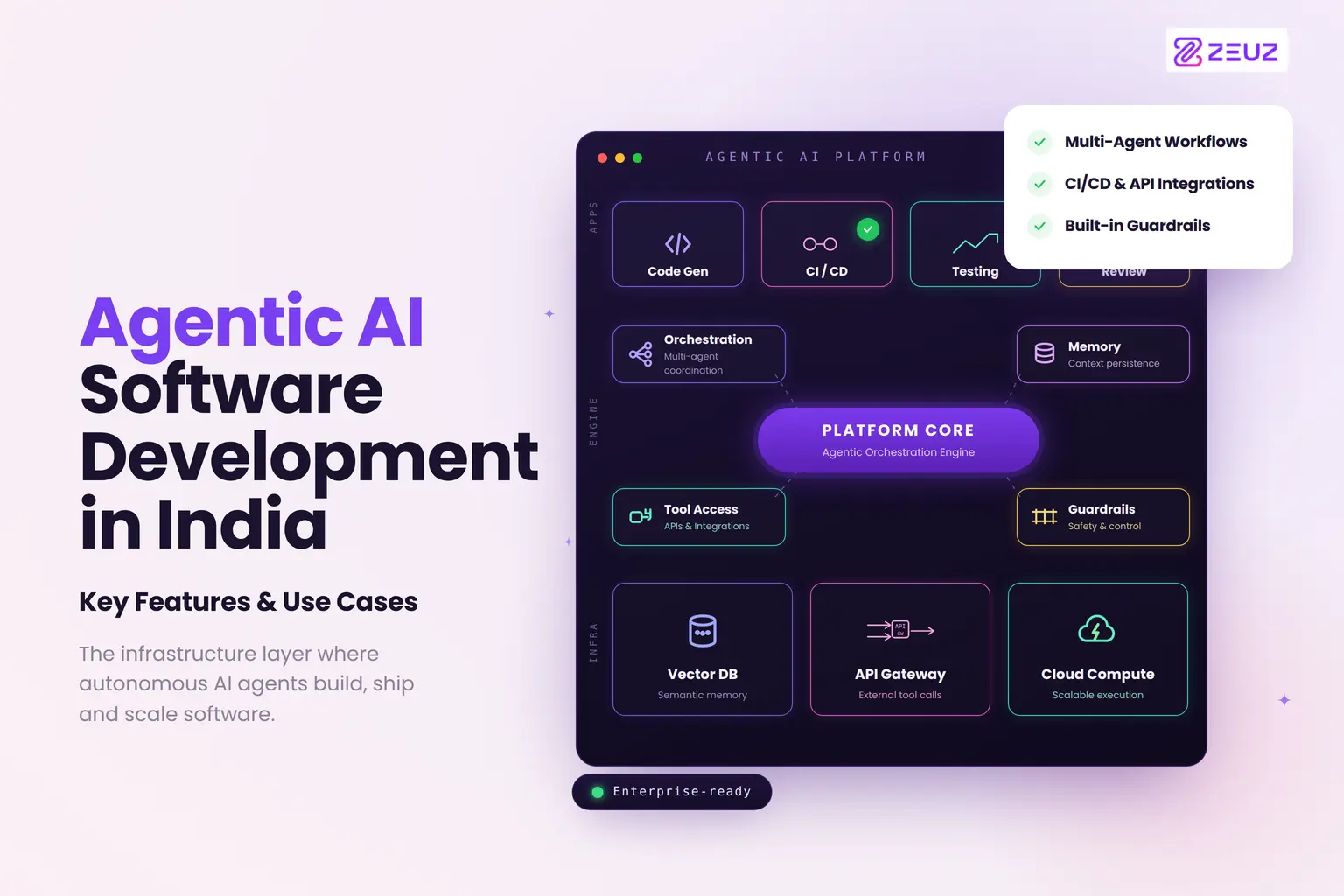
Core Components of Agentic Software Development
Enterprise Use Cases Across Indian Industries
Benefits and Business Impact
Challenges and Risks
Implementation Framework for Indian Enterprises
Best Practices for Agentic AI Adoption
Share with your community!
Agentic AI Software Development in India
India's software industry is standing at a crossroads unlike any it has faced before. On one side lies the familiar terrain of labour-driven IT services, the model that built the industry's $250 billion export engine. On the other lies a rapidly expanding frontier: Agentic AI Software Development, where AI systems plan, reason, code, test, and deploy software autonomously not as an assistant to human engineers, but as a full participant in the development lifecycle.
This shift is not theoretical. It is happening now, at scale, across Indian enterprises, Global Capability Centers (GCCs), and IT services firms serving global clients. The question for India's technology leaders, enterprise architects, and digital transformation teams in 2026 is not whether to engage with agentic AI it is how quickly and how strategically to do so.
This guide provides a definitive, data-backed exploration of agentic software development in the Indian enterprise context. Whether you are a CTO evaluating a platform investment, a QA leader modernising your delivery pipeline, or a software architect designing the next generation of your organisation's systems, this article delivers the clarity and practical direction you need.
Why Agentic AI Is Growing Rapidly in India
The Market Numbers
The global agentic AI market tells a compelling growth story. The global agentic AI market was valued at USD 7.29 billion in 2025 and is projected to grow from USD 9.14 billion in 2026 to USD 139.19 billion by 2034, exhibiting a CAGR of 40.50% making it the fastest-growing segment in enterprise technology (Fortune Business Insights, 2026). India's own agentic AI market is estimated to reach USD 0.59 billion in 2026, with a trajectory that mirrors global acceleration.
Enterprise adoption is translating these market figures into deployment reality. Gartner forecasts that 40% of enterprise applications will embed task-specific AI agents by the end of 2026, up from less than 5% in 2024. Looking further ahead, by 2028, 33% of all enterprise software applications will include built-in agentic capabilities, according to Gartner research.
India's Structural Advantages
India is not merely a passive recipient of the agentic AI wave; it is positioned to be both a major consumer and a major exporter of agentic capability. Several structural factors explain why:
1. Talent at scale India produces over 1.5 million engineering graduates annually. According to the India AI Adoption Edge 2026 report by Zinnov, OpenAI, and Z47, India ranks first globally in AI skill penetration ahead of the United States and Germany. This is the talent pool that will build, deploy, and operate agentic systems.
2. Government commitment The Government of India launched the IndiaAI Mission in March 2024 with an initial allocation of Rs 10,300 crore (approximately USD 1.25 billion), targeting computing infrastructure, large language model development, AI startups, and public-sector AI applications. This signals institutional commitment at the highest level.
3. The GCC opportunity India hosts over 1,600 Global Capability Centers. According to the EY GCC Pulse Survey 2025, 83% of GCCs are currently testing new technologies, and 58% are actively experimenting with agent-based systems. These centres are becoming the primary sites for enterprise agentic AI experimentation and deployment.
4. Enterprise AI leadership According to Deloitte's State of AI in the Enterprise 2026 report, Indian enterprises are leading global peers in at-scale AI adoption across most functions. 40% of Indian respondents report significant or full AI usage, compared with a global average of approximately 28%.
5. Investment momentum According to the Bain & Company India Enterprise Technology Report 2026, AI and data transformation initiatives are expected to account for 40–45% of India's change-related technology spending in 2026, with overall IT spending projected to grow 6–8% ahead of expected global rates.
Core Components of Agentic Software Development
Understanding agentic development requires understanding its building blocks. These are not abstract concepts they map directly to the systems enterprises are deploying today.
1. The Planning Layer
The planning layer is where the agent interprets a high-level goal and decomposes it into an executable sequence of subtasks. This involves intent recognition, constraint identification (language, framework, compliance requirements), and dependency mapping between tasks. Effective planning layers use chain-of-thought reasoning internally, which significantly improves the coherence of the generated output.
2. The Execution Layer
Execution is where agents interact with real development tools. This includes:
Writing and refactoring code across multiple files
Executing terminal commands and reading outputs
Running test suites and interpreting results
Committing code to version control systems
Calling external APIs and reading documentation
To understand what this looks like in practice, the ZeuZ blog's deep-dive on What Is an Autonomous Agent in AI? A Complete Guide (2026) provides an accessible yet technically rigorous walkthrough of how execution-layer agents operate in software testing contexts.
3. The Memory Layer
Agentic systems that improve over time require a memory architecture. This typically combines:
Short-term memory: Context within the current task session
Episodic memory: Recall of specific past interactions, previous bugs, or prior architectural decisions
Semantic memory: General knowledge about the codebase, its patterns, and domain conventions
Procedural memory: Learned sequences for recurring task types (e.g., how this particular application typically handles authentication)
For Indian IT services companies managing large, evolving codebases across multiple client engagements, this persistent memory layer is what enables agents to improve over time predicting where defects will appear and how to prioritise coverage intelligently.
4. The Orchestration Layer
Multi-agent orchestration coordinates multiple specialised agents working in parallel or in sequence. A typical agentic software development pipeline might include:
A requirements agent that processes natural language specifications and generates structured user stories
A coding agent that generates implementation code
A testing agent that autonomously designs and executes test cases
A security review agent that scans for vulnerabilities before code is committed
A deployment agent that manages CI/CD pipeline execution and monitors post-deployment behaviour
5. The Feedback and Learning Layer
Agentic systems that remain static quickly become obsolete in real enterprise environments. Production-grade implementations include feedback loops that capture deployment outcomes, user behaviour signals, and error rates feeding this information back to improve future agent performance.
As the ZeuZ blog's piece on Agentic AI in QA: Redefining the Future of Software Testing explains, the observe-reason-act loop that drives QA agents makes them fundamentally different from brittle traditional automation: they interpret application state rather than follow hardcoded flows.
Enterprise Use Cases Across Indian Industries
Banking and Financial Services
India's financial sector — home to the world's second-largest fintech ecosystem is among the most active adopters of agentic development approaches.
Regulatory compliance code generation: Agents that monitor RBI or SEBI regulatory updates and automatically generate or flag required code changes in core banking systems.
Automated API testing for payment systems: With the UPI ecosystem processing billions of transactions monthly, agentic testing systems that continuously validate API behaviour under variable load conditions are delivering measurable reliability improvements.
Fraud detection model iteration: Agent pipelines that autonomously experiment with feature engineering, retrain models on new fraud patterns, and validate updated models against historical holdout sets without requiring manual data science intervention at each cycle.
Healthcare and Life Sciences
Clinical data pipeline validation: Agentic testing frameworks that validate data transformations across patient record systems, ensuring end-to-end data integrity without requiring manual test script maintenance.
Regulatory document generation: Agents that synthesise technical documentation required for CDSCO submissions, drawing on existing code, test results, and specification documents.
Medical device software testing: With IEC 62304 compliance requirements, agentic testing systems that maintain comprehensive audit trails and automatically generate traceability matrices between requirements and test cases.
IT Services and GCCs
This is where India's agentic AI opportunity is perhaps most immediate and most significant.
Delivery compression: According to research cited in the ZeuZ blog, enterprises integrating AI agents into CI/CD pipelines report developer productivity gains of 35–55% for routine tasks and up to 72% reduction in mean-time-to-resolve for software bugs. For Indian IT services firms competing on delivery economics, these figures are transformative.
Test maintenance elimination: Traditional automation test suites require constant maintenance as application UIs and APIs evolve. Agentic testing systems that self-heal when application changes occur eliminate this overhead, one of the largest hidden costs in enterprise QA.
Code migration at scale: Several major Indian IT firms are deploying agentic systems to manage legacy modernisation programs automatically translating COBOL or legacy Java code into modern cloud-native equivalents while maintaining functional equivalence.
E-Commerce and Retail
Dynamic personalisation engine testing: Continuously validating that recommendation algorithms behave correctly across millions of user segments.
Supply chain integration testing: Agentic systems that automatically validate end-to-end order fulfilment workflows across complex multi-system integrations.
A/B test infrastructure management: Agents that design, configure, and monitor A/B tests across platform features with minimal human intervention.
Telecommunications
Network configuration validation: Automated testing of configuration changes across complex telecom infrastructure, catching misconfigurations before they affect service availability.
API ecosystem testing: With India's telcos running hundreds of third-party developer APIs, agentic systems that continuously monitor API contract compliance and regression-test at every release cycle.
Benefits and Business Impact
Quantified Productivity Gains
The productivity case for agentic development is increasingly well-supported by empirical data:
McKinsey research reports 40% fewer defects reaching production in AI-integrated development environments.
Developer productivity gains of 35–55% on routine software tasks when AI agents are integrated into CI/CD pipelines, according to market research cited across multiple enterprise implementations.
Up to 72% reduction in mean-time-to-resolve for software bugs in production environments using agentic root cause analysis.
93% of enterprise leaders believe that successfully scaling AI agents in the next 12 months will provide a competitive edge over industry peers (Capgemini Rise of Agentic AI report).
Cost Structure Transformation
The cost implications extend beyond individual productivity metrics:
Test maintenance reduction: Traditional UI test suites typically require 20–30% of QA engineer time simply to keep existing tests operational. Agentic self-healing automation eliminates this category of cost.
Delivery timeline compression: When agents handle the iterative code-test-fix cycle autonomously, release cycles that previously took weeks can compress to days. This directly improves time-to-market for software-dependent products.
Quality escalation economics: Defects caught by agents during development cost a fraction of those discovered in production. The McKinsey 40% defect reduction figure, applied to large-scale delivery operations, translates to substantial cost avoidance.
Strategic Competitive Positioning
For Indian enterprises and IT services firms, the strategic calculus is becoming clear. Those that build agentic AI capabilities now are positioning to offer fundamentally different value propositions moving from time-and-materials delivery toward outcome-based, AI-augmented delivery models that are more defensible and more profitable.
Challenges and Risks
Candour about risks is as important as enthusiasm about capabilities. Enterprise leaders should approach agentic AI adoption with clear eyes about the challenges that remain.
Governance Gaps
Only 21% of organisations have a mature governance model for autonomous AI agents (Deloitte). This is the most significant systemic risk in 2026. When an agent autonomously modifies code, deploys to production, or makes architectural decisions, accountability questions become urgent: who is responsible when an agent introduces a security vulnerability? What audit trails exist?
ROI Measurement Failure
Over 40% of agentic AI projects are at risk of cancellation by 2027 due to escalating costs and unclear business ROI (Gartner). Many enterprise AI investments are failing not because the technology doesn't work, but because organisations lack the measurement frameworks to demonstrate value in terms that business stakeholders recognise.
Data Quality Constraints
52% of organisations cite data quality as the biggest blocker to agentic AI deployment. Agents that plan and execute development tasks are only as good as the specifications, historical data, and contextual information they have access to. Enterprises with poor requirements management practices or fragmented documentation will struggle to unlock agent potential.
Security and Compliance Risks
Agentic systems with broad tool access, the ability to read codebases, modify files, execute commands, and call external services represent a significant security perimeter. Enterprises must implement strict access controls, sandboxing, and audit logging before deploying agentic systems in production environments.
The risk is particularly acute in regulated Indian sectors such as banking (RBI compliance), healthcare (DPDPA data protection requirements), and defence.
Talent Transition
The skills required to supervise and improve agentic systems are different from those required to write code manually. The transition creates a genuine talent challenge: experienced engineers must shift from execution to supervision and architecture, while junior engineers may find that the tasks previously used to build competence are now performed by agents.
Hallucination and Non-Determinism
LLM-based agents can generate plausible-looking code or test cases that are subtly incorrect. Unlike traditional software, these errors may not be immediately obvious. Robust human review checkpoints and automated validation layers are not optional; they are mandatory safeguards for production deployments.
The Future of Agentic Software Development in India
2026–2028: The Consolidation Window
The immediate future is about consolidation: separating the tools and approaches that deliver measurable enterprise value from the experiments that consumed budget without result. Gartner predicts that 40% of agentic AI projects will be cancelled by 2027, not because the technology fails, but because organisations fail to deploy it with sufficient rigour. Indian enterprises that invest in capability, governance, and measurement now will be the ones that emerge from this consolidation with genuine competitive advantages.
The GCC Evolution
India's GCC landscape is at a particularly critical juncture. These centres once characterised primarily as cost-efficient service extensions are transforming into strategic AI engineering capability hubs. The EY and AMCHAM whitepaper "The Agentic AI-first Global Capability Center" frames the emergence of the agentic AI-first GCC as one of the most consequential transitions in the sector's 25-year history.
For GCC leaders, the implication is clear: the value proposition of your centre is being redefined. Centres that embed agentic capabilities into their delivery models are commanding higher-value engagements from parent organisations and global clients. Those that continue purely labour-arbitrage models face structural pressure.
The IT Services Transformation
India's IT services sector faces both near-term disruption and long-term expansion from agentic AI. The near-term picture is complex: industry estimates suggest AI-led services could create an incremental total addressable market of USD 300–400 billion by 2030 (ICICIdirect research). But the transition involves genuine disruption to existing delivery models.
The firms that successfully navigate this transition will be those that reposition from providing engineering headcount to providing agentic engineering capability outcomes-based delivery models where value is measured in deployed functionality and production reliability, not in billable hours.
The Regulatory Landscape
India's Digital Personal Data Protection Act (DPDPA) and emerging AI governance frameworks will shape the compliance requirements for agentic systems handling personal data. Enterprises should assume that agentic systems operating on customer data will face increasing regulatory scrutiny and build compliance infrastructure proactively rather than reactively.
Looking to 2030
The longer-horizon projections paint a picture of profound structural change:
By 2028, at least 15% of day-to-day work decisions will be made autonomously by agentic AI (Gartner)
Agentic AI could add 1.0 to 1.5 percentage points of annual GDP growth to India, according to the India AI Adoption Edge 2026 analysis
Agentic AI software spending is estimated to reach USD 985 billion globally by 2030, growing at a CAGR of 62.7% (Jefferies research)
For enterprises making investment decisions today, the strategic question is not whether agentic AI will be foundational to software development by 2030 it will be. The question is whether your organisation will arrive at that future as a leader or a latecomer.
Agentic software development represents the most significant structural transformation India's technology sector has encountered since the offshoring wave of the late 1990s. Unlike that shift, which expanded the labour market for IT services, this one is fundamentally redefining what software development labour means and who (or what) performs it.
Key Takeaways for Enterprise Leaders
The market is moving fast. With 40% of enterprise applications expected to include AI agents by end of 2026 and the global market growing at over 40% CAGR, waiting for further maturity is increasingly a competitive risk, not a prudent caution.
India's structural position is strong. First-ranked globally in AI skill penetration, government-backed with USD 1.25 billion in the IndiaAI Mission, and home to 1,600+ GCCs actively experimenting with agentic systems, India is genuinely positioned to lead rather than follow.
Governance is the critical gap. With only 21% of organisations having mature agent governance, and Gartner projecting 40%+ project cancellations by 2027, the enterprises that invest in governance infrastructure now will outperform.
Start concrete, measure rigorously. The enterprises that are succeeding are those that begin with bounded, well-defined use cases, establish clear success metrics, and measure against business outcomes rather than technical proxies.
The workforce transition requires active management. Agentic AI changes the skills that create value in software development. Enterprises must invest in reskilling engineers to supervise, tune, and architect with agentic systems — not just to use them.
The window for building genuine agentic AI capability advantage is open right now. Indian enterprises, IT services firms, and GCCs that move with strategic clarity and operational discipline in 2026 will define the competitive landscape of India's technology sector for the decade ahead.
Frequently Asked Questions
Q1: What exactly is agentic software development, and how is it different from using GitHub Copilot?
Agentic software development describes AI systems that autonomously plan, execute, and iterate on entire software development workflows, not just suggest the next line of code. GitHub Copilot and similar tools are reactive: they respond to what a human engineer types. Agentic systems are proactive: given a goal, they decompose it into tasks, execute each task using real development tools (compilers, test runners, version control), evaluate results, correct errors, and continue with minimal or no human intervention at the task level. The distinction is the difference between a tool that assists and a system that acts.
Q2: Is agentic software development mature enough for Indian enterprise production deployments in 2026?
Yes, for well-scoped use cases. The most production-ready applications in 2026 include automated regression testing, self-healing UI test automation, code review and security scanning, documentation generation, and CI/CD pipeline monitoring. More complex use cases full autonomous feature development with minimal human oversight are emerging but require robust governance structures. Indian enterprises in banking, IT services, and e-commerce are already running agentic systems in production in these bounded domains.
Q3: What is the ROI timeline for agentic AI investment in software development?
For initial, well-scoped deployments such as agentic test automation, most enterprises report measurable ROI within 3–6 months. Key value drivers include elimination of test maintenance overhead, compression of regression cycle time, and reduction in production defects. The critical success factor is clear baseline measurement before deployment and rigorous outcome tracking after. Enterprises that measure only technical metrics (coverage %) rather than business outcomes (defect escape rate, time to release) consistently underreport actual ROI.
Q4: How should Indian IT services companies and GCCs adapt their delivery models for agentic AI?
The immediate priority is building agentic AI capability as a differentiator rather than a cost-cutting tool. This means investing in platform expertise, developing governance frameworks for client deployments, and repositioning delivery value propositions from headcount-based to outcome-based. GCCs should evaluate their current function portfolio against the EY analysis showing 24% of enterprise tasks are fully automatable and 42% are significantly augmentable and restructure accordingly. The GCCs that survive and thrive will be those that become the agentic AI capability hubs for their parent organisations.
Q5: What are the key risks of deploying agentic AI systems in regulated Indian industries like banking or healthcare?
The primary risks are: (1) Governance gaps agents making autonomous decisions without adequate audit trails or human approval checkpoints; (2) Data protection compliance under India's DPDPA when agents access personal data during development or testing; (3) Security vulnerabilities introduced by agents with broad system access if access controls are not properly scoped; (4) Regulatory audit challenges demonstrating to RBI or CDSCO auditors that agent-generated code or test results meet compliance standards. Mitigation requires building compliance into governance frameworks from deployment Phase 1, not retrofitting it later.
Q6: Which agentic AI capabilities should enterprises prioritise first?
Based on maturity and demonstrated enterprise ROI in 2026, the recommended sequence is: (1) Agentic test automation, the most mature and measurable entry point, with clear ROI in test maintenance reduction and defect detection; (2) Code review and security scanning, agents that flag security vulnerabilities and code quality issues before human review; (3) Documentation generation, agents that synthesise technical documentation from code and specifications; (4) Requirements analysis and user story generation, agents that process natural language specifications into structured development artefacts; (5) Full autonomous feature development, the highest-value but highest-maturity-required capability, appropriate once governance infrastructure is established.