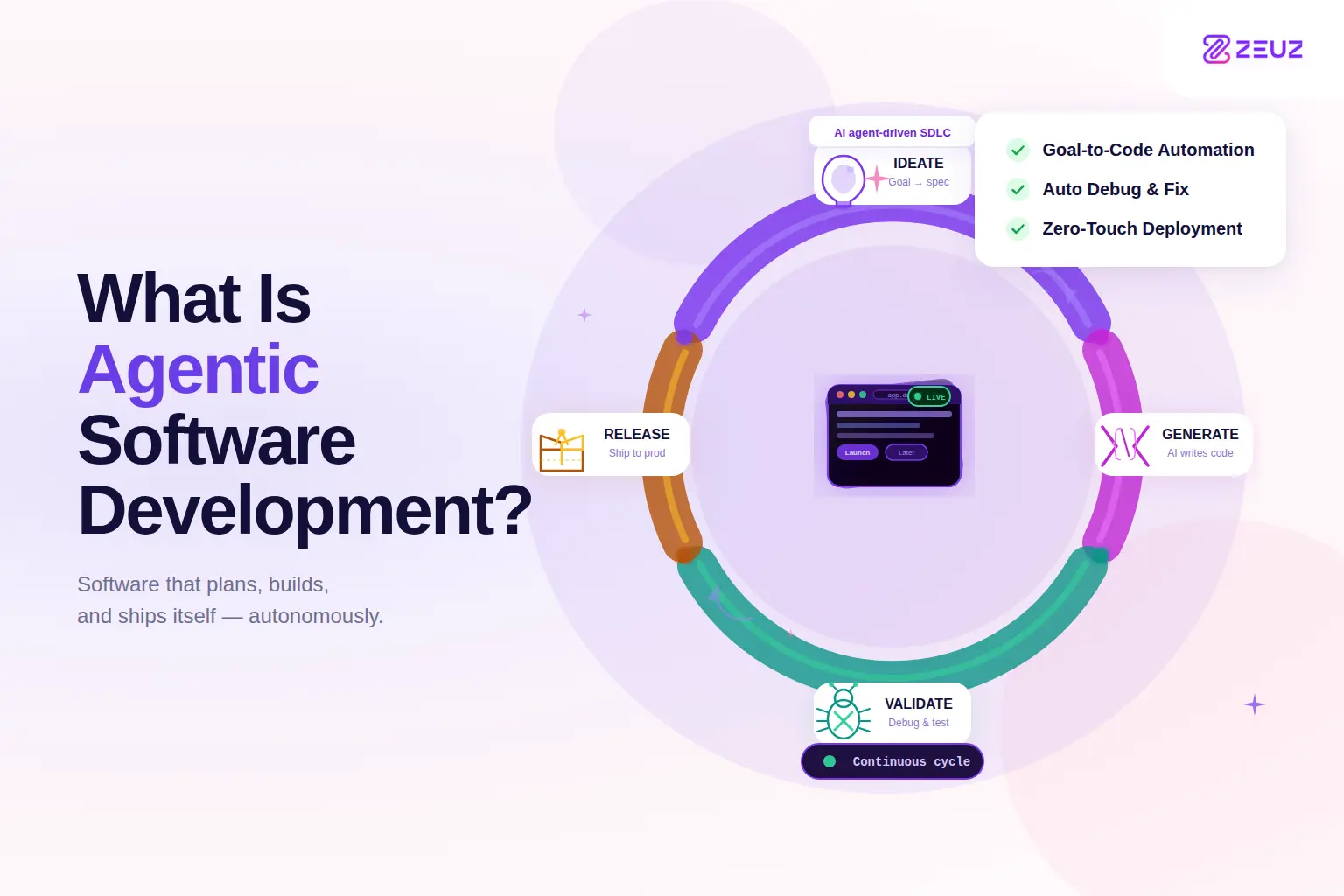
What Is Agentic Software Development? A Complete Guide for UK Enterprises
What Is Agentic Software Development? AI agents autonomously manage development tasks end-to-end
How Agentic Software Development Actually Works AI agents plan, execute, and adapt across the full SDLC independently
Agentic Software Development Across the SDLC, Agents participate actively at every stage, not just in testing or deployment
Agentic vs Traditional Development: What Actually Changes, Everything from how work is triggered to how failures are handled is structurally different
The Real-World Impact: What UK Engineering Teams Are Seeing, 20–40% faster delivery, significantly fewer defects, and lower maintenance overhead
Common Misconceptions UK Teams Have About Agentic Development, It's not about replacing developers, and it's not magic
How ZeuZ AI Enables Agentic Software Development for UK Teams, Purpose-built agentic testing and QA for the UK engineering environment
FAQ: What Is Agentic Software Development?
Key Takeaways
The Shift UK Engineering Teams Can No Longer Ignore
What Is Agentic Software Development? AI agents autonomously manage development tasks end-to-end
Why UK Enterprises Are Paying Attention Now, UK adoption is accelerating rapidly, but most teams are only at the start
How Agentic Software Development Actually Works AI agents plan, execute, and adapt across the full SDLC independently
Agentic Software Development Across the SDLC, Agents participate actively at every stage, not just in testing or deployment
Agentic vs Traditional Development: What Actually Changes, Everything from how work is triggered to how failures are handled is structurally different
The Real-World Impact: What UK Engineering Teams Are Seeing, 20–40% faster delivery, significantly fewer defects, and lower maintenance overhead
What This Means for UK QA Teams Specifically, Agentic testing shifts QA from script maintenance to quality strategy
UK Regulatory Context: What You Need to Know, UK takes a principles-based approach, but GDPR and sector-specific rules still apply to AI agents
Common Misconceptions UK Teams Have About Agentic Development, It's not about replacing developers, and it's not magic
Getting Started: A Practical Roadmap for UK Enterprise Teams, Start with one high-value workflow, prove it, then expand
The UK Competitive Landscape: Where Most Teams Are, Most UK firms haven't yet deployed agentic systems in production
How ZeuZ AI Enables Agentic Software Development for UK Teams, Purpose-built agentic testing and QA for the UK engineering environment
What's Next: The Future of Agentic Software Development in the UK, Full multi-agent SDLC coordination within 2–3 years, starting from testing
FAQ: What Is Agentic Software Development?
Conclusion: The Window Is Open, But Not Indefinitely
Share with your community!
What Is Agentic Software Development? UK Guide
The Shift UK Engineering Teams Can No Longer Ignore
Something genuinely different is happening inside the most forward-looking engineering teams across the UK right now, and it goes much further than using ChatGPT to write code faster.
Agentic software development is the practice of embedding autonomous AI agents directly into the software development lifecycle, systems that don't just assist with tasks when asked, but that can independently plan work, write and test code, identify and fix defects, manage CI/CD pipelines, and coordinate delivery workflows with minimal human direction at each step.
The UK government put it plainly in its AI Opportunities Action Plan, published in January 2025: "We will very soon see agentic systems, systems that can be given an objective, then reason, plan and act to achieve it. The economic consequences of continued progress in these areas could be enormous."
Those consequences are already visible in software engineering. Teams adopting agentic development are shipping faster, catching bugs earlier, and doing more with the same headcount. And the UK, as the third-largest AI market globally behind only the US and China, is positioned to lead, or to fall behind, depending on the decisions technology leaders make in the next 12 to 24 months.
This guide explains exactly what agentic software development is, how it works across the full development lifecycle, what UK-specific factors shape how you adopt it, and what you should do next. No jargon. No hype. Just a clear and practical picture.
What Is Agentic Software Development? AI agents autonomously manage development tasks end-to-end
Agentic software development means your AI doesn't wait to be asked. It takes ownership of goals, executes multi-step tasks, and adapts when things go wrong, all inside your real engineering workflows, using your actual tools.
To be more specific: agentic software development is an approach to building software in which AI agents, autonomous systems powered by large language models (LLMs) combined with memory, tool access, and goal-directed planning, are embedded as active participants across the software development lifecycle (SDLC). They don't replace engineers. They take ownership of the parts of development that are repetitive, time-consuming, or dependent on pattern recognition across large datasets, and they do it without waiting for human prompting at each individual step.
Think about what actually consumes engineering time in a typical UK dev team: writing boilerplate code, reviewing pull requests for common issues, running regression tests, triaging test failures, writing defect reports, managing CI/CD pipeline failures, updating test scripts after a UI change, writing release notes. These are all goal-directed tasks that follow patterns. Agentic AI is specifically designed to take ownership of exactly these kinds of tasks.
The difference from traditional AI tooling is not subtle. When a developer uses GitHub Copilot to autocomplete a function, that's generative AI helping with one step. When an AI agent detects a new pull request, analyses the changed code, selects the relevant tests, executes the test suite, identifies which failures are genuine regressions versus noise, files the defect reports in Jira, and notifies the development team, that's agentic software development. The human approved the merge. The agent handled everything else.
How Agentic Software Development Actually Works AI agents plan, execute, and adapt across the full SDLC independently
Agentic software development works because AI agents combine a reasoning engine (the LLM) with persistent memory, tool access, and goal-directed planning, giving them the ability to sustain complex workflows without human orchestration at each step.
Understanding this practically means understanding four interconnected capabilities that distinguish agentic development systems from the AI tools most teams already use.
The Reasoning Engine, The LLM thinks; the agent layer acts
The large language model at the core of an agentic system handles planning, reasoning, code generation, and output interpretation. It's the same technology that powers familiar tools like GitHub Copilot or ChatGPT. What makes the system agentic is everything built around it, the architecture that gives the LLM the ability to act in the world rather than just producing text for a human to act on.
Memory and Context, Agents remember what they've done and what they're trying to achieve
Unlike a standard AI assistant that starts fresh every conversation, an agentic system maintains context across sessions. It remembers which tests it ran yesterday, what defects it identified last sprint, and what the quality baseline looked like for the last ten releases. This persistent memory is what makes it possible for an agent to manage an ongoing quality programme rather than just answering one-off questions.
Tool Access, Agents can actually do things in your engineering environment
An agent with tool access can interact directly with your code repository, CI/CD pipeline, test runner, issue tracker, and monitoring dashboard. It doesn't tell you what tests to run, it runs them. It doesn't suggest what to write in a Jira ticket, it files the ticket. The gap between describing an action and performing it is the practical difference between generative AI and agentic AI. For a UK engineering team, this means the agent is a genuine participant in your toolchain, not a chatbot you paste questions into.
Self-Correction, Agents adapt when things go wrong, rather than stopping and escalating
When an agentic system encounters a test failure caused by a UI change rather than a genuine defect, it doesn't stop and alert a human. It identifies that the application interface has changed, updates the test script to reflect the current state, re-executes, and continues toward the goal. This self-healing behaviour is one of the most practically valuable aspects of agentic development, because it directly addresses the single biggest overhead of traditional test automation: the constant maintenance burden when applications change.
Agentic Software Development Across the SDLC, Agents participate actively at every stage, not just in testing or deployment
Agentic AI isn't a feature you plug into one stage of your pipeline. Properly implemented, it changes how every phase of development works, from planning all the way through to monitoring.
Requirements and Sprint Planning, Agents structure ambiguity into actionable work faster
One of the most underestimated time sinks in software development isn't coding, it's the work before coding: turning business requirements into structured user stories, identifying dependencies, estimating effort, and flagging gaps. Agentic planning systems can analyse requirement documents and stakeholder inputs, generate structured user stories with acceptance criteria, identify dependencies and risk areas, and produce a proposed sprint structure, compressing days of manual effort into minutes. This isn't replacing the product manager or engineering manager's judgment. It's doing the heavy lifting of information gathering and structuring so that human judgment can be applied at a higher level.
Code Development, Agents go beyond autocomplete to autonomous implementation
Agentic development agents can go significantly further than code completion tools. Given a well-defined specification or user story, an agent can propose a complete implementation approach, write the module or service, run unit tests against it, identify and fix issues, and prepare a pull request with documentation, handling the entire development cycle for well-scoped tasks without waiting for human input at each step.
For UK engineering teams dealing with talent shortages (lack of expertise is the top barrier to AI adoption cited by 35% of UK IT decision-makers, according to ANS and YouGov research), agentic coding assistance is particularly compelling. It extends the effective capacity of existing teams rather than requiring headcount growth to keep pace with delivery demands.
Automated Testing and QA, Agents autonomously manage the full testing lifecycle
This is where agentic software development has the deepest and most immediate impact today. Traditional test automation requires ongoing human investment to stay current, scripts break when UIs change, new features need new test cases written, and someone has to triage every batch of test results to separate real failures from noise.
Agentic testing systems like ZeuZ AI change all of this fundamentally. They can generate test cases directly from specifications and user stories, execute full regression suites autonomously, self-heal broken scripts when the application changes, perform intelligent failure analysis that distinguishes genuine defects from environmental issues, and produce release readiness assessments that synthesise all quality signals. The result isn't just faster testing, it's testing that actually stays current as the application evolves, rather than quietly decaying over time.
CI/CD and DevOps, Agents make your delivery pipeline intelligent rather than just automated
Static CI/CD pipelines do exactly what they're configured to do. When something unexpected happens, they fail and page a human. Agentic pipeline management makes delivery intelligent: agents can analyse incoming commits to determine optimal test coverage scope, predict builds likely to fail before they run, identify and handle transient infrastructure failures (rather than failing the whole build), monitor deployment rollouts dynamically, and trigger rollbacks when post-deployment quality metrics degrade, all within defined parameters, without requiring human decision-making for each event.
McKinsey's 2025 State of AI report notes that nearly two-thirds of organisations are now experimenting with or scaling AI agents, but production deployment remains the bottleneck. For DevOps teams, the practical challenge is not identifying where agentic AI would help, it's building the governance and integration infrastructure to deploy it safely in a production pipeline.
Monitoring and Incident Response, Agents shift operations from reactive to proactive
Post-deployment, agentic monitoring systems continuously analyse application health signals, correlate anomalies with recent deployments and infrastructure changes, form and test hypotheses about root cause, and within defined parameters, initiate remediation actions. Rather than paging an on-call engineer with a raw alert, an agentic system hands them a complete situational summary with a recommended response already in progress.
Agentic vs Traditional Development: What Actually Changes, Everything from how work is triggered to how failures are handled is structurally different
The difference between agentic software development and traditional development with AI tools is not a matter of degree. It's a structural change in how work flows through an engineering organisation.
Dimension
Traditional Development (with AI tools)
Agentic Software Development
How work starts
Engineer initiates every task
Agent detects change/event and acts
Scope per interaction
Single task, one prompt, one output
Multi-step workflow from goal to completion
Tool use
Engineer applies AI output manually
Agent acts directly in your toolchain
Memory
No context between sessions
Persistent, learns from every interaction
When something breaks
Engineer reviews and decides next step
Agent detects, adapts, continues
Test maintenance
Manual update required when app changes
Agent self-heals broken scripts automatically
Defect reporting
Engineer writes and files reports
Agent generates and files directly in Jira/Azure DevOps
Release decision
Human reviews test outputs manually
Agent synthesises all signals into release readiness report
The practical implication for UK development teams is that the value proposition shifts from "AI helps each person work faster" to "AI handles the workflow, people handle the judgment." That's a fundamentally different return on investment, and it's why the organisations making the most of AI in 2025 are increasingly those that have moved beyond AI assistants into agentic architectures.
The Real-World Impact: What UK Engineering Teams Are Seeing, 20–40% faster delivery, significantly fewer defects, and lower maintenance overhead
The productivity case for agentic software development isn't theoretical, early-adopting organisations have measurable outcomes to share.
McKinsey's research on enterprises that have embedded AI into software development workflows reports 20–30% faster overall delivery velocity, 40% fewer defects reaching production, and 25% greater release predictability. AI-integrated DevOps pipelines specifically are achieving 40% faster build times and 30% fewer deployment rollbacks.
Organisations project an average ROI of 171% from agentic AI deployments, with U.S. enterprises forecasting 192% returns. 62% of organisations anticipate exceeding 100% ROI on their agentic AI investments.
For a Forrester-studied enterprise deploying AI agents in an operational workflow, the outcomes included 210% ROI over three years and a payback period under six months.
For UK engineering teams specifically, the benefits map to three structural challenges that most development organisations face:
The quality debt problem. As development velocity increases, manual QA becomes a bottleneck. Test suites grow large and maintenance-heavy; coverage gaps appear as new features are added faster than test cases. Agentic testing platforms address this structurally, generating tests for new features automatically and self-healing existing ones when the application changes.
The talent constraint. Lack of expertise is the top barrier to AI adoption cited by 35% of UK IT decision-makers, with high costs (30%) and uncertainty around ROI (25%) closely behind, according to ANS and YouGov research. Agentic development extends the effective capacity of existing engineering teams without requiring proportional headcount growth.
The maintenance overhead. Traditional automation creates its own maintenance burden, scripts that break with every release, test suites that quietly decay, pipelines that need constant manual attention. Agentic systems reduce this overhead because they maintain themselves, adapting to application changes rather than requiring human rework.
What This Means for UK QA Teams Specifically, Agentic testing shifts QA from script maintenance to quality strategy
For QA engineers and testing leads in UK organisations, agentic software development doesn't mean your job disappears. It means your job changes, and, frankly, improves.
The work that consumes most QA team capacity today, writing test scripts, maintaining them as the application changes, triaging large batches of test results, writing defect reports, chasing developers for defect fixes, is exactly the work that agentic testing systems are best at. The work that requires human judgment, deciding what quality actually means for a given feature, evaluating risk, communicating quality status to stakeholders, designing the testing strategy, is the work that remains genuinely human.
The teams that adapt to agentic testing most effectively are those that recognise this shift deliberately. Reskilling investment should go toward quality strategy, AI orchestration, and outcome validation rather than test scripting and automation frameworks. The QA engineer of 2026 is less a test writer and more a quality architect, defining what the agent should measure and reviewing whether it's measuring the right things.
Gartner, in its 4 Essential Steps to Build Test Automation Capabilities report, notes that "software engineering leaders are looking for new practices and approaches that their teams can adopt to mitigate risks to the business. Test automation, increasingly powered and enhanced by generative AI technologies, becomes an indispensable building block to reap these benefits."
ZeuZ AI's agentic testing platform is specifically designed for this transition, enabling UK QA teams to move from manually managing test execution to owning quality strategy while the platform manages the execution, maintenance, and analysis autonomously.
UK Regulatory Context: What You Need to Know, UK takes a principles-based approach, but GDPR and sector-specific rules still apply to AI agents
Agentic AI in software development sits within a UK regulatory environment that is deliberately permissive by global standards, but that doesn't mean compliance is optional or trivial.
The UK's Approach: Sector-Led, Principles-Based
Unlike the EU, which has enacted the comprehensive EU AI Act with specific requirements by risk category, the UK has chosen a principles-based, sector-led approach to AI governance. As of 2025, there is no standalone UK AI Act. Instead, existing sectoral regulators, the ICO for data protection, the FCA for financial services, Ofcom for communications, the MHRA for healthcare AI, apply established regulatory principles to AI systems within their remits.
The UK government's AI White Paper set out five principles all AI systems should uphold: safety and robustness, transparency, fairness, accountability, and contestability. These are not currently legally binding across all sectors, but regulators are using them as the standard against which AI deployments will be evaluated.
UK GDPR and Automated Decision-Making
This is the most directly relevant legal constraint for agentic software development teams. Article 22 of UK GDPR restricts solely automated decisions that produce legal or similarly significant effects on individuals. Organisations must establish a lawful basis, provide meaningful transparency notices, and offer human review mechanisms.
For most agentic software development applications, test automation, pipeline management, code review, sprint planning, Article 22 doesn't directly apply, because the decisions being made affect software systems rather than individuals. However, if your agentic systems process personal data (for example, in test environments that include real user data), UK GDPR data processing requirements apply in full.
Best practice for UK engineering teams: ensure test environments use synthetic or properly anonymised data, log all autonomous agent decisions in auditable records, and design human review checkpoints into any agentic workflow that could affect sensitive systems.
The Sector-Specific Dimension
If you operate in financial services, healthcare, or another regulated sector, your AI deployments, including agentic software development tools, fall under sector-specific regulatory frameworks in addition to UK GDPR. FCA-regulated firms should treat the FCA's AI discussion papers as de facto compliance benchmarks. Healthcare organisations developing AI-touched software products should factor in MHRA requirements.
The practical guidance from AI governance specialists is to map every AI system in your organisation to the relevant sector regulator and assign a named compliance owner, not as a paper exercise, but as a genuine operational governance responsibility.
The Divergence from EU AI Act: A UK Advantage with Caveats
For UK-only businesses, the difference between the UK's principles-based approach and the EU AI Act's risk-based prescriptive framework is a meaningful competitive advantage, less regulatory overhead, faster deployment, more flexibility. For UK businesses that also serve EU customers, the stricter EU rules apply for EU users. This means designing AI systems to comply with both frameworks simultaneously is both the safest and most efficient approach.
The UK government's position, confirmed in the January 2025 AI Opportunities Action Plan and its January 2026 one-year review, is that the UK intends to remain an innovation-friendly AI environment. But the direction of travel globally is toward more AI regulation, not less. Building governance frameworks now, before regulation makes them mandatory, is both lower-cost and strategically wise.
Common Misconceptions UK Teams Have About Agentic Development, It's not about replacing developers, and it's not magic
Before going further, let's clear up the most common misunderstandings that UK engineering leaders raise when they first encounter agentic software development.
"This will replace our developers"
No. Agentic software development changes what developers do, it doesn't eliminate the need for them. The work that shifts to agents is the repetitive, pattern-driven, high-volume execution work: writing boilerplate, maintaining test scripts, triaging failures, running pipelines. The work that remains human is the genuinely creative, judgment-intensive, stakeholder-facing work: system design, architectural decisions, quality strategy, user research, technical leadership.
Only 4.1% of all UK businesses report reducing headcount following AI adoption, while just over half report no change. The data suggests that, at least for now, AI is used primarily to augment productivity rather than replace roles.
The teams achieving the best outcomes are not the ones that have shrunk their engineering organisations. They're the ones that have freed their engineers from the most draining and least satisfying parts of the job, and as a result, improved both productivity and retention.
"It's just better automation, not fundamentally different"
This is the most common miscategorisation, and it matters because it leads to underinvestment. Traditional automation follows fixed, predefined scripts. When something unexpected happens, it fails and escalates to a human. Agentic software development reasons about what's happening and adapts. The difference between a test automation framework that breaks when the UI changes and an agentic testing system that self-heals is not cosmetic, it's the difference between automation that creates maintenance overhead and automation that reduces it.
"We need to wait until the technology matures more"
According to a January 2025 Gartner poll of 3,412 webinar attendees, 19% said their organisation had made significant investments in agentic AI, 42% had made conservative investments, with the remaining 31% taking a wait-and-see approach. The organisations in the 19% making significant investments right now are building institutional knowledge, workflow experience, and quality baselines that will compound into substantial advantages. Waiting until the technology is mainstream means competing against organisations that have already had 18–24 months of production experience.
"Agent washing means we can't trust vendor claims"
This is a valid concern. Gartner has formally named and documented "agent washing" the practice of rebranding chatbots, RPA tools, and AI assistants as agentic AI without genuine autonomous capability. The test is simple: does the system take actions in external tools autonomously, maintain memory across sessions, adapt when things go wrong, and sustain multi-step workflows toward a goal without requiring human prompting at each step? If the answer is no to any of these, it's not genuinely agentic, regardless of how it's marketed.
Getting Started: A Practical Roadmap for UK Enterprise Teams, Start with one high-value workflow, prove it, then expand
The most effective path to agentic software development isn't a big-bang transformation, it's a deliberate, staged adoption that builds from proven value.
Step 1: Identify Your Highest-Value Starting Point
Look for workflows in your engineering organisation that are: repetitive and pattern-driven, time-consuming relative to their strategic value, already partially automated (meaning the toolchain integration is less complex), and measurable (so you can quantify the improvement). For most UK engineering teams, autonomous testing and CI/CD pipeline intelligence are the strongest starting points, because the ROI is immediate and measurable, the toolchain integration is well-established, and the governance requirements are manageable.
Step 2: Define Clear Success Metrics Before You Start
The organisations that successfully scale agentic AI are those that define what success looks like before deployment, not after. For a testing deployment: what's your current mean time from test trigger to actionable quality report? What percentage of test failures require manual analysis? What's your test script maintenance overhead per sprint? These are your baselines. Your agentic deployment should measurably improve each of them within a defined timeframe.
Step 3: Design Governance First, Don't Add It Later
This is the lesson from Gartner's prediction that over 40% of agentic AI projects will be cancelled by end-2027. The failures are not primarily technical, they're governance failures. Before an agent takes any action in your production pipeline, you need: defined audit trails for every agent decision, clear human-in-the-loop checkpoints for high-stakes actions, defined agent authority boundaries (what it can and cannot do autonomously), and a rollback mechanism if agent behaviour deviates from expectations.
Step 4: Build Your Team's Capability to Work With Agents
The skill shift required for agentic software development is real. Your team needs to understand how to define goals for agents (not just prompts), how to evaluate and validate agent outputs, how to design governance workflows, and how to interpret the new kinds of data that agentic systems generate (agent decision logs, confidence metrics, workflow traces). The UK government's AI Skills Boost platform and the 10 million worker upskilling programme are relevant resources here, but internal training investment is equally important.
Step 5: Expand From Proven Foundations
Once you have one agentic workflow delivering measurable value, let's say, autonomous regression testing with a 60% reduction in time from test trigger to defect report, you have the proof of concept, the institutional knowledge, and the governance foundations to expand. The natural progression is from testing into DevOps pipeline intelligence, then into requirements automation, and eventually into coordinated multi-agent workflows that span the full SDLC.
The UK Competitive Landscape: Where Most Teams Are, Most UK firms haven't yet deployed agentic systems in production
Understanding where the UK market actually sits today helps you calibrate your own position, and your urgency.
McKinsey found that 62% of organisations are experimenting with AI agents, but fewer than 10% have scaled them in any function, and only 23% are actively building towards agentic systems. Fewer than 5% of enterprise applications included agentic features in 2025.
The British Chambers of Commerce's 2026 research reports that 54% of UK firms are actively using AI of some kind, but only 11% of SMEs use AI extensively to automate operations. Large firms (250+ employees) have nearly doubled their adoption to 44% between 2023 and 2025, while small firms have moved much more slowly.
What this means practically: if you're a UK enterprise and you deploy a genuinely agentic testing or development platform in 2025–2026, you're ahead of roughly 95% of enterprise applications in terms of agentic capability. The early-mover advantage in building that institutional knowledge and operational experience is significant, and the window is still open.
82% of organisations plan on integrating agentic AI within the next one to three years, and 50% of enterprises currently using generative AI are expected to deploy agentic AI systems by 2027, doubling from 25% in 2025. The mainstream adoption is coming. The question is whether you arrive at it having already built operational expertise, or having to learn while competitors are already compounding their advantages.
How ZeuZ AI Enables Agentic Software Development for UK Teams, Purpose-built agentic testing and QA for the UK engineering environment
ZeuZ AI is an AI-native software testing and automation platform built specifically for the agentic era, not a legacy testing tool with an AI layer added on top, but a system architected from the ground up around autonomous, goal-directed quality management.
For UK engineering teams, ZeuZ AI addresses the most concrete and immediate opportunity for agentic software development: autonomous quality assurance across the full SDLC.
Autonomous Test Lifecycle Management. ZeuZ agents detect code changes, select and prioritise relevant test coverage, execute test suites across your environments, analyse failures with intelligent root cause analysis, self-heal broken scripts, and deliver release readiness assessments, all without requiring human orchestration of each step.
Self-Healing Test Automation. When your application changes and test scripts break, ZeuZ agents identify the breakage, understand the original test intent, and update the script to match the current application state. This directly addresses the biggest overhead cost of traditional test automation: the maintenance burden that causes test coverage to quietly decay over time.
UK Regulatory Readiness. ZeuZ AI's audit trail, governance controls, and human-in-the-loop checkpoints are designed with the UK's regulatory environment in mind, supporting compliance with UK GDPR data processing requirements and the ICO's AI and data protection guidance without adding friction to your development workflow.
Integration With Your Existing UK Engineering Stack. ZeuZ connects with the tools your UK engineering teams already use, Jira, GitHub, GitLab, Azure DevOps, Jenkins, Slack, so agentic quality intelligence flows through your existing workflow rather than requiring a parallel toolchain.
For UK CTOs and engineering directors evaluating where to start with agentic software development, ZeuZ AI's autonomous testing platform provides the highest-certainty ROI pathway: measurable quality improvements, reduced maintenance overhead, and accelerated delivery velocity, without the complexity and governance risk of starting with autonomous coding or deployment agents.
What's Next: The Future of Agentic Software Development in the UK, Full multi-agent SDLC coordination within 2–3 years, starting from testing
The trajectory of agentic software development over the next two to three years is becoming clearer, and for UK enterprises, the implications are significant.
By 2028, 33% of enterprise software applications will incorporate agentic AI capabilities, up from less than 1% in 2024, and agentic AI will make at least 15% of day-to-day work decisions autonomously. For software engineering specifically, this timeline is likely to be even faster, because software development is already a digital-native, tool-accessible domain where agentic systems can demonstrate immediate, measurable value.
The near-term evolution (2025–2026) is about production deployment of agentic systems in specific high-value workflows, autonomous testing, intelligent pipeline management, AI-assisted planning. This is where UK early-adopter organisations are operating right now.
The medium-term evolution (2027–2028) is about multi-agent coordination, specialised agents for requirements, development, testing, and deployment working in coordinated workflows, with humans acting as orchestrators and approvers rather than executors of individual steps. 66.4% of current agentic AI implementations already use multi-agent system designs, suggesting this architecture is the mainstream, not the exception.
The longer-term evolution (2029+) is about agentic capabilities becoming standard infrastructure embedded in every enterprise engineering platform. The question will no longer be "do we use agentic AI?" but "how well-designed is our agentic architecture?"
The UK's principles-based regulatory environment, combined with the government's active investment in AI infrastructure and skills, positions British enterprises well for this trajectory, provided they build the foundations now rather than waiting for the technology to be fully mainstream before engaging seriously.
FAQ: What Is Agentic Software Development?
Q: What is agentic software development in plain English?
Agentic software development means your AI doesn't wait to be asked, it actively manages development tasks end-to-end. An agentic system receives a goal (such as "validate the quality of this release" or "review this pull request"), then independently plans the necessary steps, uses your engineering tools to execute them, monitors results, and adapts if something goes wrong. Engineers set the goals and review the outcomes; the agent handles the execution.
Q: How is agentic software development different from just using AI tools like GitHub Copilot?
GitHub Copilot and similar tools are generative AI, they help you write code faster when you ask them to. Agentic software development goes further: the AI takes ownership of multi-step workflows autonomously. A developer uses Copilot to complete a function. An agentic system detects a new pull request, runs the relevant tests, analyses the results, files defect reports, and reports release readiness, without the developer triggering each step. The difference is between a powerful tool you use and a capable colleague who manages work independently.
Q: Does agentic software development replace developers and QA engineers?
No. It changes what they do. The tasks that shift to agents are the repetitive, pattern-driven, execution-heavy work, maintaining test scripts, triaging test results, running pipelines. The tasks that stay human are the ones requiring genuine judgment, creativity, and stakeholder communication, system design, quality strategy, architectural decisions, and technical leadership. ONS data shows only 4.1% of UK businesses have reduced headcount after AI adoption; the overwhelming majority use it to augment rather than replace.
Q: What UK regulatory rules apply to agentic software development?
The UK follows a principles-based, sector-led approach, there's no standalone UK AI Act as of 2025. However, UK GDPR Article 22 applies to any automated decisions that produce significant effects on individuals, and sector-specific rules (FCA for financial services, MHRA for healthcare) apply based on your industry. For most software development applications, the key compliance requirement is ensuring test environments don't process real personal data and that agent decision logs are auditable. If you operate in a regulated sector, engage your sector regulator's AI guidance as your compliance benchmark.
Q: What's the best starting point for a UK enterprise wanting to adopt agentic software development?
Autonomous testing is the highest-certainty starting point for most UK engineering teams. The ROI is immediate and measurable (faster quality analysis, reduced test maintenance overhead), the toolchain integration is well-established, and the governance requirements are manageable. Start with one well-defined testing workflow,such as autonomous regression test execution and analysis, prove the value with clear metrics, and then expand from that foundation.
Q: How long does it take to see results from agentic software development?
Early adopters report measurable productivity improvements within the first quarter of deployment for well-scoped agentic testing implementations. Forrester research on AI agent deployments documents payback periods under six months and 210% ROI over three years. The timeline depends heavily on the quality of implementation and governance design, which is why starting with a specific, well-defined workflow rather than a broad transformation is the more reliable approach.
Q: What is "agent washing" and how do I avoid it when evaluating vendors?
Agent washing is Gartner's term for vendors rebranding existing chatbots, RPA tools, or AI assistants as agentic AI without genuine autonomous capability. To test whether a system is genuinely agentic: Does it maintain memory between sessions? Can it take autonomous actions in your engineering tools without human copy-paste? Does it self-correct when it encounters unexpected situations? Can it sustain multi-step workflows toward a goal without requiring human prompting at each step? A system that answers no to any of these is not genuinely agentic, regardless of its marketing.
Q: How does ZeuZ AI specifically help UK engineering teams with agentic software development?
ZeuZ AI is an agentic testing and quality management platform that autonomously manages the full software testing lifecycle, from intelligent test selection through execution, self-healing maintenance, failure analysis, and release readiness reporting. For UK teams, it integrates with standard UK engineering stacks (Jira, GitHub, Azure DevOps, Jenkins), includes audit trail and governance controls designed for the UK regulatory environment, and addresses the most common UK enterprise challenges: quality debt, talent constraints, and test maintenance overhead.
The Window Is Open, But Not Indefinitely
Agentic software development is not a future technology you can monitor from the sidelines for another couple of years before deciding to engage. It's a present-day competitive reality that UK engineering teams are navigating right now, some building structural advantages, most still in early experimentation.
The market data is unambiguous. Gartner projects that 33% of enterprise software applications will include agentic AI by 2028, up from less than 1% in 2024. McKinsey documents 20–30% faster delivery velocity and 40% fewer defects in AI-integrated development environments. And the UK government has made its position clear: be an AI maker, not an AI taker.
For UK CTOs, engineering directors, and QA leads, the practical question is not whether to engage with agentic software development. It's where to start, how to govern it responsibly within the UK regulatory context, and how to build from a proven foundation rather than a speculative bet.
Autonomous testing is where that foundation is most clearly available today. It delivers measurable outcomes, fits within UK regulatory requirements, integrates with existing toolchains, and builds the institutional knowledge and governance experience that everything else depends on.
ZeuZ AI exists to make that starting point as clear and productive as possible for UK engineering teams. If you're ready to move from monitoring this technology to deploying it, the conversation starts with understanding what your quality workflow looks like today, and what it could look like when an AI agent owns the execution.